
Yuri Gagarin Biography Quotes 2 Report mistakes
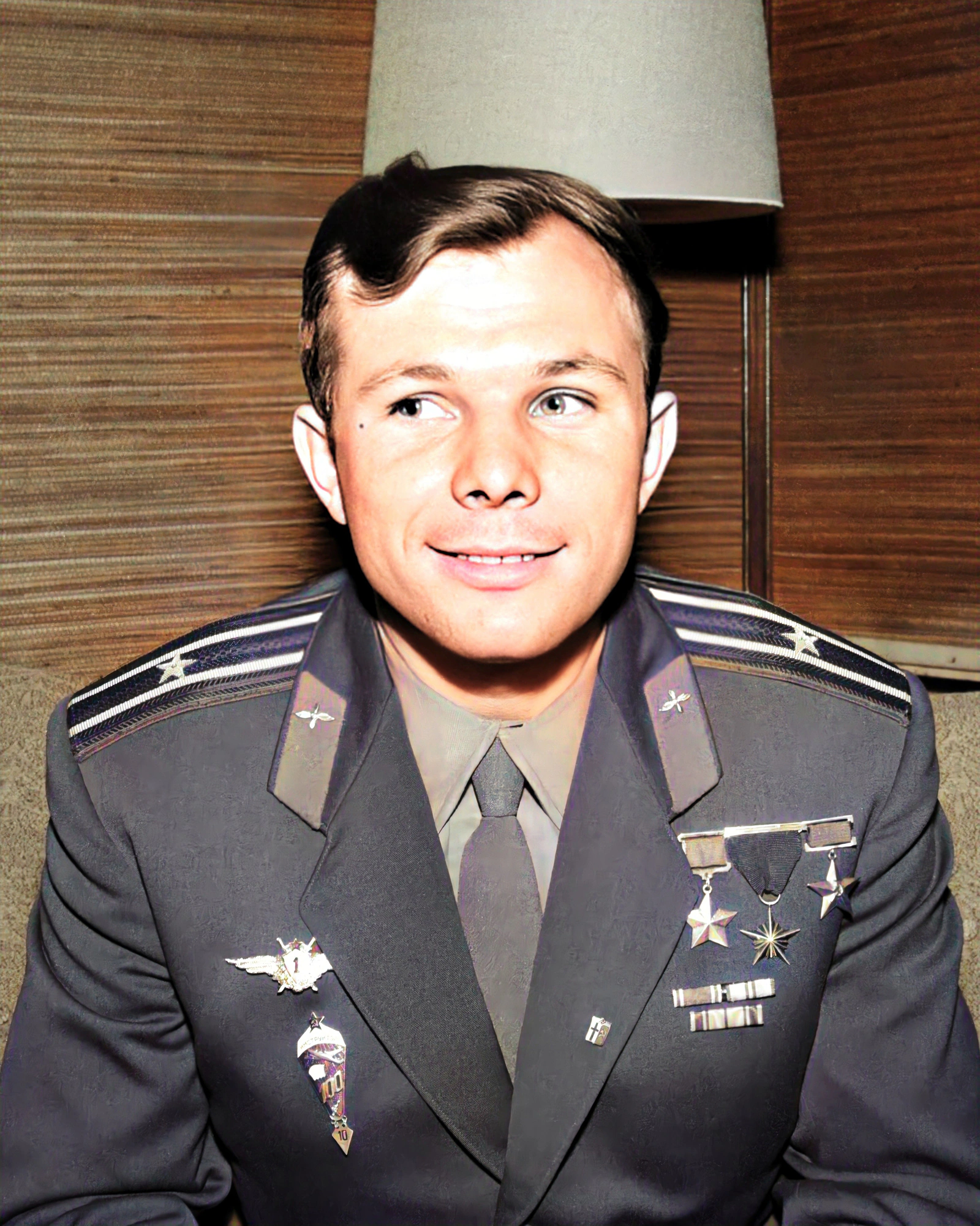
Attr: Arto Jousi
| 2 Quotes | |
| Born as | Yuri Alekseyevich Gagarin |
| Occup. | Astronaut |
| From | Russia |
| Spouse | Valentina Goryacheva |
| Born | March 9, 1934 Klushino, Smolensk Oblast, Russian SFSR, Soviet Union |
| Died | March 27, 1968 Novoselovo, Vladimir Oblast, Russian SFSR, Soviet Union |
| Cause | Plane crash |
| Aged | 34 years |
| Cite | |
Citation Formats
APA Style (7th ed.)
Yuri gagarin biography, facts and quotes. (2026, March 20). FixQuotes. https://fixquotes.com/authors/yuri-gagarin/
Chicago Style
"Yuri Gagarin biography, facts and quotes." FixQuotes. March 20, 2026. https://fixquotes.com/authors/yuri-gagarin/.
MLA Style (9th ed.)
"Yuri Gagarin biography, facts and quotes." FixQuotes, 20 Mar. 2026, https://fixquotes.com/authors/yuri-gagarin/. Accessed 24 Mar. 2026.
Early Life and Background
Yuri Alekseyevich Gagarin was born on March 9, 1934, in the village of Klushino near Gzhatsk in western Russia, then part of the Soviet Union. He grew up in a peasant family shaped by labor, scarcity, and the brutal upheavals of war. His father, Aleksei Ivanovich Gagarin, was a carpenter, and his mother, Anna Timofeyevna, worked on a collective farm. The German invasion during World War II scarred the family deeply: their home was seized by occupying forces, the family was forced into a crude dugout, and two of Yuri's siblings were deported for forced labor. These experiences fixed in him a seriousness beyond his years and linked private survival to the larger Soviet story of sacrifice and endurance.
Yet his childhood also revealed traits that later made him uniquely suited to symbolic greatness. He was small in stature, open-faced, disciplined, and unusually calm under pressure. Neighbors and teachers remembered a boy drawn to tools, machinery, and the idea of flight. In the postwar Soviet Union, aviation was not merely a profession - it was a national myth, proof that technology and socialist resolve could master the modern world. Gagarin came of age exactly when the state needed exemplary young men from humble origins to embody that promise, and he fit the role with remarkable natural ease.
Education and Formative Influences
After the war, Gagarin's family moved to Gzhatsk, and he attended local schools before entering vocational training. He studied at a foundry school in Lyubertsy near Moscow and then at the Saratov Industrial Technical School, where he trained as a metalworker while joining an aero club that transformed fascination into vocation. At the Saratov flying club he first flew solo in a Yak aircraft, discovering both technical confidence and an instinctive composure in the cockpit. In 1955 he entered the Orenburg Higher Air Force Pilots School, where he trained rigorously and met Valentina Goryacheva, whom he married in 1957. Service as a fighter pilot in the Soviet Air Forces followed, including posting near the Norwegian border. By then he had absorbed the key formative influences of his generation: wartime resilience, faith in engineering, military discipline, and the Soviet cult of heroic ascent through merit and collective purpose.
Career, Major Works, and Turning Points
Gagarin's decisive turn came in 1960, when he was selected from thousands of military pilots for the Soviet cosmonaut corps. The early space program demanded not only fitness and intelligence but obedience, emotional steadiness, and the ability to personify Soviet triumph before the world. Gagarin excelled on all counts. On April 12, 1961, aboard Vostok 1, he became the first human to travel into space and orbit Earth, completing a single circuit of the planet in 108 minutes. The flight was technologically hazardous and politically immense: at the height of the Cold War, his success announced Soviet superiority in a contest where science, ideology, and prestige were inseparable. He instantly became an international icon, received the title Hero of the Soviet Union, and toured widely as the smiling face of a new age. Yet fame changed his life as much as flight did. He was increasingly used as a state emblem, limiting his chance to fly again, though he continued training, studied at the Zhukovsky Air Force Engineering Academy, and served in the cosmonaut program as a deputy director and mentor. In 1968, while on a routine training flight in a MiG-15UTI near Kirzhach, he and instructor Vladimir Seryogin crashed and were killed. He was only thirty-four, and his early death froze him in history not as an aging official but as the eternal first voyager.
Philosophy, Style, and Themes
Gagarin left no systematic philosophy, but his words and conduct reveal a personality formed by tension between individual wonder and collective duty. His public style was simple, warm, and unpretentious - an ideal Soviet hero who seemed untouched by arrogance. But beneath the state-crafted image was a man genuinely animated by discovery. His most famous exclamation, “I see Earth! It is so beautiful!” captures more than spectacle; it shows a consciousness suddenly widened by distance, in which the planet appears not as a battlefield of ideologies but as a unified, fragile whole. For a man raised amid occupation, deprivation, and militarized competition, that reaction suggests an imagination capable of transcending the very system that elevated him.
A second remark is even more psychologically revealing: “I could have gone on flying through space forever”. It conveys exhilaration, but also release - space as a domain free of gravity, bureaucracy, and the burdens of symbolic representation. Gagarin's inner life seems to have been driven by mastery, composure, and a deep appetite for motion. He was not a philosopher in the literary sense, yet his life dramatized modern themes with unusual purity: the transformation of a village child into a technological pioneer; the use of one human face to carry national myth; and the paradox that the first person to leave Earth became, in doing so, one of the clearest symbols of shared humanity. His smile became famous because it looked effortless, but its power lay in how perfectly it joined courage to accessibility.
Legacy and Influence
Gagarin's legacy endures on several levels at once. In Russia, he remains a foundational national hero, commemorated in monuments, museums, songs, stamps, and in the renaming of Gzhatsk as Gagarin. Internationally, he stands at the beginning of human spaceflight itself, the first figure in a lineage that runs through lunar missions, space stations, and today's multinational crews. For historians, he embodies the Cold War's fusion of propaganda and genuine achievement; for biographers, he is a study in how a modest, disciplined individual can be both uplifted and constrained by history. His flight changed the scale of human self-understanding: after April 12, 1961, space was no longer theoretical or remote but inhabited by human experience. Gagarin remains the archetype of that threshold moment - not only the first man in space, but the first to return with the authority to say that Earth, seen whole, was beautiful.
Our collection contains 2 quotes written by Yuri, under the main topics: Nature - Adventure.
Other people related to Yuri: Valentina Tereshkova (Astronaut)
Source / external links