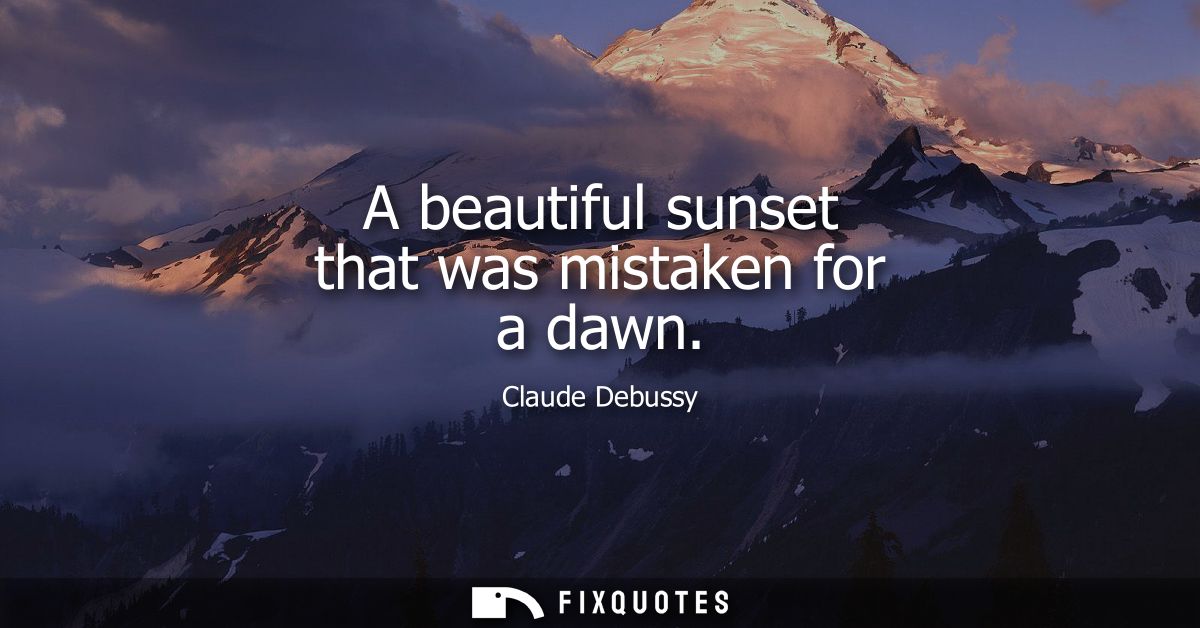
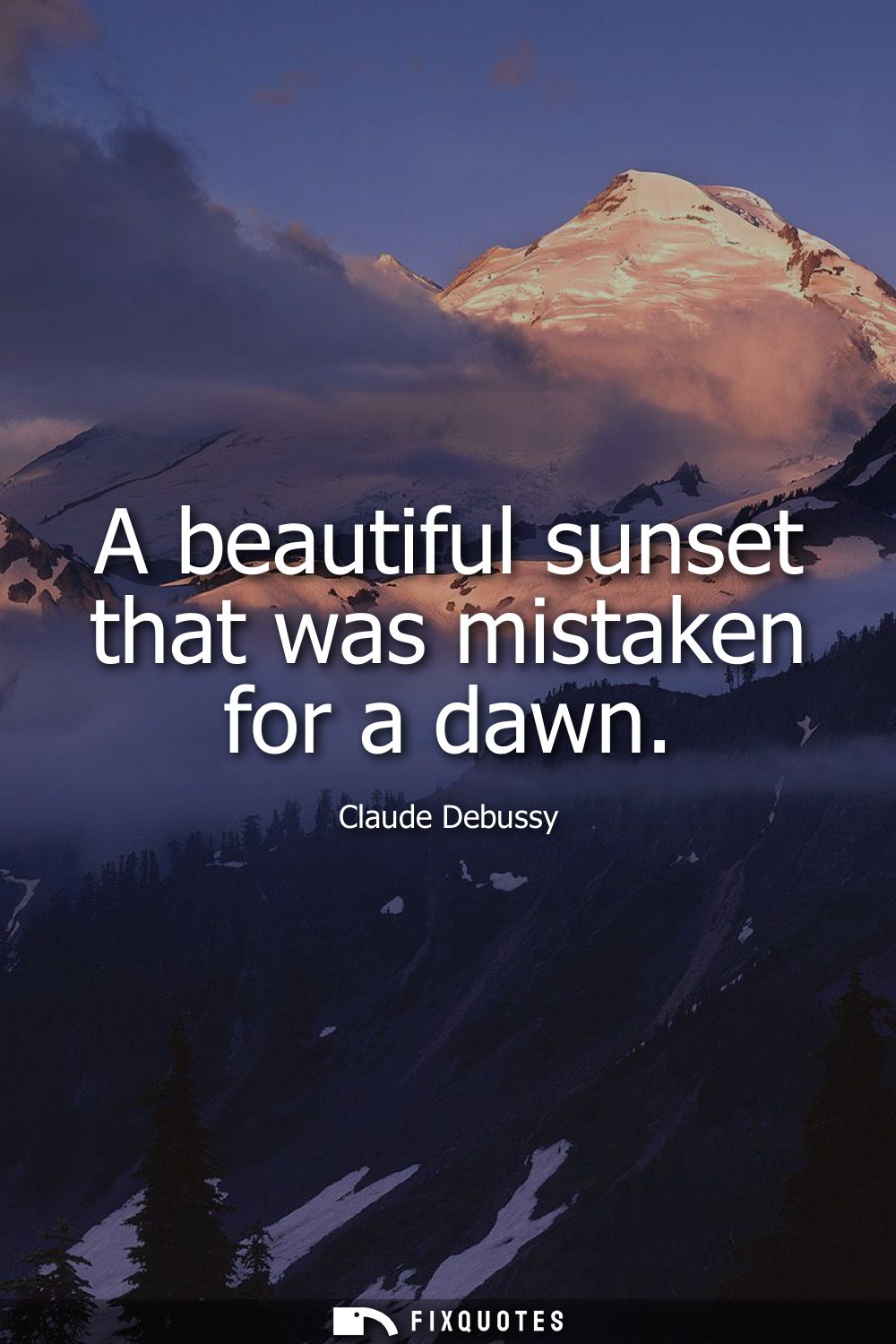
"A beautiful sunset that was mistaken for a dawn"
About this Quote
A beautiful sunset mistaken for a dawn is Debussy in miniature: an artist of shimmer, ambiguity, and emotional misdirection, quietly laughing at our need to label experience as progress. The line reads like a postcard, but it carries a critique. We want beginnings. We’re trained to see light on the horizon as promise, to treat any glow as forward motion. Debussy flips the compass. The radiance is real, the feeling is real, but the story we attach to it may be backward.
That’s why it works: it’s not moralizing, it’s perceptual. Debussy’s music often lives in that same threshold space, where harmony doesn’t “resolve” so much as dissolve, where atmosphere outranks argument. A sunset can look like a dawn because the eye can’t always tell whether the world is opening or closing; only time gives the answer. The subtext is almost modernist: certainty is a costume we throw over sensations, and we’re embarrassingly eager to be fooled if the colors are good.
Context matters, too. Debussy came of age in a France anxious about old orders and seduced by new ones: Symbolism, Impressionism, the lure of the “new” that might just be another kind of ending. The phrase can be heard as a warning about fashion and optimism - the cultural habit of confusing novelty with renewal - and as a tender defense of illusion: even if it’s a sunset, it’s still beautiful, and beauty still changes you.
That’s why it works: it’s not moralizing, it’s perceptual. Debussy’s music often lives in that same threshold space, where harmony doesn’t “resolve” so much as dissolve, where atmosphere outranks argument. A sunset can look like a dawn because the eye can’t always tell whether the world is opening or closing; only time gives the answer. The subtext is almost modernist: certainty is a costume we throw over sensations, and we’re embarrassingly eager to be fooled if the colors are good.
Context matters, too. Debussy came of age in a France anxious about old orders and seduced by new ones: Symbolism, Impressionism, the lure of the “new” that might just be another kind of ending. The phrase can be heard as a warning about fashion and optimism - the cultural habit of confusing novelty with renewal - and as a tender defense of illusion: even if it’s a sunset, it’s still beautiful, and beauty still changes you.
Quote Details
| Topic | Nature |
|---|---|
| Source | Help us find the source |
| Cite |
Citation Formats
APA Style (7th ed.)
Debussy, Claude. (2026, January 15). A beautiful sunset that was mistaken for a dawn. FixQuotes. https://fixquotes.com/quotes/a-beautiful-sunset-that-was-mistaken-for-a-dawn-42257/
Chicago Style
Debussy, Claude. "A beautiful sunset that was mistaken for a dawn." FixQuotes. January 15, 2026. https://fixquotes.com/quotes/a-beautiful-sunset-that-was-mistaken-for-a-dawn-42257/.
MLA Style (9th ed.)
"A beautiful sunset that was mistaken for a dawn." FixQuotes, 15 Jan. 2026, https://fixquotes.com/quotes/a-beautiful-sunset-that-was-mistaken-for-a-dawn-42257/. Accessed 12 Feb. 2026.
More Quotes by Claude
Add to List