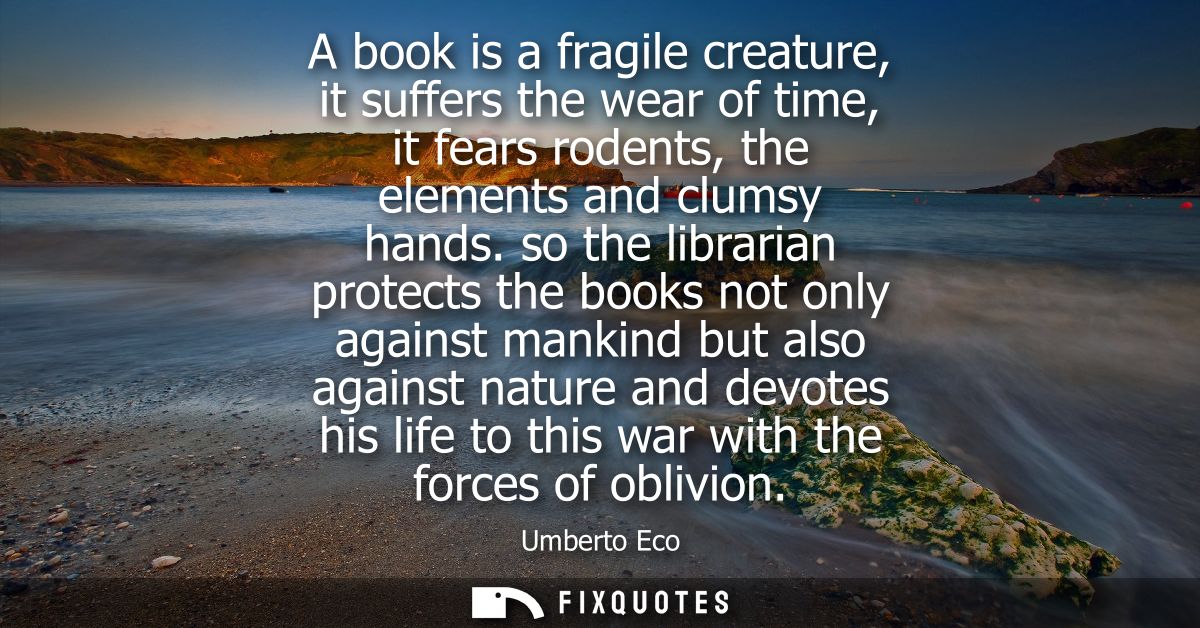
"A book is a fragile creature, it suffers the wear of time, it fears rodents, the elements and clumsy hands. So the librarian protects the books not only against mankind but also against nature and devotes his life to this war with the forces of oblivion"
About this Quote
The subtext flatters librarians without sentimentalizing them. They are not passive caretakers of culture; they are combatants in a war nobody notices because its victories look like nothing happening. A book that survives another decade is a non-event, which is precisely Eco's point about memory: it requires invisible labor, constant vigilance, and a willingness to fight battles that rarely produce applause.
Context matters here because Eco lived as both theorist and storyteller, steeped in archives, manuscripts, and the anxiety of missing texts. His fiction is haunted by libraries that burn, secrets that rot, catalogs that lie. So when he says the librarian protects books "against mankind", he's needling our self-image as enlightened readers; the real threat to culture often comes from ordinary negligence and institutional indifference, not just censors and bonfires. Nature isn't neutral either. Time, entropy, and damp are portrayed as aggressors, making preservation a kind of defiance: the insistence that meaning can outlast the messy world that keeps trying to erase it.
Quote Details
| Topic | Book |
|---|---|
| Source | Help us find the source |
| Cite |
Citation Formats
APA Style (7th ed.)
Eco, Umberto. (2026, February 17). A book is a fragile creature, it suffers the wear of time, it fears rodents, the elements and clumsy hands. So the librarian protects the books not only against mankind but also against nature and devotes his life to this war with the forces of oblivion. FixQuotes. https://fixquotes.com/quotes/a-book-is-a-fragile-creature-it-suffers-the-wear-105556/
Chicago Style
Eco, Umberto. "A book is a fragile creature, it suffers the wear of time, it fears rodents, the elements and clumsy hands. So the librarian protects the books not only against mankind but also against nature and devotes his life to this war with the forces of oblivion." FixQuotes. February 17, 2026. https://fixquotes.com/quotes/a-book-is-a-fragile-creature-it-suffers-the-wear-105556/.
MLA Style (9th ed.)
"A book is a fragile creature, it suffers the wear of time, it fears rodents, the elements and clumsy hands. So the librarian protects the books not only against mankind but also against nature and devotes his life to this war with the forces of oblivion." FixQuotes, 17 Feb. 2026, https://fixquotes.com/quotes/a-book-is-a-fragile-creature-it-suffers-the-wear-105556/. Accessed 5 Apr. 2026.