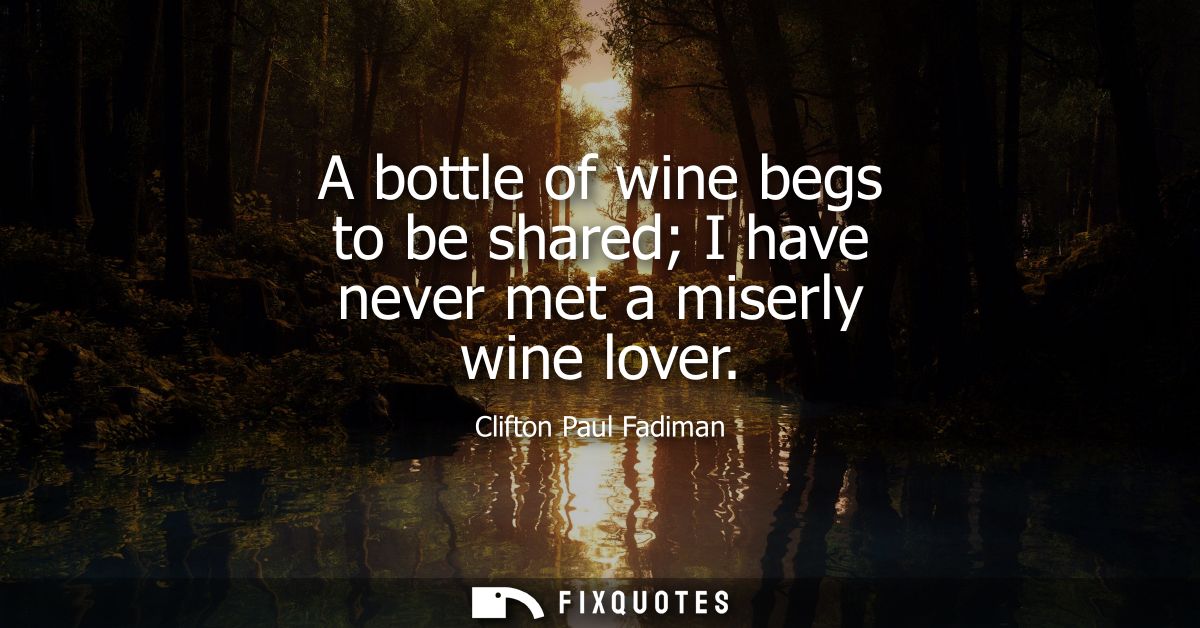
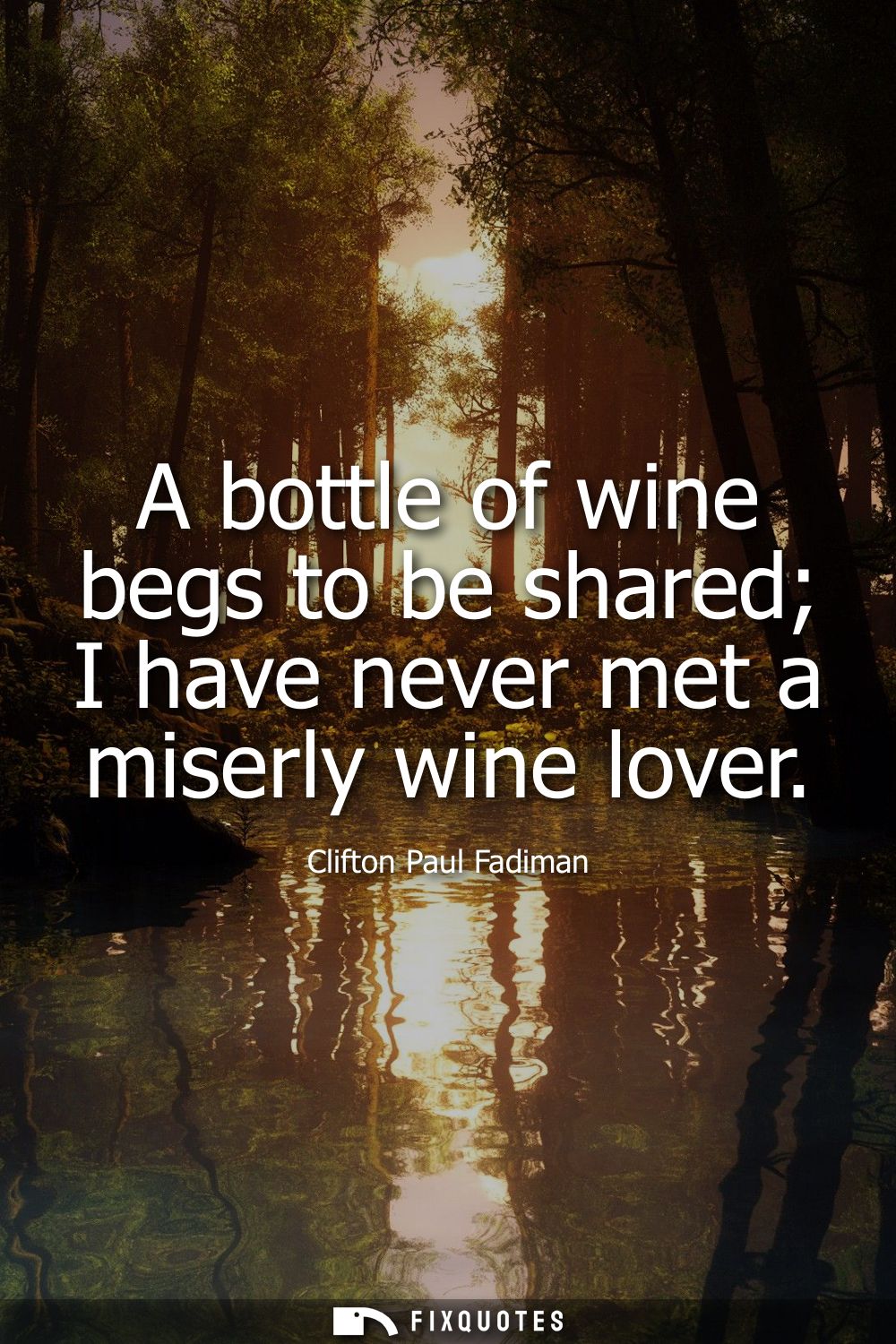
"A bottle of wine begs to be shared; I have never met a miserly wine lover"
About this Quote
Fadiman’s subtext is old-world humanism in mid-century American dress. As a writer-critic who moved easily through literary and broadcasting circles, he’s defending a certain idea of culture: refined pleasures are communal, not hoarded. This is the anti-collector’s creed. Compare it to the modern prestige economy where rare bottles become trophies, photographed more than poured. Fadiman’s quip pushes back against that acquisitive impulse by insisting that the point of connoisseurship is conviviality, not possession.
The slyer move is how he launders a social norm through sensory romance. Wine is already coded as conversation, dinner, intimacy; he simply makes that code sound like fact. “I have never met” gives it the authority of experience, not sermonizing, and the word “miserly” does heavy lifting: it casts stinginess as not merely impolite but vaguely grotesque, incompatible with the very identity of “wine lover.” The intent is to elevate sharing from etiquette to essence, a toast to generosity disguised as a wink.
Quote Details
| Topic | Wine |
|---|---|
| Source | Help us find the source |
| Cite |
Citation Formats
APA Style (7th ed.)
Fadiman, Clifton Paul. (2026, January 16). A bottle of wine begs to be shared; I have never met a miserly wine lover. FixQuotes. https://fixquotes.com/quotes/a-bottle-of-wine-begs-to-be-shared-i-have-never-110066/
Chicago Style
Fadiman, Clifton Paul. "A bottle of wine begs to be shared; I have never met a miserly wine lover." FixQuotes. January 16, 2026. https://fixquotes.com/quotes/a-bottle-of-wine-begs-to-be-shared-i-have-never-110066/.
MLA Style (9th ed.)
"A bottle of wine begs to be shared; I have never met a miserly wine lover." FixQuotes, 16 Jan. 2026, https://fixquotes.com/quotes/a-bottle-of-wine-begs-to-be-shared-i-have-never-110066/. Accessed 30 Mar. 2026.