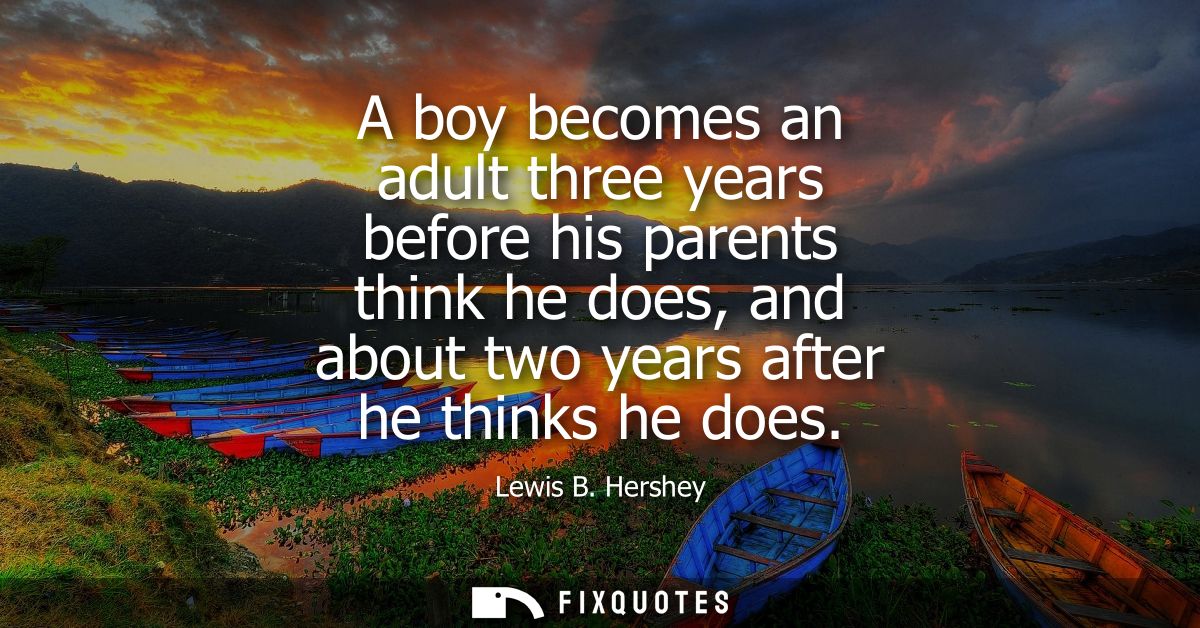
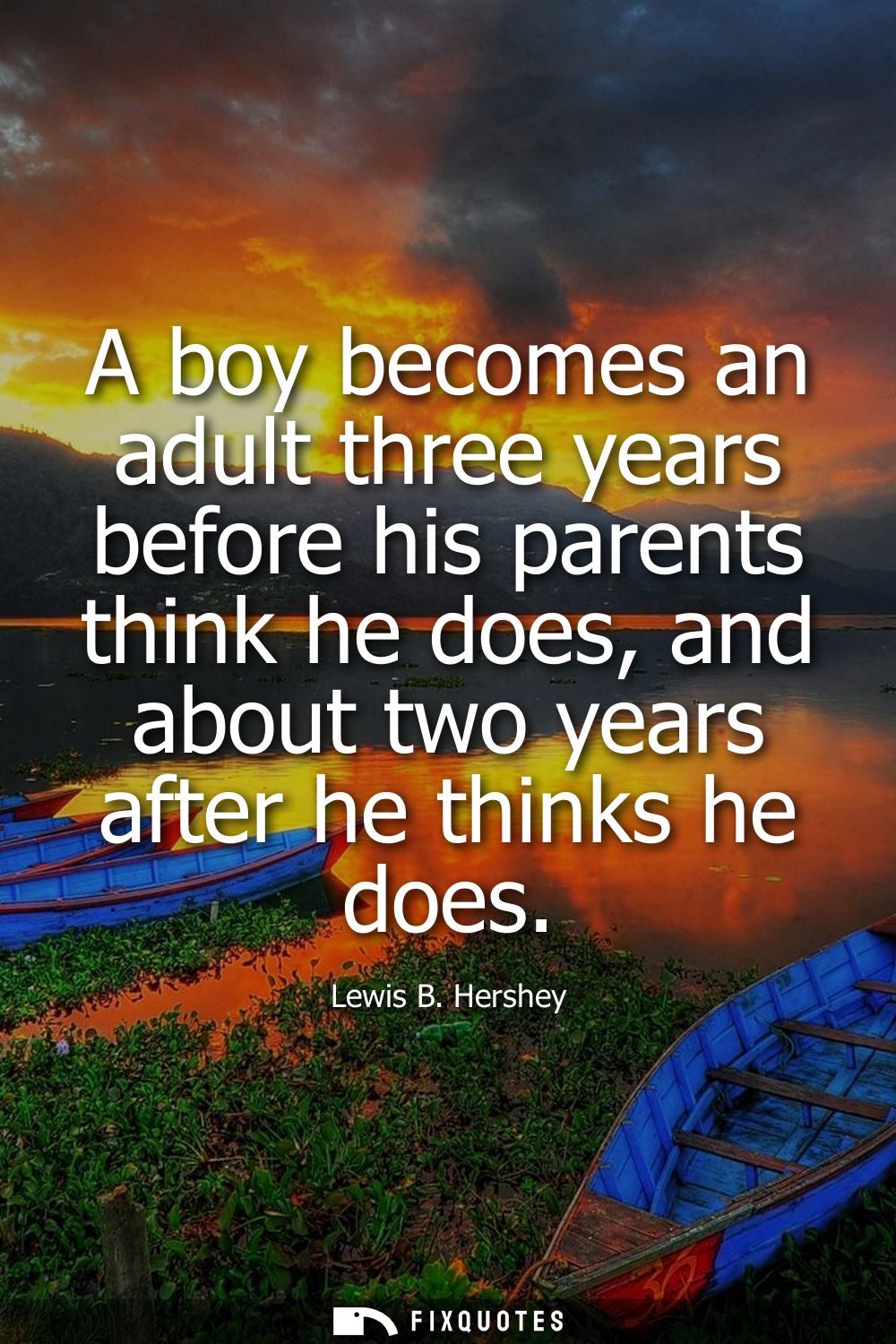
"A boy becomes an adult three years before his parents think he does, and about two years after he thinks he does"
About this Quote
Hershey’s arithmetic is the joke and the knife. “Three years before” parents grant it: that’s a jab at how authority clings to its jurisdiction, how caretakers keep rewriting dependency long after the kid has begun making real choices. Then the twist: “two years after he thinks he does.” The bravado of adolescence gets punctured. What feels like independence is often just the first draft of it, written in volume and certainty, not judgment.
Context sharpens the subtext. Hershey wasn’t a novelist; he was a U.S. Army general and longtime head of Selective Service, a man whose professional life revolved around turning teenagers into soldiers and citizens on a timetable the state could enforce. That vantage point makes the quote less a cozy family observation than an institutional one: society assigns adult responsibilities (work, war, legal consequences) before families are emotionally ready, and before young men are psychologically prepared. The result is a permanent mismatch between permission, self-image, and capability.
It works because it’s both wry and disciplinary: a small, quotable formula that flatters neither youth nor parents, and quietly insists that adulthood is earned in the gap between confidence and proof.
Quote Details
| Topic | Youth |
|---|---|
| Source | Help us find the source |
| Cite |
Citation Formats
APA Style (7th ed.)
Hershey, Lewis B. (2026, January 15). A boy becomes an adult three years before his parents think he does, and about two years after he thinks he does. FixQuotes. https://fixquotes.com/quotes/a-boy-becomes-an-adult-three-years-before-his-153750/
Chicago Style
Hershey, Lewis B. "A boy becomes an adult three years before his parents think he does, and about two years after he thinks he does." FixQuotes. January 15, 2026. https://fixquotes.com/quotes/a-boy-becomes-an-adult-three-years-before-his-153750/.
MLA Style (9th ed.)
"A boy becomes an adult three years before his parents think he does, and about two years after he thinks he does." FixQuotes, 15 Jan. 2026, https://fixquotes.com/quotes/a-boy-becomes-an-adult-three-years-before-his-153750/. Accessed 16 Feb. 2026.