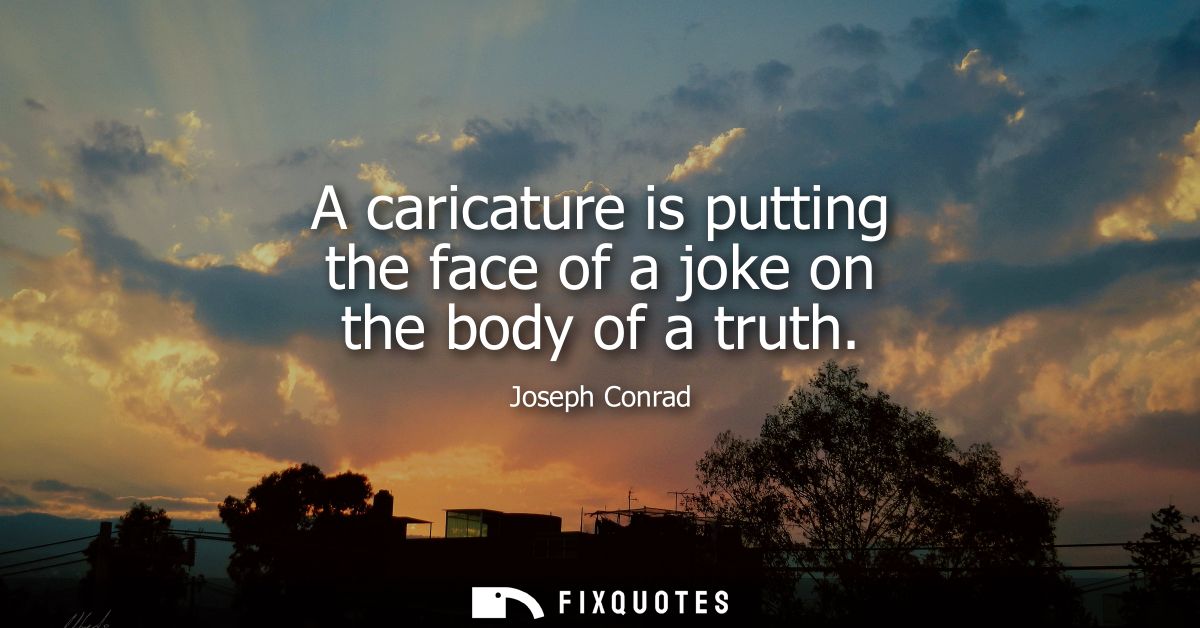
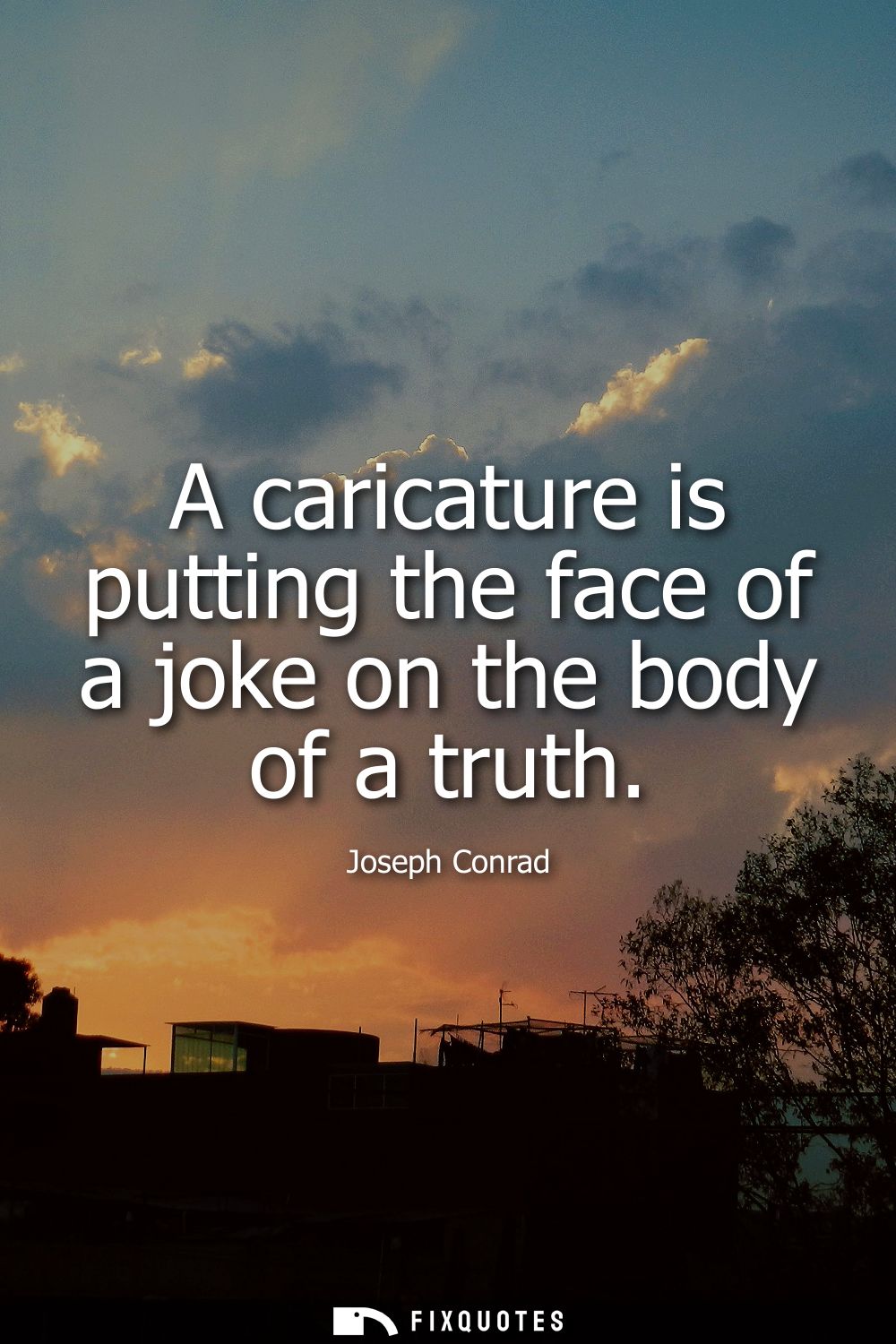
"A caricature is putting the face of a joke on the body of a truth"
About this Quote
Caricature, Conrad suggests, isn’t the enemy of truth; it’s truth forced to wear a grin. The line turns on a sly bodily metaphor: truth has weight, structure, consequence, but caricature swaps the face - the part we read first, the part that triggers instant recognition - for a “joke.” That swap matters. A joke isn’t simply comic; it’s a social weapon, a shortcut that recruits the audience’s biases and pleasures before the facts have a chance to complicate things.
Conrad wrote in an era obsessed with types: racial “characters” in imperial discourse, class sketches in popular journalism, political cartoons that reduced messy public life to a single nose, chin, or sneer. His novels are famously allergic to easy moral silhouettes. So the warning is not prudishness about humor; it’s suspicion of compression. Caricature works because it feels like revelation. Exaggeration masquerades as insight, making a partial truth look like the whole. The “body of a truth” stays intact enough to claim legitimacy, while the “face of a joke” licenses cruelty, dismissal, and certainty.
The subtext is about power and distance. Caricature usually punches outward, not upward: it requires that the subject be knowable at a glance, reducible, already halfway dehumanized. Conrad’s phrasing catches that uneasy double action: the joke makes the truth more shareable, more memorable, more viral in modern terms - and more dangerous, because it trains us to prefer the instantly legible over the actually accurate.
Conrad wrote in an era obsessed with types: racial “characters” in imperial discourse, class sketches in popular journalism, political cartoons that reduced messy public life to a single nose, chin, or sneer. His novels are famously allergic to easy moral silhouettes. So the warning is not prudishness about humor; it’s suspicion of compression. Caricature works because it feels like revelation. Exaggeration masquerades as insight, making a partial truth look like the whole. The “body of a truth” stays intact enough to claim legitimacy, while the “face of a joke” licenses cruelty, dismissal, and certainty.
The subtext is about power and distance. Caricature usually punches outward, not upward: it requires that the subject be knowable at a glance, reducible, already halfway dehumanized. Conrad’s phrasing catches that uneasy double action: the joke makes the truth more shareable, more memorable, more viral in modern terms - and more dangerous, because it trains us to prefer the instantly legible over the actually accurate.
Quote Details
| Topic | Witty One-Liners |
|---|---|
| Source | Help us find the source |
| Cite |
Citation Formats
APA Style (7th ed.)
Conrad, Joseph. (2026, January 16). A caricature is putting the face of a joke on the body of a truth. FixQuotes. https://fixquotes.com/quotes/a-caricature-is-putting-the-face-of-a-joke-on-the-103676/
Chicago Style
Conrad, Joseph. "A caricature is putting the face of a joke on the body of a truth." FixQuotes. January 16, 2026. https://fixquotes.com/quotes/a-caricature-is-putting-the-face-of-a-joke-on-the-103676/.
MLA Style (9th ed.)
"A caricature is putting the face of a joke on the body of a truth." FixQuotes, 16 Jan. 2026, https://fixquotes.com/quotes/a-caricature-is-putting-the-face-of-a-joke-on-the-103676/. Accessed 24 Mar. 2026.
More Quotes by Joseph
Add to List