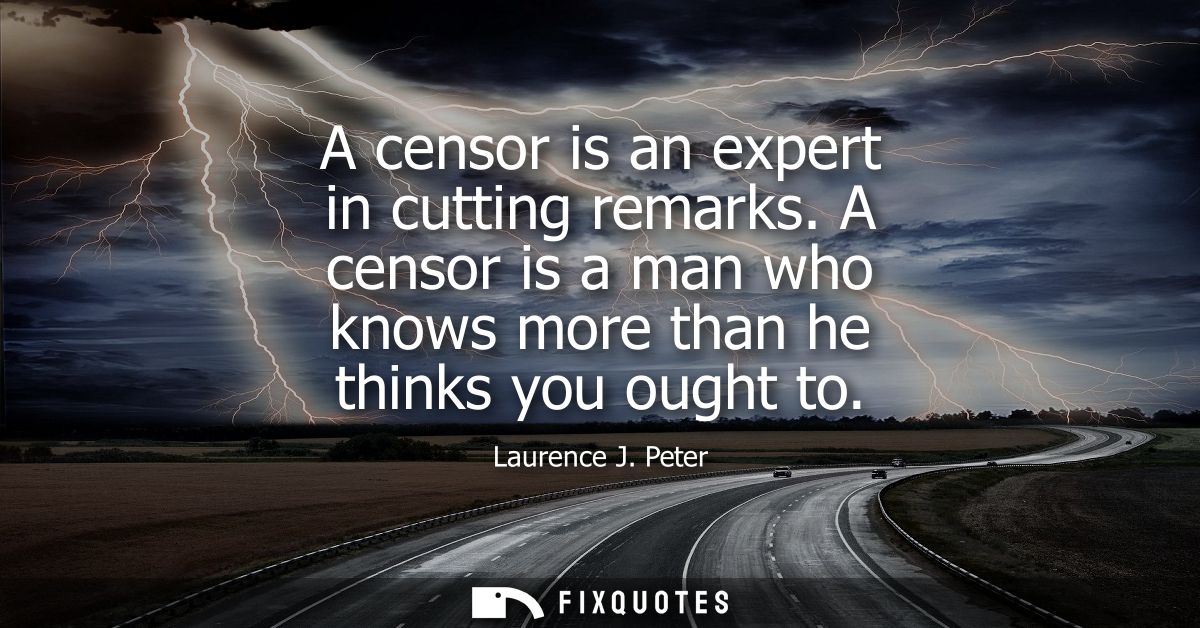
"A censor is an expert in cutting remarks. A censor is a man who knows more than he thinks you ought to"
About this Quote
The second line sharpens the blade. “A man who knows more than he thinks you ought to” is not really about knowledge; it’s about ownership. Peter implies that the censor’s real job is to ration information, to act as the gatekeeper of what counts as “appropriate” for everyone else. The subtext is paternalism with an ego: I have access, and you don’t get it unless I approve. It’s a portrait of power that frames itself as protection.
Context matters here. Peter wrote in a 20th-century world where information was increasingly mass-produced and mass-managed: broadcast TV, Cold War secrecy, school boards, obscenity trials, bureaucratic “standards.” His line anticipates how censorship often hides inside procedures and good intentions. By defining the censor as someone who “knows more,” Peter also suggests the perverse irony: censorship doesn’t eliminate knowledge, it concentrates it. The censor becomes the most informed person in the room while insisting the room stay dim.
Quote Details
| Topic | Witty One-Liners |
|---|---|
| Source | Help us find the source |
| Cite |
Citation Formats
APA Style (7th ed.)
Peter, Laurence J. (2026, January 15). A censor is an expert in cutting remarks. A censor is a man who knows more than he thinks you ought to. FixQuotes. https://fixquotes.com/quotes/a-censor-is-an-expert-in-cutting-remarks-a-censor-161180/
Chicago Style
Peter, Laurence J. "A censor is an expert in cutting remarks. A censor is a man who knows more than he thinks you ought to." FixQuotes. January 15, 2026. https://fixquotes.com/quotes/a-censor-is-an-expert-in-cutting-remarks-a-censor-161180/.
MLA Style (9th ed.)
"A censor is an expert in cutting remarks. A censor is a man who knows more than he thinks you ought to." FixQuotes, 15 Jan. 2026, https://fixquotes.com/quotes/a-censor-is-an-expert-in-cutting-remarks-a-censor-161180/. Accessed 29 Mar. 2026.