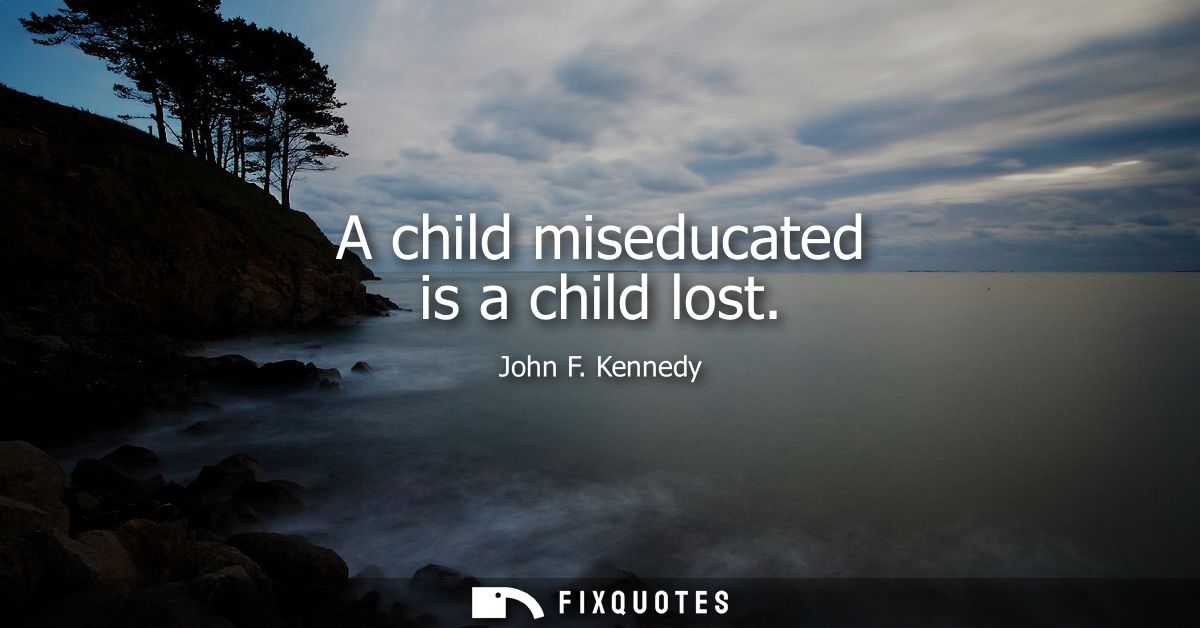
"A child miseducated, is a child lost"
About this Quote
Kennedy’s line lands with the chill of a national-security warning, except the threat is quieter: not missiles, but missed potential. “Miseducated” is the key verb. It’s not the tragedy of a child who simply lacks schooling; it’s the moral indictment of a system that actively teaches the wrong things - narrowing horizons, dulling curiosity, training obedience over judgment. In that framing, failure isn’t accidental. It’s manufactured.
The phrase “a child lost” does double duty. On the surface it’s intimate, almost parental, evoking the fear of watching someone drift beyond reach. Underneath, it’s civic: a “lost” child is a lost citizen, a diminished worker, a voter without the tools to resist demagoguery. Kennedy compresses a whole theory of democracy into a single, brisk sentence: the republic runs on educated minds, and when education goes bad, the costs compound across decades.
Context matters. Kennedy governed at the height of the Cold War, when schooling was tied to national competitiveness (Sputnik-era anxiety), racial integration battles, and the expanding promise of postwar liberalism. The quote carries that era’s characteristic fusion of compassion and calculation: invest in children because it’s right, and because the country cannot afford not to. The rhetoric is bluntly transactional - “miseducated” becomes “lost” - which is why it sticks. It refuses comforting ambiguity and pins responsibility where Kennedy wanted it: on policy, institutions, and the adults in charge.
The phrase “a child lost” does double duty. On the surface it’s intimate, almost parental, evoking the fear of watching someone drift beyond reach. Underneath, it’s civic: a “lost” child is a lost citizen, a diminished worker, a voter without the tools to resist demagoguery. Kennedy compresses a whole theory of democracy into a single, brisk sentence: the republic runs on educated minds, and when education goes bad, the costs compound across decades.
Context matters. Kennedy governed at the height of the Cold War, when schooling was tied to national competitiveness (Sputnik-era anxiety), racial integration battles, and the expanding promise of postwar liberalism. The quote carries that era’s characteristic fusion of compassion and calculation: invest in children because it’s right, and because the country cannot afford not to. The rhetoric is bluntly transactional - “miseducated” becomes “lost” - which is why it sticks. It refuses comforting ambiguity and pins responsibility where Kennedy wanted it: on policy, institutions, and the adults in charge.
Quote Details
| Topic | Learning |
|---|---|
| Source | Help us find the source |
| Cite |
Citation Formats
APA Style (7th ed.)
Kennedy, John F. (2026, February 20). A child miseducated, is a child lost. FixQuotes. https://fixquotes.com/quotes/a-child-miseducated-is-a-child-lost-24810/
Chicago Style
Kennedy, John F. "A child miseducated, is a child lost." FixQuotes. February 20, 2026. https://fixquotes.com/quotes/a-child-miseducated-is-a-child-lost-24810/.
MLA Style (9th ed.)
"A child miseducated, is a child lost." FixQuotes, 20 Feb. 2026, https://fixquotes.com/quotes/a-child-miseducated-is-a-child-lost-24810/. Accessed 30 Mar. 2026.
More Quotes by John
Add to List