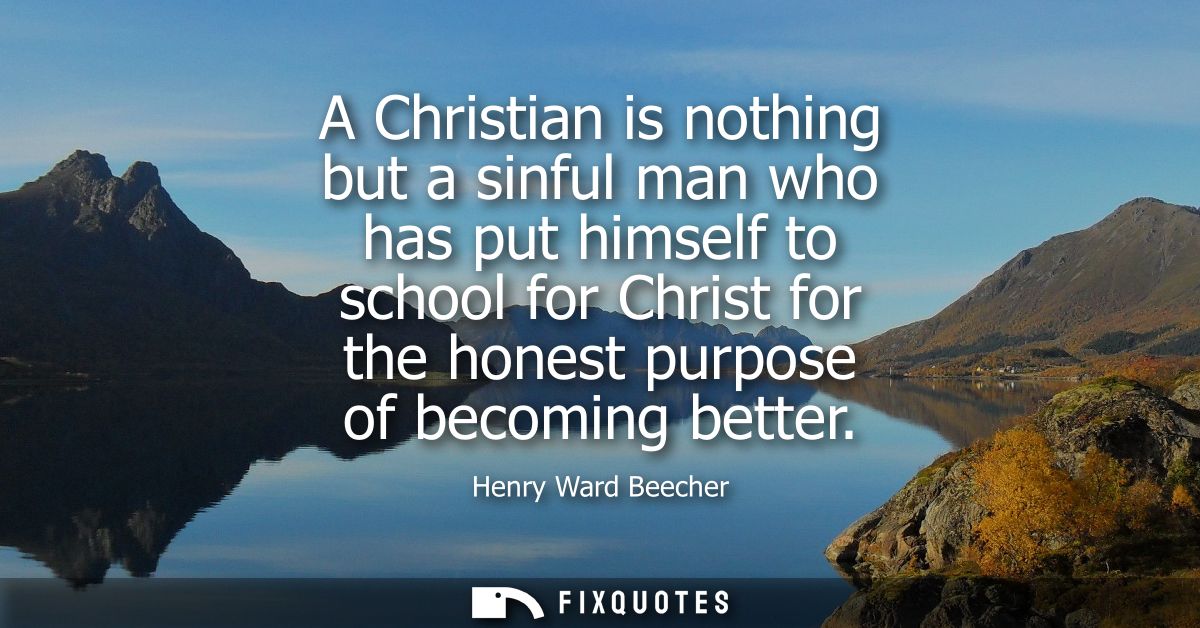
"A Christian is nothing but a sinful man who has put himself to school for Christ for the honest purpose of becoming better"
About this Quote
Beecher strips Christianity of its polite self-congratulation and drags it back into the messy workshop of character. A Christian, he argues, isn’t a moral type or a respectable badge-wearer but “nothing but a sinful man” who has enrolled in a kind of lifelong apprenticeship. The barbed sweetness is in that phrase “nothing but”: it punctures spiritual status anxiety. If you’re looking for a halo, you’re already missing the point.
The line works because it shifts faith from identity to discipline. “Put himself to school for Christ” frames belief as training rather than arrival, practice rather than performance. Beecher’s Protestant world was saturated with public piety, social reform, and the temptation to confuse churchgoing with goodness. By insisting on the “honest purpose of becoming better,” he takes aim at religious self-fashioning: the kind that uses doctrine as cover and community standing as proof. Honesty is doing heavy lifting here; it implies a whole shadow market of dishonesty - people claiming sanctity while quietly negotiating their vices.
Context sharpens the intent. Beecher preached in a 19th-century America obsessed with moral improvement, from temperance to abolition to domestic virtue. His phrasing borrows the era’s faith in self-culture while refusing the era’s appetite for moral superiority. The subtext: Christianity is not a tribunal where you prosecute other people’s failures; it’s a classroom where you admit your own.
It’s also quietly democratic. If the starting point is sin, then everyone qualifies. The only distinction left is willingness to be taught - and to change.
The line works because it shifts faith from identity to discipline. “Put himself to school for Christ” frames belief as training rather than arrival, practice rather than performance. Beecher’s Protestant world was saturated with public piety, social reform, and the temptation to confuse churchgoing with goodness. By insisting on the “honest purpose of becoming better,” he takes aim at religious self-fashioning: the kind that uses doctrine as cover and community standing as proof. Honesty is doing heavy lifting here; it implies a whole shadow market of dishonesty - people claiming sanctity while quietly negotiating their vices.
Context sharpens the intent. Beecher preached in a 19th-century America obsessed with moral improvement, from temperance to abolition to domestic virtue. His phrasing borrows the era’s faith in self-culture while refusing the era’s appetite for moral superiority. The subtext: Christianity is not a tribunal where you prosecute other people’s failures; it’s a classroom where you admit your own.
It’s also quietly democratic. If the starting point is sin, then everyone qualifies. The only distinction left is willingness to be taught - and to change.
Quote Details
| Topic | Faith |
|---|---|
| Source | Help us find the source |
More Quotes by Henry
Add to List