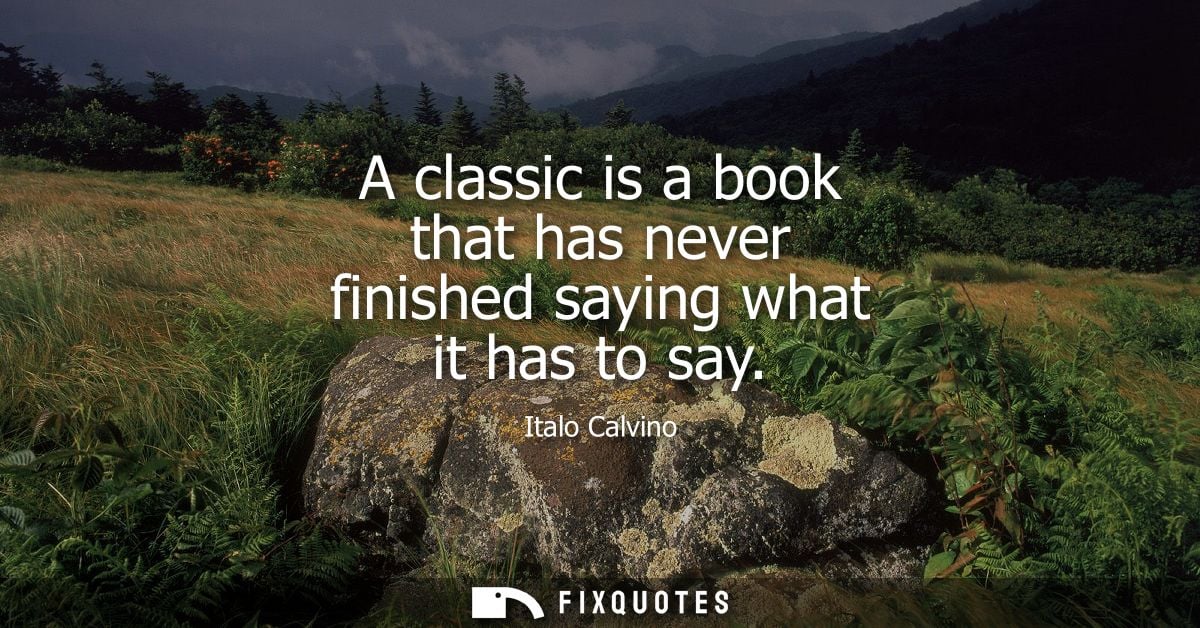
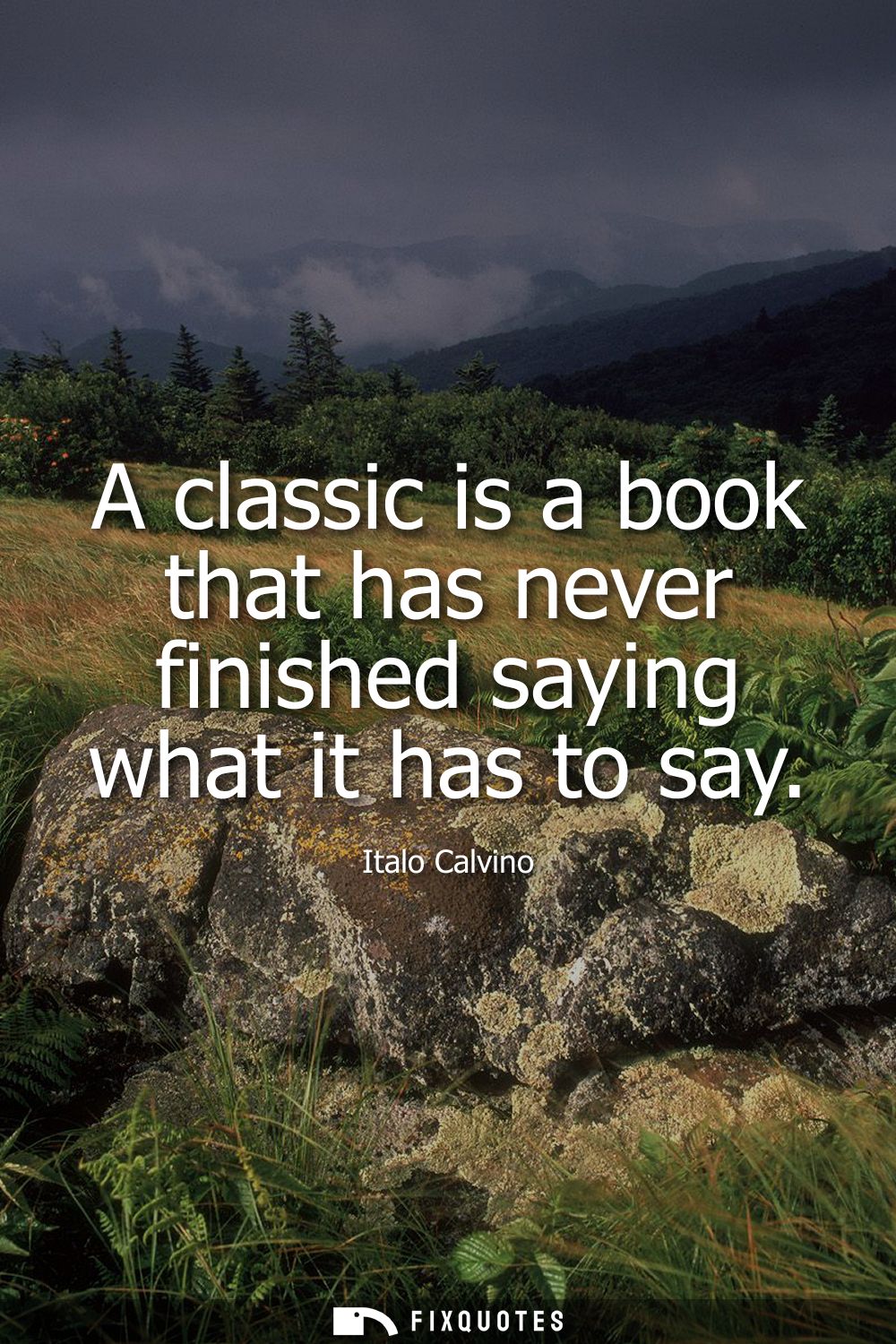
"A classic is a book that has never finished saying what it has to say"
About this Quote
Calvino’s line flatters “the classic” while quietly denying it the museum-glass certainty we usually grant the canon. A book becomes “classic” not because it contains a final, sealed message, but because it keeps generating new ones, especially under pressure from new readers, new politics, new technologies, new anxieties. The trick is in the verb tense: “has never finished” makes interpretation an ongoing event, not a verdict. It reframes greatness as durability plus instability.
The subtext is a critique of how cultural authority gets built. If a classic is never done speaking, then no institution - school curricula, critics, national literatures - can honestly claim to have pinned down its “meaning.” Calvino, who lived through fascism, war, and Italy’s postwar reinvention, knew how quickly official readings harden into ideology. His formulation resists that. It also defends rereading as an adult practice rather than a nostalgic one: you return not to confirm what you already know, but to be surprised by what your life now makes visible.
Context matters: Calvino was a novelist and essayist shaped by journalism’s attention to the present and by postwar literary experimentation. Calling a classic unfinished is also a sly endorsement of modernity: the past remains usable only if it stays arguable. In that sense, the quote is both democratic and demanding. A classic doesn’t ask for reverence; it asks for work - the work of meeting it where you are, then noticing it has already moved.
The subtext is a critique of how cultural authority gets built. If a classic is never done speaking, then no institution - school curricula, critics, national literatures - can honestly claim to have pinned down its “meaning.” Calvino, who lived through fascism, war, and Italy’s postwar reinvention, knew how quickly official readings harden into ideology. His formulation resists that. It also defends rereading as an adult practice rather than a nostalgic one: you return not to confirm what you already know, but to be surprised by what your life now makes visible.
Context matters: Calvino was a novelist and essayist shaped by journalism’s attention to the present and by postwar literary experimentation. Calling a classic unfinished is also a sly endorsement of modernity: the past remains usable only if it stays arguable. In that sense, the quote is both democratic and demanding. A classic doesn’t ask for reverence; it asks for work - the work of meeting it where you are, then noticing it has already moved.
Quote Details
| Topic | Book |
|---|---|
| Source | Unverified source: Italiani, vi esorto ai classici (Italo Calvino, 1981)
Evidence: Un classico è un libro che non ha mai finito di dire quel che ha da dire. (pp. 58–68 (exact page for the sentence not verified from a scanned issue)). This line is Calvino’s well-known ‘definition #6’ of a classic. The essay first appeared (as far as primary-source bibliographies and multiple sch... Other candidates (1) With This Root about My Person (Jennifer Reid, Davíd Carrasco, 2020) compilation95.0% ... Italo Calvino uses the term in his essay " Why Read the Classics . ” One of his fourteen " suggested definitions ... |
| Cite |
Citation Formats
APA Style (7th ed.)
Calvino, Italo. (2026, March 5). A classic is a book that has never finished saying what it has to say. FixQuotes. https://fixquotes.com/quotes/a-classic-is-a-book-that-has-never-finished-169446/
Chicago Style
Calvino, Italo. "A classic is a book that has never finished saying what it has to say." FixQuotes. March 5, 2026. https://fixquotes.com/quotes/a-classic-is-a-book-that-has-never-finished-169446/.
MLA Style (9th ed.)
"A classic is a book that has never finished saying what it has to say." FixQuotes, 5 Mar. 2026, https://fixquotes.com/quotes/a-classic-is-a-book-that-has-never-finished-169446/. Accessed 3 Apr. 2026.
More Quotes by Italo
Add to List