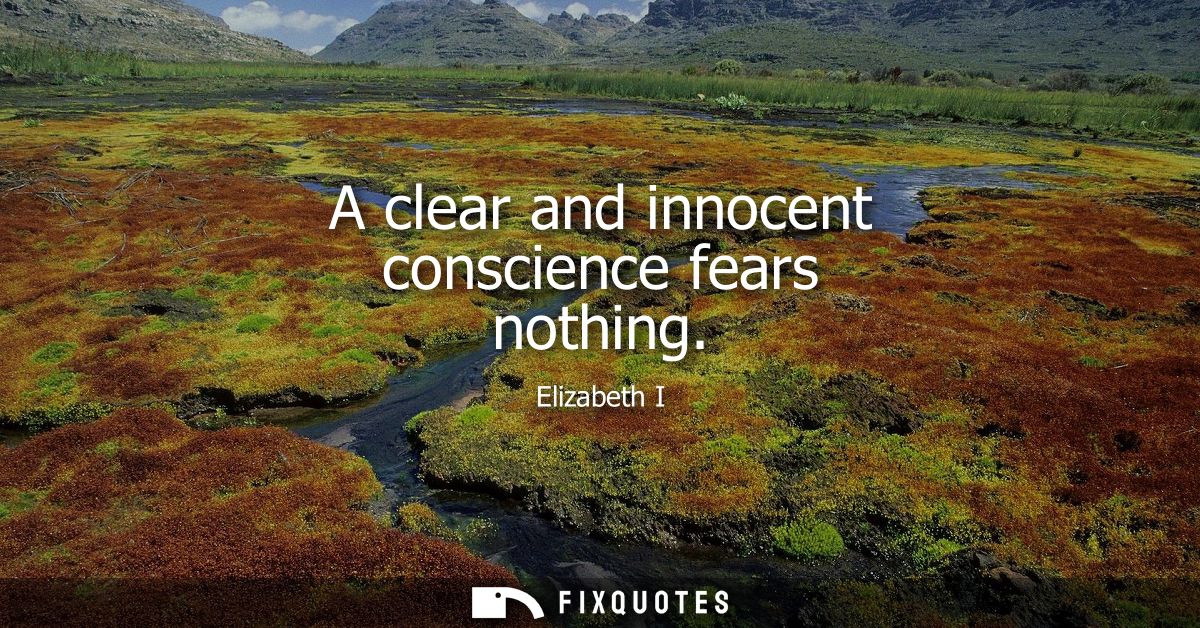
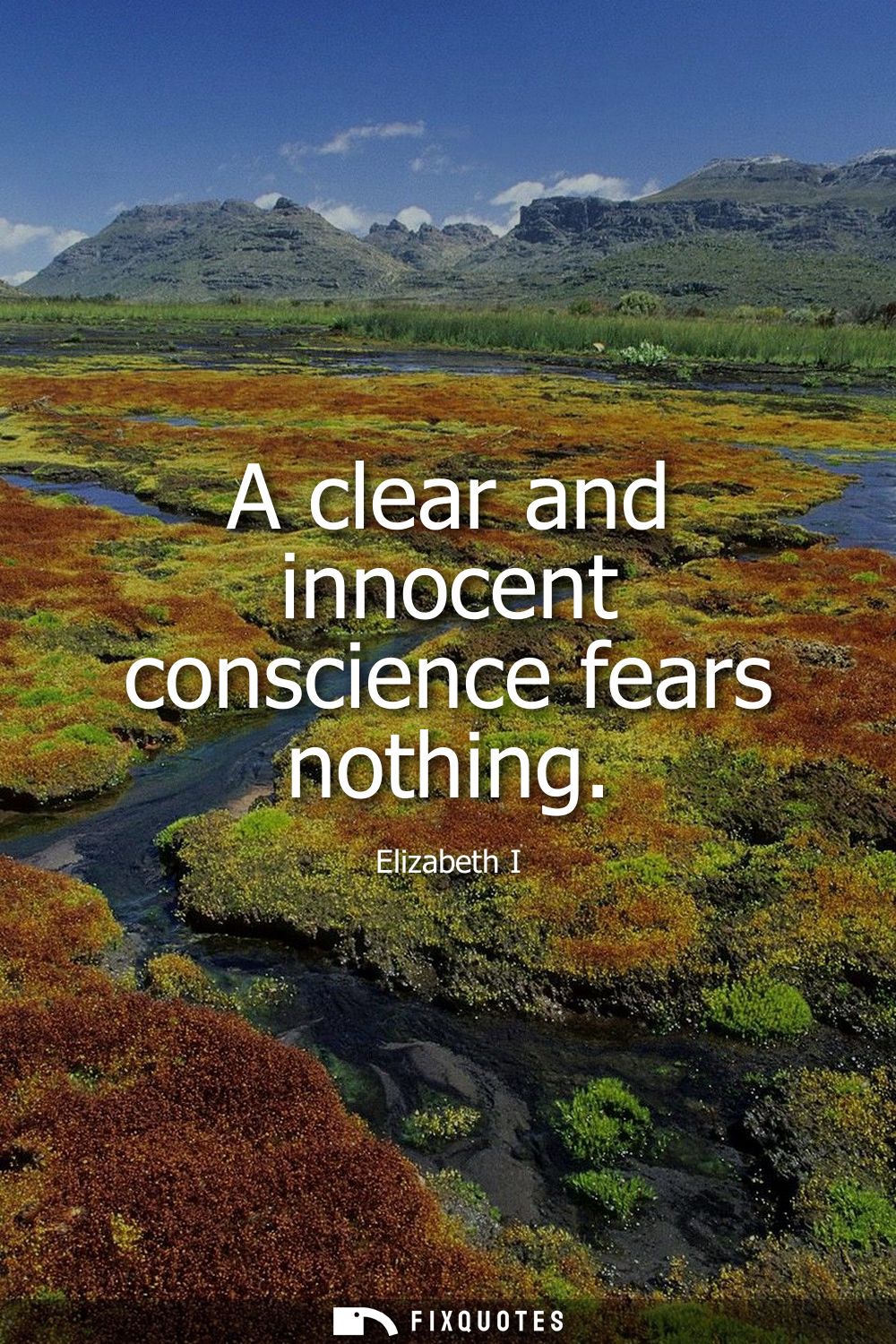
"A clear and innocent conscience fears nothing"
About this Quote
Power, in Elizabeth I's world, was inseparable from suspicion. To claim that "A clear and innocent conscience fears nothing" is less a Hallmark reassurance than a monarch's hard-edged political technology: a way to convert inner purity into public armor. Spoken by a queen who lived amid plots, religious fracture, and the constant question of her legitimacy, the line works as both self-justification and warning. If you are loyal, you have no reason to tremble. If you are trembling, perhaps you are not loyal.
The rhetoric is elegantly totalizing. It relocates danger from the realm of capricious rulers and unstable courts into the soul of the subject. Fear becomes incriminating evidence. That move is useful for a sovereign whose authority must be asserted without always being enforced; it pressures courtiers into performing composure, because anxiety reads as guilt. In a culture where surveillance traveled through rumor, confession, and the threat of interrogation, the quote also flatters the state's moral order: the crown does not punish the innocent, so innocence should feel safe. History, of course, complicates that premise.
There is subtextual autobiography here, too. Elizabeth had been declared illegitimate, imprisoned, and nearly executed under Mary I. She learned that innocence doesn't always protect you, but it can be staged as if it does. The line is a performance of unshakeable legitimacy: a queen presenting her conscience as evidence, turning interior certainty into a claim of sovereign right. It's political poise disguised as moral clarity.
The rhetoric is elegantly totalizing. It relocates danger from the realm of capricious rulers and unstable courts into the soul of the subject. Fear becomes incriminating evidence. That move is useful for a sovereign whose authority must be asserted without always being enforced; it pressures courtiers into performing composure, because anxiety reads as guilt. In a culture where surveillance traveled through rumor, confession, and the threat of interrogation, the quote also flatters the state's moral order: the crown does not punish the innocent, so innocence should feel safe. History, of course, complicates that premise.
There is subtextual autobiography here, too. Elizabeth had been declared illegitimate, imprisoned, and nearly executed under Mary I. She learned that innocence doesn't always protect you, but it can be staged as if it does. The line is a performance of unshakeable legitimacy: a queen presenting her conscience as evidence, turning interior certainty into a claim of sovereign right. It's political poise disguised as moral clarity.
Quote Details
| Topic | Ethics & Morality |
|---|---|
| Source | Help us find the source |
| Cite |
Citation Formats
APA Style (7th ed.)
I, Elizabeth. (2026, January 15). A clear and innocent conscience fears nothing. FixQuotes. https://fixquotes.com/quotes/a-clear-and-innocent-conscience-fears-nothing-5431/
Chicago Style
I, Elizabeth. "A clear and innocent conscience fears nothing." FixQuotes. January 15, 2026. https://fixquotes.com/quotes/a-clear-and-innocent-conscience-fears-nothing-5431/.
MLA Style (9th ed.)
"A clear and innocent conscience fears nothing." FixQuotes, 15 Jan. 2026, https://fixquotes.com/quotes/a-clear-and-innocent-conscience-fears-nothing-5431/. Accessed 12 Feb. 2026.
More Quotes by Elizabeth
Add to List