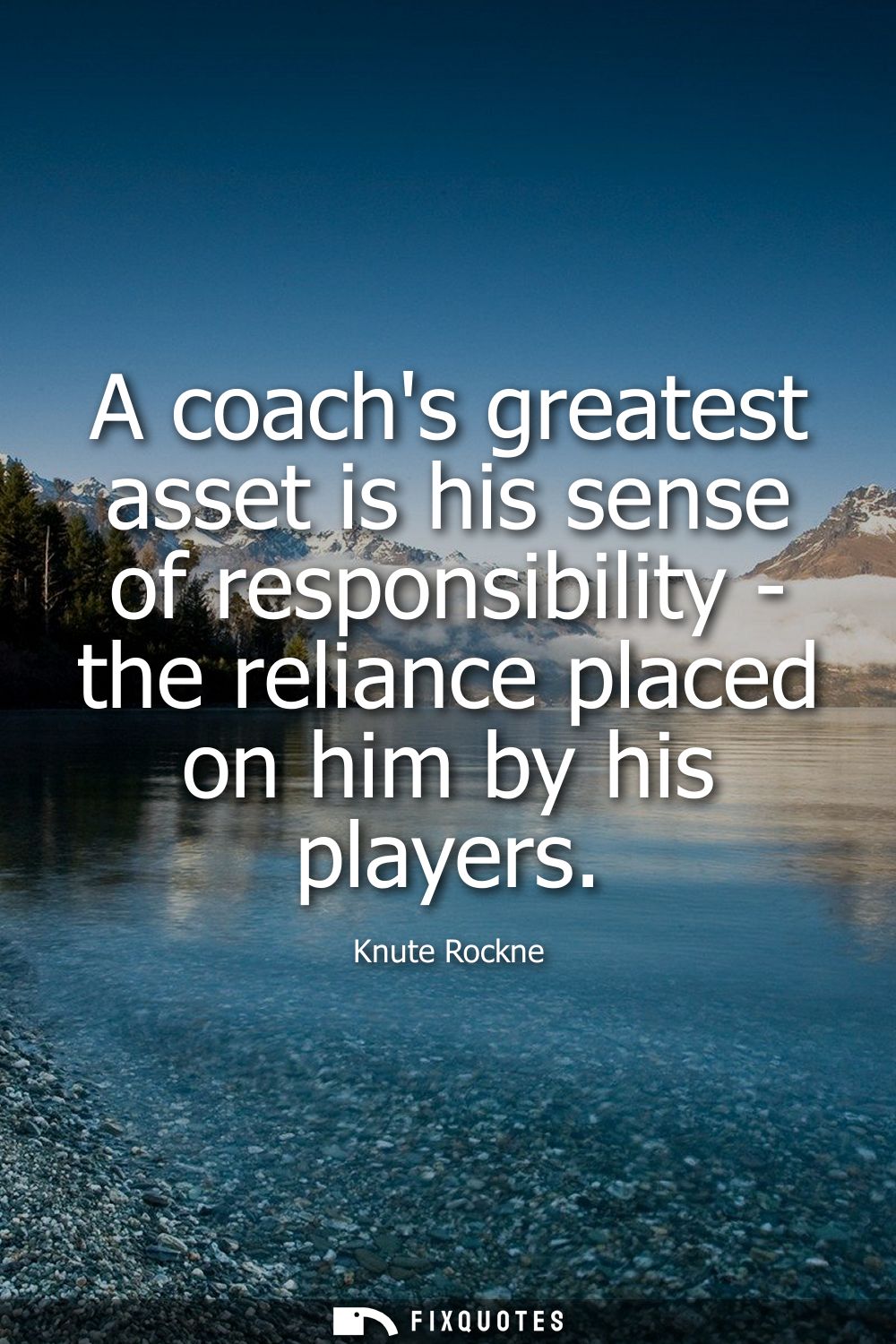
"A coach's greatest asset is his sense of responsibility - the reliance placed on him by his players"
About this Quote
The key phrase is "the reliance placed on him by his players". It's a reminder that authority in sports is borrowed, not owned. Players surrender time, trust, and often pain tolerance to a figure who gets to decide what "worth it" means on any given day. Rockne isn't romanticizing this; he's quietly warning that the job's real power lies in the asymmetry. When people rely on you, your choices stop being private opinions and start becoming lived consequences for others.
Context matters: Rockne helped professionalize college football's culture in the early 20th century, when the sport was still negotiating its legitimacy and its brutality. Coaching was becoming a public-facing vocation - part tactician, part moral steward, part institutional representative. In that environment, "responsibility" reads like a defense of authority that doesn't tip into authoritarianism: the coach earns influence by treating dependence as a duty, not a perk.
Subtext: winning is an outcome; care is the constraint. A program can survive a lost game. It can't survive a leader who forgets what other people have handed him.
Quote Details
| Topic | Coaching |
|---|---|
| Source | Help us find the source |
| Cite |
Citation Formats
APA Style (7th ed.)
Rockne, Knute. (2026, January 17). A coach's greatest asset is his sense of responsibility - the reliance placed on him by his players. FixQuotes. https://fixquotes.com/quotes/a-coachs-greatest-asset-is-his-sense-of-63124/
Chicago Style
Rockne, Knute. "A coach's greatest asset is his sense of responsibility - the reliance placed on him by his players." FixQuotes. January 17, 2026. https://fixquotes.com/quotes/a-coachs-greatest-asset-is-his-sense-of-63124/.
MLA Style (9th ed.)
"A coach's greatest asset is his sense of responsibility - the reliance placed on him by his players." FixQuotes, 17 Jan. 2026, https://fixquotes.com/quotes/a-coachs-greatest-asset-is-his-sense-of-63124/. Accessed 29 Mar. 2026.