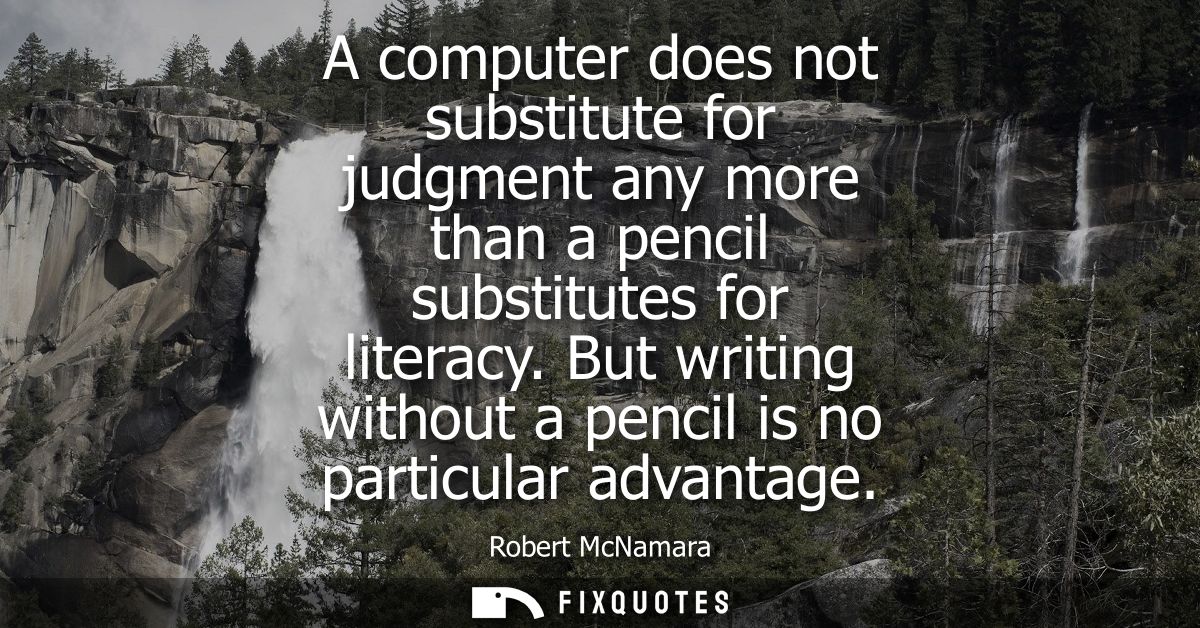
"A computer does not substitute for judgment any more than a pencil substitutes for literacy. But writing without a pencil is no particular advantage"
About this Quote
The kicker is the second sentence, which punctures a fashionable fantasy: that doing things “without the pencil” (without intermediating tools, without process, without what looks like friction) is inherently superior. McNamara is defending the unglamorous infrastructure of decision-making: drafts, checks, constraints, and feedback loops. In a culture that loves immediacy, he’s arguing that mediation is often the advantage.
Context matters. McNamara was a systems-minded administrator who lived through the seductions and limits of quantification, most notoriously in Vietnam-era metrics-driven strategy. Read with that history, the quote becomes a quiet warning from someone who watched data and models gain moral authority they didn’t deserve. Computers can optimize what you ask them to optimize; they cannot tell you whether the goal is sane, humane, or even coherent. The subtext is accountability: when judgment fails, you can’t point to the machine like it made the call.
Quote Details
| Topic | Decision-Making |
|---|---|
| Source | Help us find the source |
| Cite |
Citation Formats
APA Style (7th ed.)
McNamara, Robert. (2026, January 15). A computer does not substitute for judgment any more than a pencil substitutes for literacy. But writing without a pencil is no particular advantage. FixQuotes. https://fixquotes.com/quotes/a-computer-does-not-substitute-for-judgment-any-162353/
Chicago Style
McNamara, Robert. "A computer does not substitute for judgment any more than a pencil substitutes for literacy. But writing without a pencil is no particular advantage." FixQuotes. January 15, 2026. https://fixquotes.com/quotes/a-computer-does-not-substitute-for-judgment-any-162353/.
MLA Style (9th ed.)
"A computer does not substitute for judgment any more than a pencil substitutes for literacy. But writing without a pencil is no particular advantage." FixQuotes, 15 Jan. 2026, https://fixquotes.com/quotes/a-computer-does-not-substitute-for-judgment-any-162353/. Accessed 7 Mar. 2026.