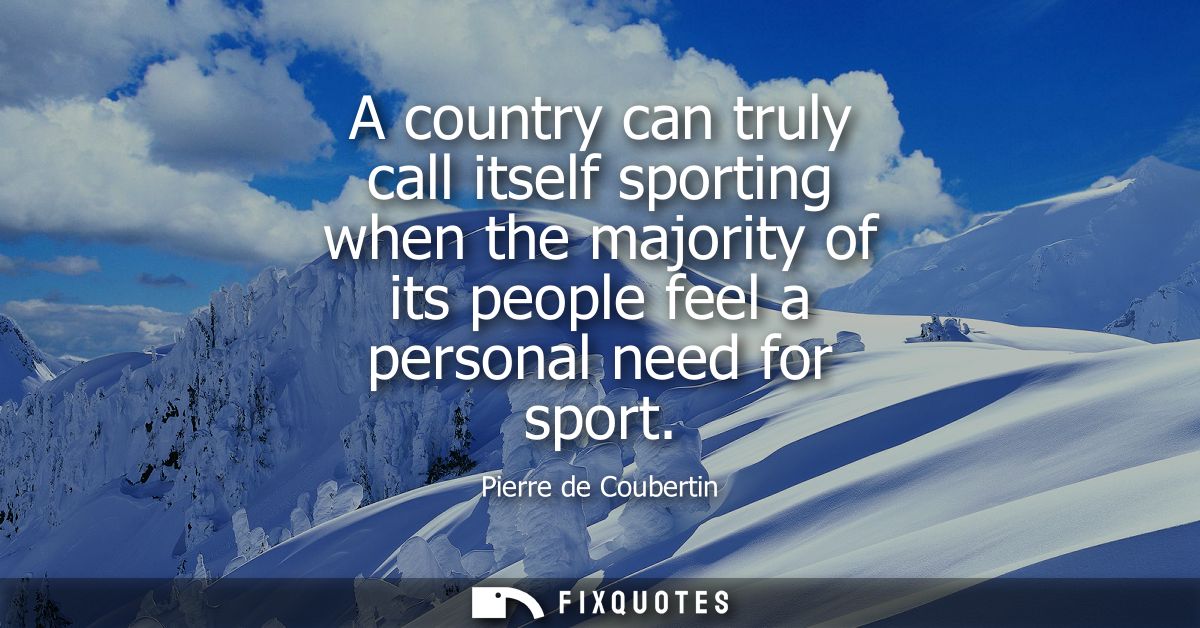
"A country can truly call itself sporting when the majority of its people feel a personal need for sport"
About this Quote
The subtext is disciplining in the most flattering way possible. By calling the desire for sport a “need,” Coubertin naturalizes a particular set of values: self-mastery, competition under rules, healthy bodies as social capital. If people don’t “need” sport, the implication isn’t just that they’re inactive; it’s that the nation is missing a modern moral engine. In a Europe anxious about industrial softness, urban crowding, and national strength, this is a gentler version of militarized preparedness: train the body, and you indirectly train the citizen.
Context matters because Coubertin helped revive the modern Olympics and tied athletics to education and nation-building. He wanted sport woven into everyday life through schools and civic institutions, producing citizens who internalize discipline without being coerced. The line also doubles as a recruitment pitch for states and elites: invest in sport, and you’ll manufacture cohesion, prestige, and a controllable outlet for aggression.
It works because it’s both democratic and demanding. “Majority of its people” sounds inclusive, even egalitarian; “personal need” raises the bar to something almost existential. Coubertin sells national power as a private craving.
Quote Details
| Topic | Sports |
|---|---|
| Source | Help us find the source |
| Cite |
Citation Formats
APA Style (7th ed.)
Coubertin, Pierre de. (2026, January 16). A country can truly call itself sporting when the majority of its people feel a personal need for sport. FixQuotes. https://fixquotes.com/quotes/a-country-can-truly-call-itself-sporting-when-the-106011/
Chicago Style
Coubertin, Pierre de. "A country can truly call itself sporting when the majority of its people feel a personal need for sport." FixQuotes. January 16, 2026. https://fixquotes.com/quotes/a-country-can-truly-call-itself-sporting-when-the-106011/.
MLA Style (9th ed.)
"A country can truly call itself sporting when the majority of its people feel a personal need for sport." FixQuotes, 16 Jan. 2026, https://fixquotes.com/quotes/a-country-can-truly-call-itself-sporting-when-the-106011/. Accessed 5 Apr. 2026.