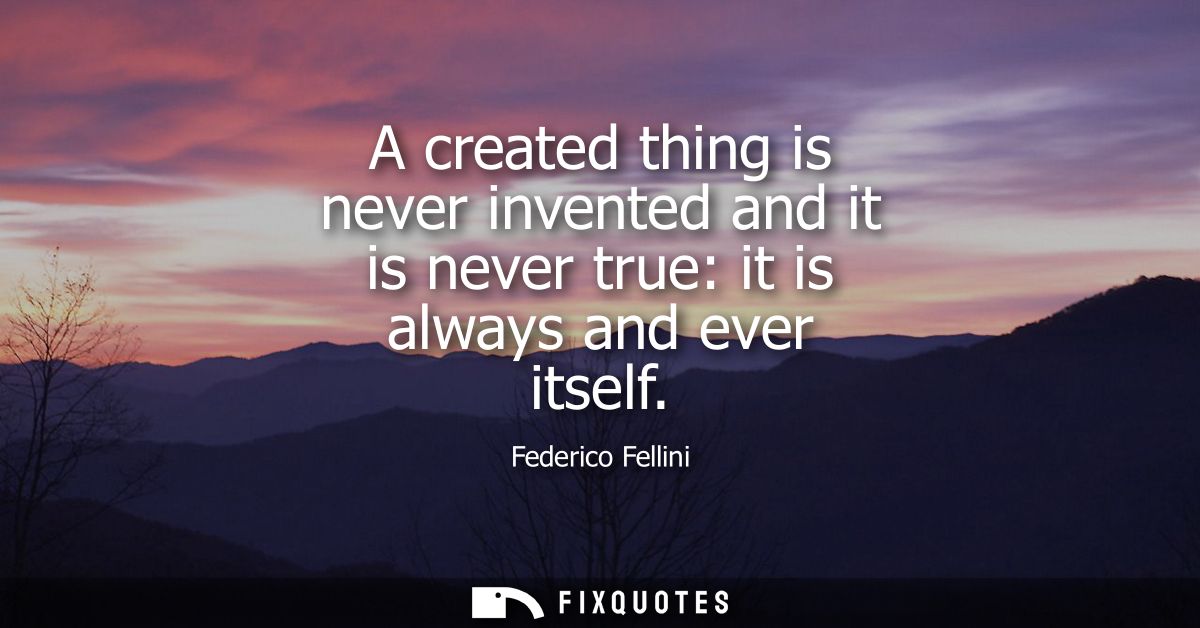
"A created thing is never invented and it is never true: it is always and ever itself"
About this Quote
The phrasing is stubbornly paradoxical. If it’s created, how is it not invented? If it isn’t true, why should we care? Fellini’s point is that the artwork doesn’t owe you a receipt. It doesn’t exist to be audited against “what really happened,” or to prove the artist’s cleverness. It exists with the irreducible selfhood of a person: messy, specific, untranslatable. “Always and ever itself” is both a shrug and a manifesto.
Context matters. Fellini built films that feel like memories you never lived: 8 1/2, Amarcord, La Dolce Vita. They’re autobiographical without being reliable, documentary in texture while openly theatrical. The subtext is a defense against critics (and censors) who wanted moral clarity, realism, or plot as proof of seriousness. He’s arguing for a third category: the cinematic object as its own reality, where authenticity comes from coherence of vision, not fidelity to events. Art, for Fellini, isn’t a lie that pretends to be true; it’s a thing that refuses the entire courtroom.
Quote Details
| Topic | Truth |
|---|---|
| Source | Help us find the source |
| Cite |
Citation Formats
APA Style (7th ed.)
Fellini, Federico. (2026, January 17). A created thing is never invented and it is never true: it is always and ever itself. FixQuotes. https://fixquotes.com/quotes/a-created-thing-is-never-invented-and-it-is-never-51390/
Chicago Style
Fellini, Federico. "A created thing is never invented and it is never true: it is always and ever itself." FixQuotes. January 17, 2026. https://fixquotes.com/quotes/a-created-thing-is-never-invented-and-it-is-never-51390/.
MLA Style (9th ed.)
"A created thing is never invented and it is never true: it is always and ever itself." FixQuotes, 17 Jan. 2026, https://fixquotes.com/quotes/a-created-thing-is-never-invented-and-it-is-never-51390/. Accessed 30 Mar. 2026.