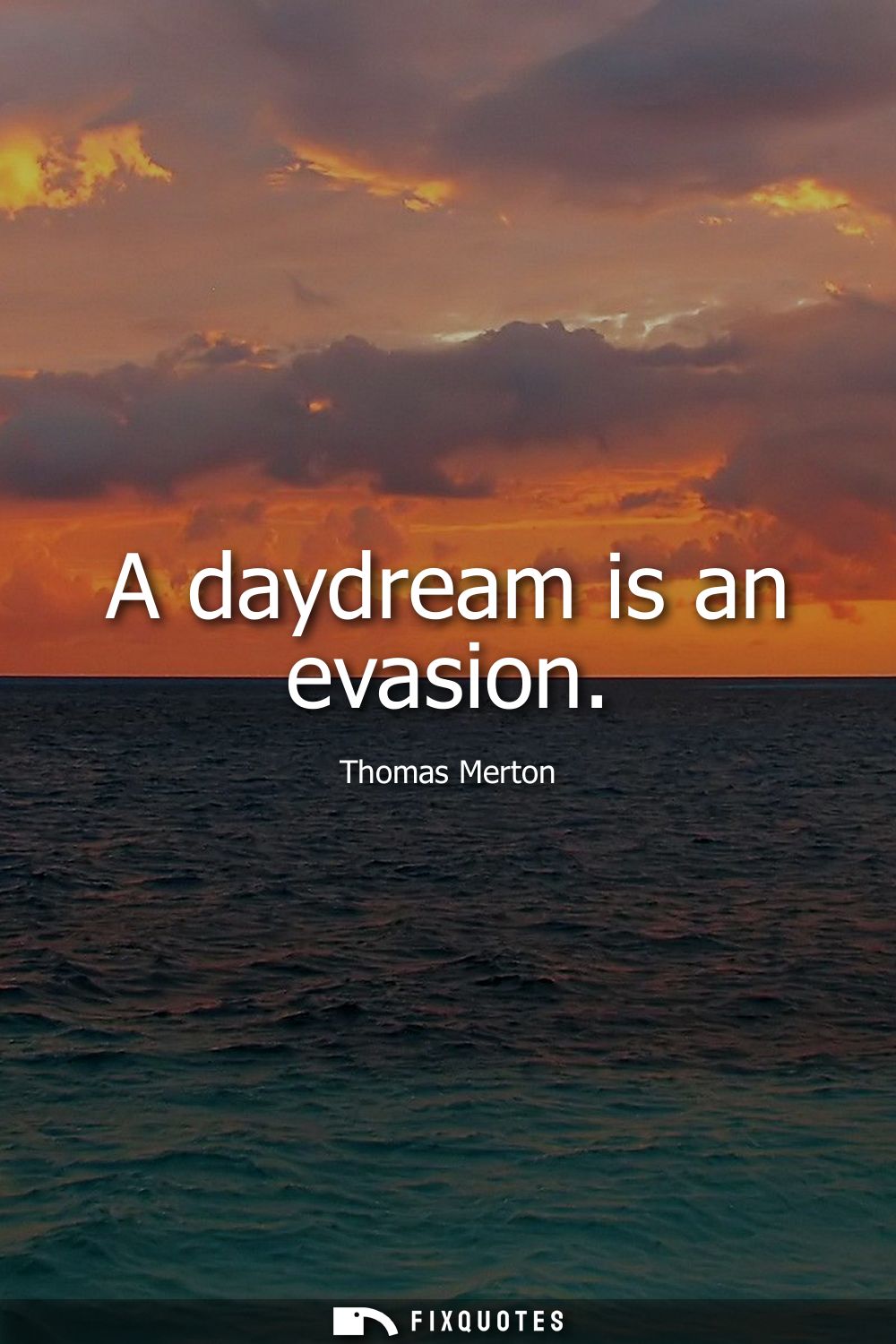
"A daydream is an evasion"
About this Quote
Merton’s line lands like a monk’s slap: not cruel, just clarifying. “A daydream is an evasion” reframes reverie from harmless escape to moral maneuver. The word “evasion” is doing the heavy lifting. It’s not “rest” or “play” or even “fantasy” - it’s the language of dodging responsibility, of slipping out a side door when reality asks for your attention. In seven words, Merton turns the mind into a suspect and the self into its own getaway driver.
The intent feels less like puritanical scolding than diagnostic precision. As a Trappist monk and spiritual writer, Merton was obsessed with how the ego manufactures noise to avoid the difficult work of presence: prayer, honesty, silence, the unglamorous chores of being alive. Daydreaming becomes a small, seductive technology for postponement. You don’t have to face your loneliness if you can storyboard a cooler version of your life. You don’t have to make a choice if you can audition outcomes in your head.
The subtext is sharper: escapism isn’t neutral. It has consequences because it reorganizes your loyalties. Attention is your real currency, and daydreaming spends it on imagined control, imagined admiration, imagined safety - a world where you’re never interrupted and never truly accountable.
Context matters here: mid-century America was accelerating into distraction, consumption, and status theater, and Merton watched how easily inner life becomes a marketplace. His warning reads now like pre-social-media prophecy. Daydreaming isn’t the villain; the reflex to flee is.
The intent feels less like puritanical scolding than diagnostic precision. As a Trappist monk and spiritual writer, Merton was obsessed with how the ego manufactures noise to avoid the difficult work of presence: prayer, honesty, silence, the unglamorous chores of being alive. Daydreaming becomes a small, seductive technology for postponement. You don’t have to face your loneliness if you can storyboard a cooler version of your life. You don’t have to make a choice if you can audition outcomes in your head.
The subtext is sharper: escapism isn’t neutral. It has consequences because it reorganizes your loyalties. Attention is your real currency, and daydreaming spends it on imagined control, imagined admiration, imagined safety - a world where you’re never interrupted and never truly accountable.
Context matters here: mid-century America was accelerating into distraction, consumption, and status theater, and Merton watched how easily inner life becomes a marketplace. His warning reads now like pre-social-media prophecy. Daydreaming isn’t the villain; the reflex to flee is.
Quote Details
| Topic | Wisdom |
|---|---|
| Source | Help us find the source |
| Cite |
Citation Formats
APA Style (7th ed.)
Merton, Thomas. (2026, January 18). A daydream is an evasion. FixQuotes. https://fixquotes.com/quotes/a-daydream-is-an-evasion-2072/
Chicago Style
Merton, Thomas. "A daydream is an evasion." FixQuotes. January 18, 2026. https://fixquotes.com/quotes/a-daydream-is-an-evasion-2072/.
MLA Style (9th ed.)
"A daydream is an evasion." FixQuotes, 18 Jan. 2026, https://fixquotes.com/quotes/a-daydream-is-an-evasion-2072/. Accessed 29 Mar. 2026.
More Quotes by Thomas
Add to List