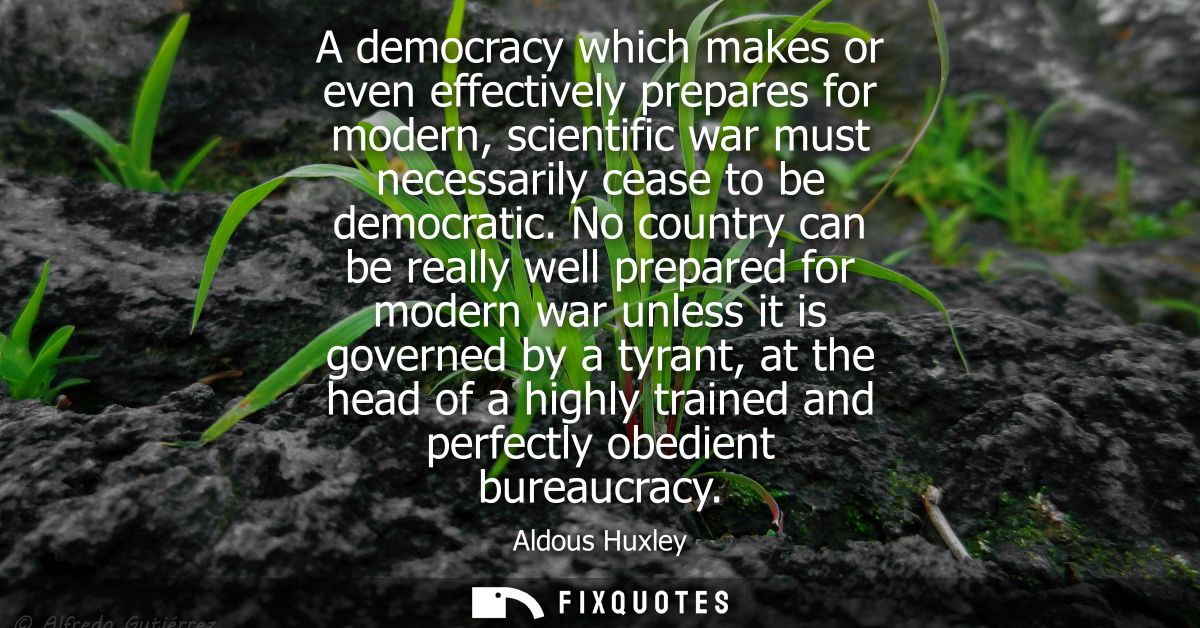
"A democracy which makes or even effectively prepares for modern, scientific war must necessarily cease to be democratic. No country can be really well prepared for modern war unless it is governed by a tyrant, at the head of a highly trained and perfectly obedient bureaucracy"
About this Quote
His phrasing is surgical. “Effectively prepares” matters as much as “makes”: even the pretext of readiness justifies surveillance, secrecy, propaganda, and the normalization of command structures. Preparation becomes a political solvent. Then comes the real Huxley move: the tyrant isn’t presented as a monster but as an organizational requirement. A “highly trained and perfectly obedient bureaucracy” is the quiet villain here, a portrait of modern power that doesn’t need theatrical cruelty; it needs compliance, expertise, and routine.
Context sharpens the warning. Huxley is writing in the shadow of World War I’s technocratic slaughter and the interwar rise of fascism, when states learned to mobilize science, industry, and public opinion as weapons. It’s also the backdrop to his later dystopian imagination: control achieved not only through fear, but through administration. The line lands because it refuses comforting exceptions. If modern war is treated as a standing policy option, democracy becomes performance art - elections held under the glow of a permanent emergency.
Quote Details
| Topic | War |
|---|---|
| Source | Help us find the source |
| Cite |
Citation Formats
APA Style (7th ed.)
Huxley, Aldous. (2026, January 15). A democracy which makes or even effectively prepares for modern, scientific war must necessarily cease to be democratic. No country can be really well prepared for modern war unless it is governed by a tyrant, at the head of a highly trained and perfectly obedient bureaucracy. FixQuotes. https://fixquotes.com/quotes/a-democracy-which-makes-or-even-effectively-29669/
Chicago Style
Huxley, Aldous. "A democracy which makes or even effectively prepares for modern, scientific war must necessarily cease to be democratic. No country can be really well prepared for modern war unless it is governed by a tyrant, at the head of a highly trained and perfectly obedient bureaucracy." FixQuotes. January 15, 2026. https://fixquotes.com/quotes/a-democracy-which-makes-or-even-effectively-29669/.
MLA Style (9th ed.)
"A democracy which makes or even effectively prepares for modern, scientific war must necessarily cease to be democratic. No country can be really well prepared for modern war unless it is governed by a tyrant, at the head of a highly trained and perfectly obedient bureaucracy." FixQuotes, 15 Jan. 2026, https://fixquotes.com/quotes/a-democracy-which-makes-or-even-effectively-29669/. Accessed 4 Apr. 2026.