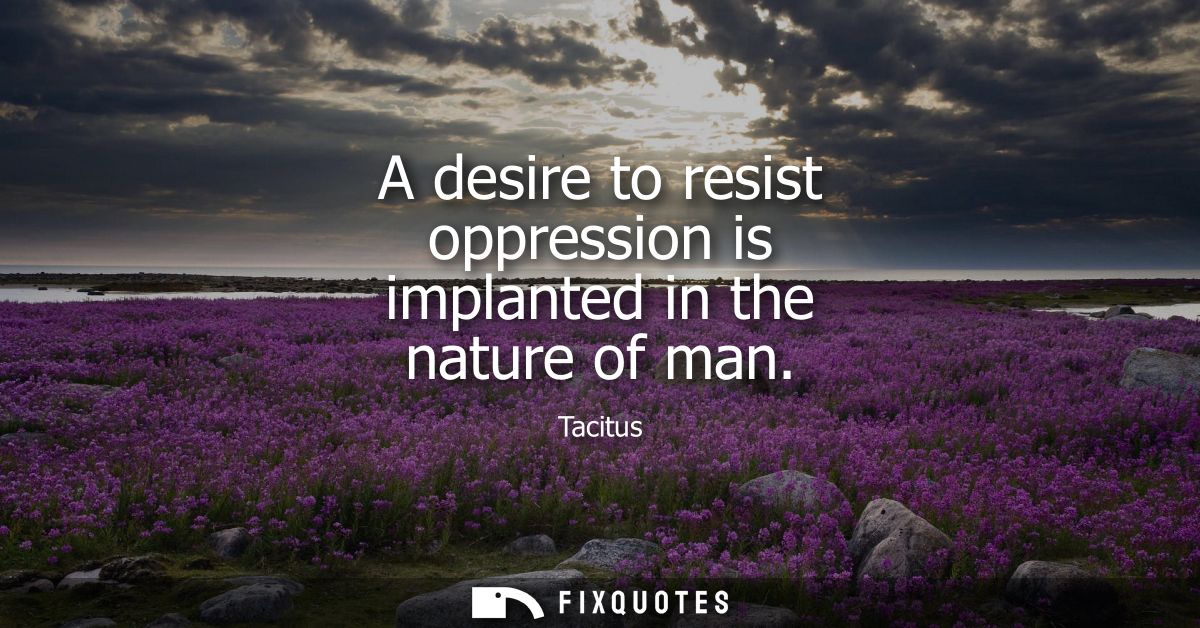
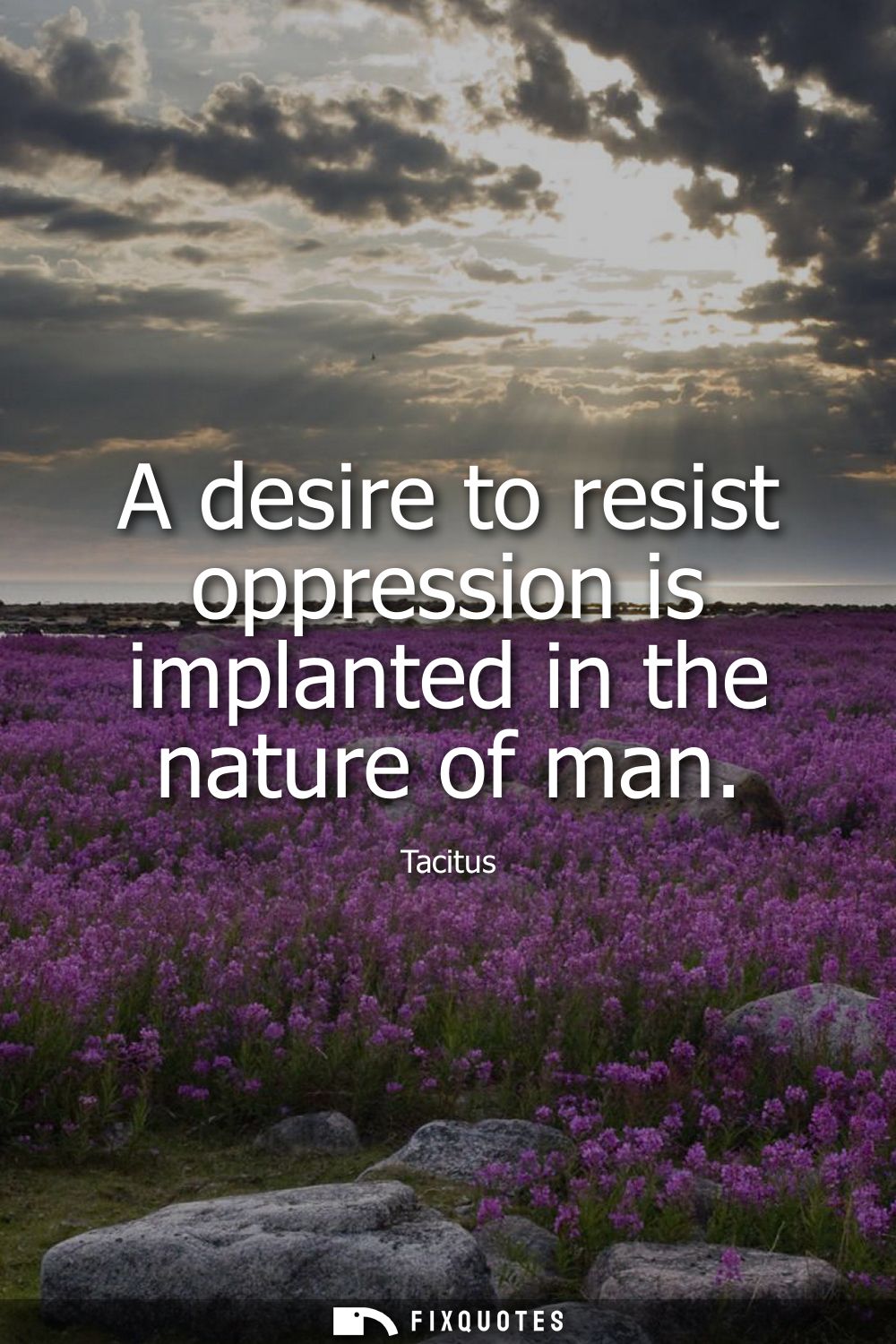
"A desire to resist oppression is implanted in the nature of man"
About this Quote
Tacitus isn’t flattering humanity so much as indicting the system. “Implanted” is the tell: resistance isn’t a fashionable opinion or a civic hobby; it’s something built into the body, a reflex that power can bruise but not cauterize. Coming from Rome’s great anatomist of tyranny, the line reads like a field note from an empire that ran on obedience while quietly breeding its opposite. You can hear the veteran historian’s dry amusement: the more carefully oppression is engineered, the more reliably it manufactures defiance.
The intent is double-edged. On the surface, it offers a sturdy, almost comforting anthropology: people push back. Underneath, Tacitus is warning rulers that coercion has a boomerang effect. Fear can discipline behavior, but it cannot erase the internal ledger of humiliation. Even when resistance fails publicly, it survives privately as memory, rumor, and grievance - the long fuse of revolt.
Context matters because Tacitus wrote after the Julio-Claudian and Flavian emperors, when informers, purges, and performative loyalty were everyday instruments of state. His histories repeatedly show how autocracy corrupts not just leaders but language itself: truth becomes dangerous, silence becomes a pose, praise becomes a survival tactic. Against that backdrop, the “desire” he names is less romantic heroism than a stubborn remainder of selfhood. Oppression tries to turn citizens into subjects; the implanted impulse to resist is the part that refuses the conversion, even if it has to wait generations to make itself legible.
The intent is double-edged. On the surface, it offers a sturdy, almost comforting anthropology: people push back. Underneath, Tacitus is warning rulers that coercion has a boomerang effect. Fear can discipline behavior, but it cannot erase the internal ledger of humiliation. Even when resistance fails publicly, it survives privately as memory, rumor, and grievance - the long fuse of revolt.
Context matters because Tacitus wrote after the Julio-Claudian and Flavian emperors, when informers, purges, and performative loyalty were everyday instruments of state. His histories repeatedly show how autocracy corrupts not just leaders but language itself: truth becomes dangerous, silence becomes a pose, praise becomes a survival tactic. Against that backdrop, the “desire” he names is less romantic heroism than a stubborn remainder of selfhood. Oppression tries to turn citizens into subjects; the implanted impulse to resist is the part that refuses the conversion, even if it has to wait generations to make itself legible.
Quote Details
| Topic | Freedom |
|---|---|
| Source | Later attribution: Treasury of Thought (Maturin Murray Ballou, 1894) modern compilationID: C4JZAAAAMAAJ
Evidence:
... A desire to resist oppression is implanted in the nature of man . -Tacitus . I never could believe that Providence had sent a few men into the world , ready booted and spurred to ride , and millions ready saddled and bridled to be ... |
| Cite |
Citation Formats
APA Style (7th ed.)
Tacitus. (2026, March 23). A desire to resist oppression is implanted in the nature of man. FixQuotes. https://fixquotes.com/quotes/a-desire-to-resist-oppression-is-implanted-in-the-107615/
Chicago Style
Tacitus. "A desire to resist oppression is implanted in the nature of man." FixQuotes. March 23, 2026. https://fixquotes.com/quotes/a-desire-to-resist-oppression-is-implanted-in-the-107615/.
MLA Style (9th ed.)
"A desire to resist oppression is implanted in the nature of man." FixQuotes, 23 Mar. 2026, https://fixquotes.com/quotes/a-desire-to-resist-oppression-is-implanted-in-the-107615/. Accessed 28 Mar. 2026.
More Quotes by Tacitus
Add to List