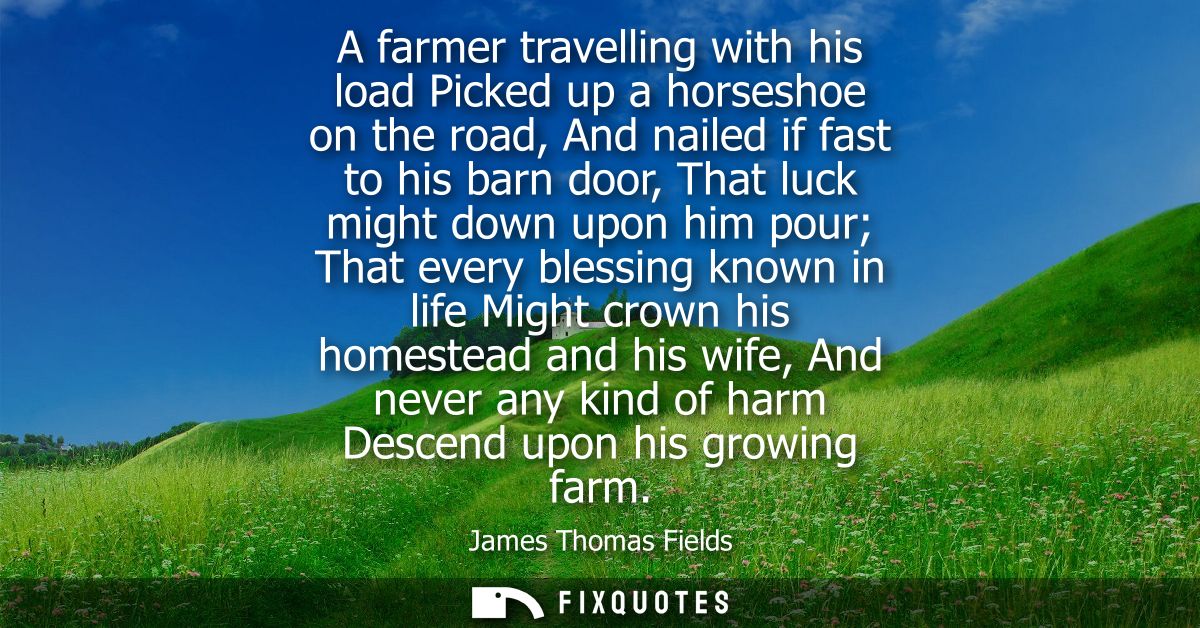
"A farmer travelling with his load Picked up a horseshoe on the road, And nailed if fast to his barn door, That luck might down upon him pour; That every blessing known in life Might crown his homestead and his wife, And never any kind of harm Descend upon his growing farm"
About this Quote
The intent is less to mock the farmer than to stage a familiar bargain between effort and fate. Notice how quickly the poem shifts from “luck” to a full inventory of domestic hopes: “homestead,” “wife,” “growing farm.” The horseshoe isn’t about random fortune; it’s a talisman guarding a fragile ideal of stability. Fields stacks “every blessing” against “never any kind of harm,” exposing the fantasy at the heart of prosperity: not merely gain, but immunity.
Context matters: as a publisher and literary tastemaker in 19th-century New England, Fields would have known the era’s tension between Enlightenment rationality and persistent rural belief. The poem leans into that tension without resolving it. By presenting superstition as practical housekeeping, it quietly suggests that modern life doesn’t abolish magical thinking; it just relocates it to whatever symbols we can afford and control. The barn door becomes a threshold between the uncontrollable outside world and the curated story people tell themselves to keep going.
Quote Details
| Topic | Family |
|---|---|
| Source | Later attribution: The Cyclopedia of Practical Quotations (Jehiel Keeler Hoyt, 1896) modern compilationID: Fp1GAQAAMAAJ
Evidence:
... A farmer travelling with his load Picked up a horseshoe on the road , And nailed it fast to his barn door , That luck might down upon him pour ; That every blessing known in life Bk . I. Might crown his homestead and his wife , And ... |
| Cite |
Citation Formats
APA Style (7th ed.)
Fields, James Thomas. (2026, January 14). A farmer travelling with his load Picked up a horseshoe on the road, And nailed if fast to his barn door, That luck might down upon him pour; That every blessing known in life Might crown his homestead and his wife, And never any kind of harm Descend upon his growing farm. FixQuotes. https://fixquotes.com/quotes/a-farmer-travelling-with-his-load-picked-up-a-21500/
Chicago Style
Fields, James Thomas. "A farmer travelling with his load Picked up a horseshoe on the road, And nailed if fast to his barn door, That luck might down upon him pour; That every blessing known in life Might crown his homestead and his wife, And never any kind of harm Descend upon his growing farm." FixQuotes. January 14, 2026. https://fixquotes.com/quotes/a-farmer-travelling-with-his-load-picked-up-a-21500/.
MLA Style (9th ed.)
"A farmer travelling with his load Picked up a horseshoe on the road, And nailed if fast to his barn door, That luck might down upon him pour; That every blessing known in life Might crown his homestead and his wife, And never any kind of harm Descend upon his growing farm." FixQuotes, 14 Jan. 2026, https://fixquotes.com/quotes/a-farmer-travelling-with-his-load-picked-up-a-21500/. Accessed 21 Mar. 2026.