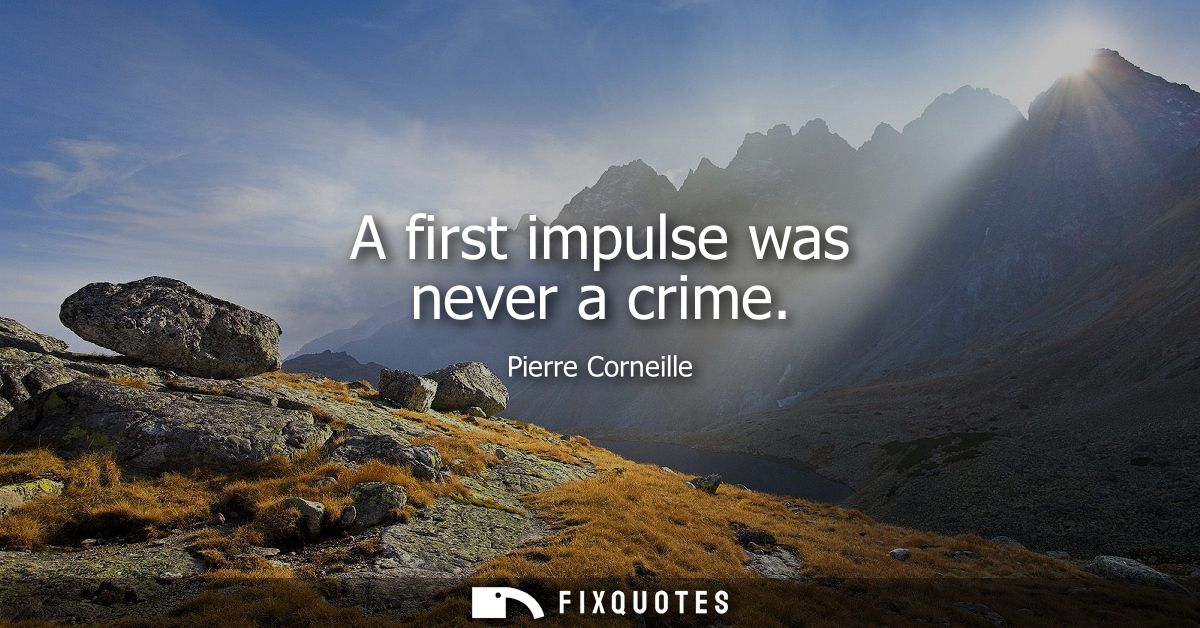
"A first impulse was never a crime"
About this Quote
“A first impulse was never a crime” is Corneille doing what great dramatists do best: putting a legal-sounding line in the mouth of emotion, then daring the audience to believe it. The phrasing borrows the vocabulary of courts and confessionals, but it’s really a defense brief for the human heart. “Impulse” suggests speed and heat; “crime” drags in punishment, surveillance, the state. Between them sits a moral loophole: you can be tempted, even briefly delighted by the temptation, without being guilty.
That’s the subtext of so much 17th-century French tragedy, where honor is public property and private feeling is a threat. Corneille’s characters are forever caught between what they want and what their rank requires, with every glance or hesitation potentially incriminating. By exonerating the “first” impulse, he draws a crucial line between involuntary spark and deliberate act. Desire becomes a reflex, not a decision. The line doesn’t deny ethics; it reassigns where ethics starts: not at the flash of wanting, but at what you do once you’ve noticed you want.
It’s also a clever psychological move. Calling the impulse “first” implies there will be a second, a third: the moment where self-control either shows up as virtue or collapses into plot. Corneille grants his characters a sliver of mercy so the drama can focus on the real battlefield - choice under pressure, and the humiliating fact that the noblest people still have nervous systems.
That’s the subtext of so much 17th-century French tragedy, where honor is public property and private feeling is a threat. Corneille’s characters are forever caught between what they want and what their rank requires, with every glance or hesitation potentially incriminating. By exonerating the “first” impulse, he draws a crucial line between involuntary spark and deliberate act. Desire becomes a reflex, not a decision. The line doesn’t deny ethics; it reassigns where ethics starts: not at the flash of wanting, but at what you do once you’ve noticed you want.
It’s also a clever psychological move. Calling the impulse “first” implies there will be a second, a third: the moment where self-control either shows up as virtue or collapses into plot. Corneille grants his characters a sliver of mercy so the drama can focus on the real battlefield - choice under pressure, and the humiliating fact that the noblest people still have nervous systems.
Quote Details
| Topic | Ethics & Morality |
|---|---|
| Source | Help us find the source |
| Cite |
Citation Formats
APA Style (7th ed.)
Corneille, Pierre. (2026, January 16). A first impulse was never a crime. FixQuotes. https://fixquotes.com/quotes/a-first-impulse-was-never-a-crime-94432/
Chicago Style
Corneille, Pierre. "A first impulse was never a crime." FixQuotes. January 16, 2026. https://fixquotes.com/quotes/a-first-impulse-was-never-a-crime-94432/.
MLA Style (9th ed.)
"A first impulse was never a crime." FixQuotes, 16 Jan. 2026, https://fixquotes.com/quotes/a-first-impulse-was-never-a-crime-94432/. Accessed 31 Mar. 2026.
More Quotes by Pierre
Add to List