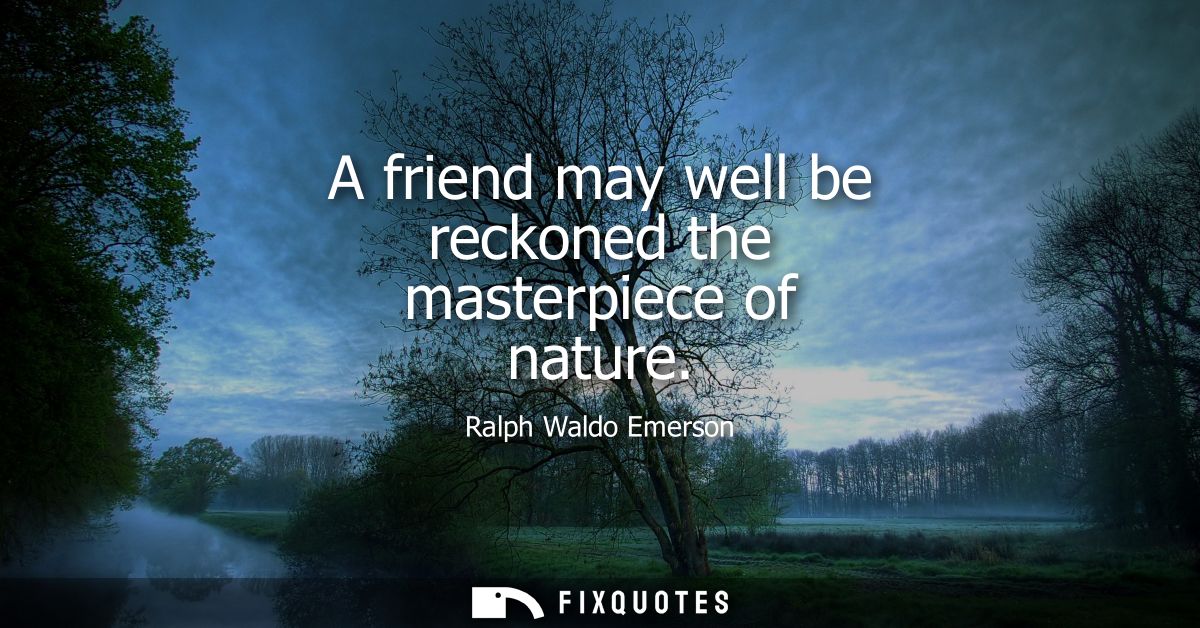
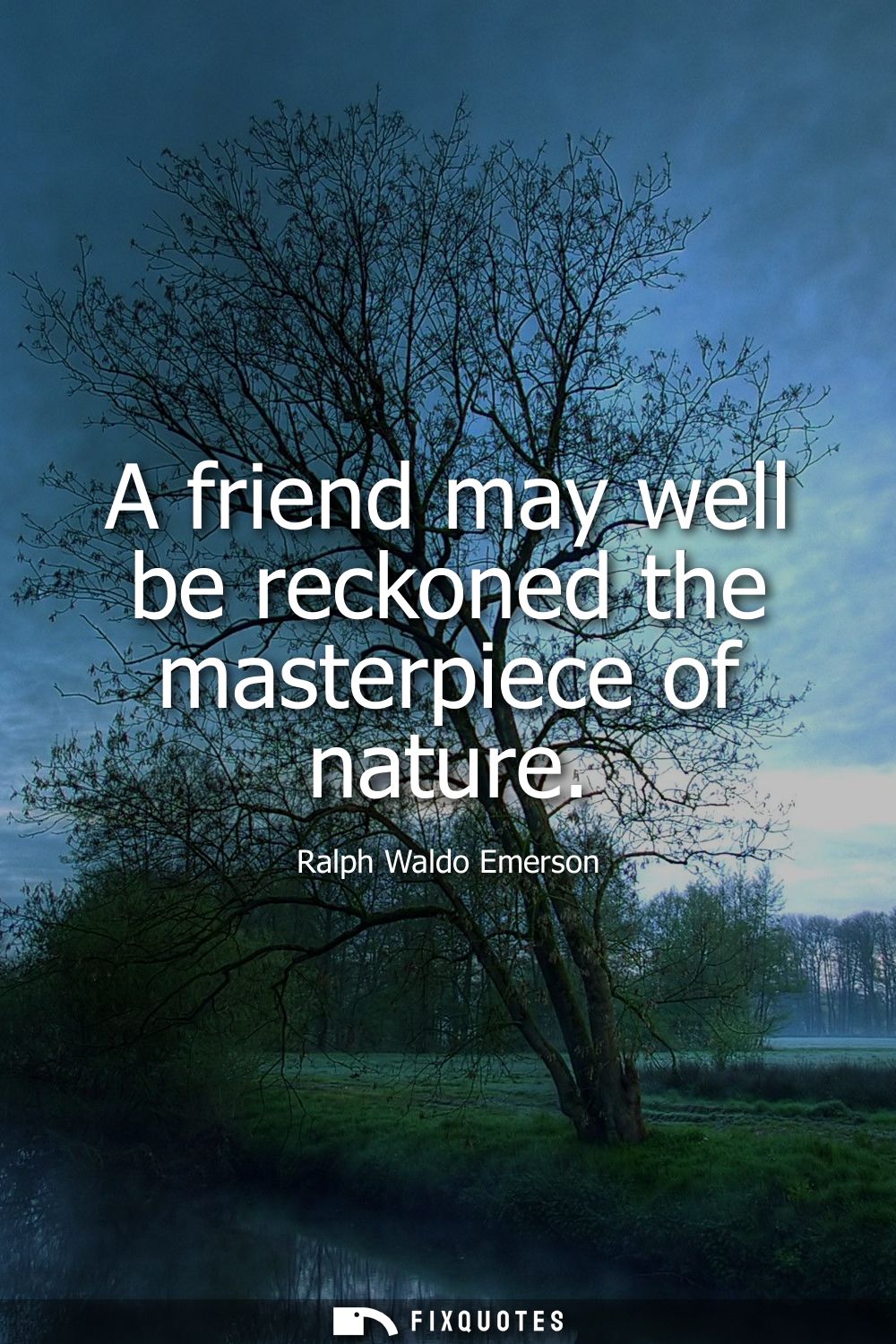
"A friend may well be reckoned the masterpiece of nature"
About this Quote
Emerson doesn’t call a friend a blessing, a comfort, or even a virtue. He calls a friend nature’s “masterpiece,” a word that upgrades friendship from private sentiment to apex achievement. That’s a very Emerson move: take something ordinary, then treat it as evidence that the universe isn’t just machinery but meaning. The line flatters friendship, sure, but it also smuggles in his core belief that the natural world is not merely scenery; it’s a moral and spiritual workshop whose finest product is a certain kind of human relation.
The subtext is selective, even demanding. A “friend” here isn’t the social-media category or the casual companion. Emerson’s ideal friendship is rare enough to deserve museum lighting: a person who meets you at the level of your best self, who refuses your performative masks, who makes you braver about your own thoughts. Calling that “nature’s” achievement is also a rebuke to the era’s stiff social hierarchies and transactional relationships. Status, inheritance, and institutional authority are demoted; an authentic bond outshines them all.
Context matters: Emerson is writing in a 19th-century America obsessed with self-reliance, reform, and the promise (and loneliness) of individualism. The quote works because it resolves that tension without denying it. Friendship becomes the proof that independence doesn’t have to curdle into isolation. Nature, in Emerson’s hands, is a radical alibi: if deep companionship feels almost impossibly pure, that’s because it’s the world at its most accomplished, not humanity at its most naive.
The subtext is selective, even demanding. A “friend” here isn’t the social-media category or the casual companion. Emerson’s ideal friendship is rare enough to deserve museum lighting: a person who meets you at the level of your best self, who refuses your performative masks, who makes you braver about your own thoughts. Calling that “nature’s” achievement is also a rebuke to the era’s stiff social hierarchies and transactional relationships. Status, inheritance, and institutional authority are demoted; an authentic bond outshines them all.
Context matters: Emerson is writing in a 19th-century America obsessed with self-reliance, reform, and the promise (and loneliness) of individualism. The quote works because it resolves that tension without denying it. Friendship becomes the proof that independence doesn’t have to curdle into isolation. Nature, in Emerson’s hands, is a radical alibi: if deep companionship feels almost impossibly pure, that’s because it’s the world at its most accomplished, not humanity at its most naive.
Quote Details
| Topic | Friendship |
|---|---|
| Source | Ralph Waldo Emerson, "Friendship", Essays: First Series (1841). |
| Cite |
Citation Formats
APA Style (7th ed.)
Emerson, Ralph Waldo. (2026, January 15). A friend may well be reckoned the masterpiece of nature. FixQuotes. https://fixquotes.com/quotes/a-friend-may-well-be-reckoned-the-masterpiece-of-26722/
Chicago Style
Emerson, Ralph Waldo. "A friend may well be reckoned the masterpiece of nature." FixQuotes. January 15, 2026. https://fixquotes.com/quotes/a-friend-may-well-be-reckoned-the-masterpiece-of-26722/.
MLA Style (9th ed.)
"A friend may well be reckoned the masterpiece of nature." FixQuotes, 15 Jan. 2026, https://fixquotes.com/quotes/a-friend-may-well-be-reckoned-the-masterpiece-of-26722/. Accessed 31 Mar. 2026.
More Quotes by Ralph
Add to List