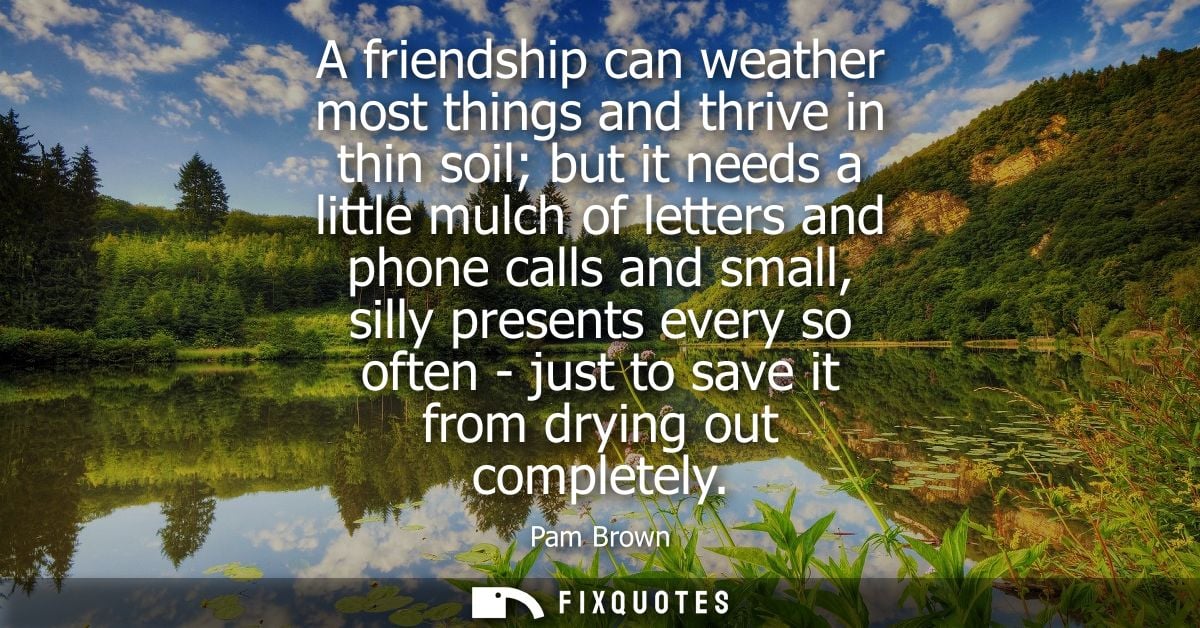
"A friendship can weather most things and thrive in thin soil; but it needs a little mulch of letters and phone calls and small, silly presents every so often - just to save it from drying out completely"
About this Quote
The subtext is a gentle rebuke to modern neglect disguised as respect. We like to say “no pressure” and “we’ll pick up where we left off,” as if friendship were a paused video. Brown offers a different ethic: low-stakes, frequent proof of care. Letters, calls, “small, silly presents” are not evidence of neediness; they’re a practical technology for keeping someone in your mental weather system. The “silly” matters because it removes the performance anxiety of big gestures. You don’t have to be eloquent, just present.
As a poet writing in a late-20th/early-21st-century culture of mobility and fractured attention, Brown captures the precariousness of adult intimacy: friendships don’t usually end in explosions; they desiccate. The quote works because it normalizes that risk without melodrama, then offers a tender, doable antidote.
Quote Details
| Topic | Friendship |
|---|---|
| Source | Help us find the source |
| Cite |
Citation Formats
APA Style (7th ed.)
Brown, Pam. (2026, January 16). A friendship can weather most things and thrive in thin soil; but it needs a little mulch of letters and phone calls and small, silly presents every so often - just to save it from drying out completely. FixQuotes. https://fixquotes.com/quotes/a-friendship-can-weather-most-things-and-thrive-125650/
Chicago Style
Brown, Pam. "A friendship can weather most things and thrive in thin soil; but it needs a little mulch of letters and phone calls and small, silly presents every so often - just to save it from drying out completely." FixQuotes. January 16, 2026. https://fixquotes.com/quotes/a-friendship-can-weather-most-things-and-thrive-125650/.
MLA Style (9th ed.)
"A friendship can weather most things and thrive in thin soil; but it needs a little mulch of letters and phone calls and small, silly presents every so often - just to save it from drying out completely." FixQuotes, 16 Jan. 2026, https://fixquotes.com/quotes/a-friendship-can-weather-most-things-and-thrive-125650/. Accessed 11 Mar. 2026.