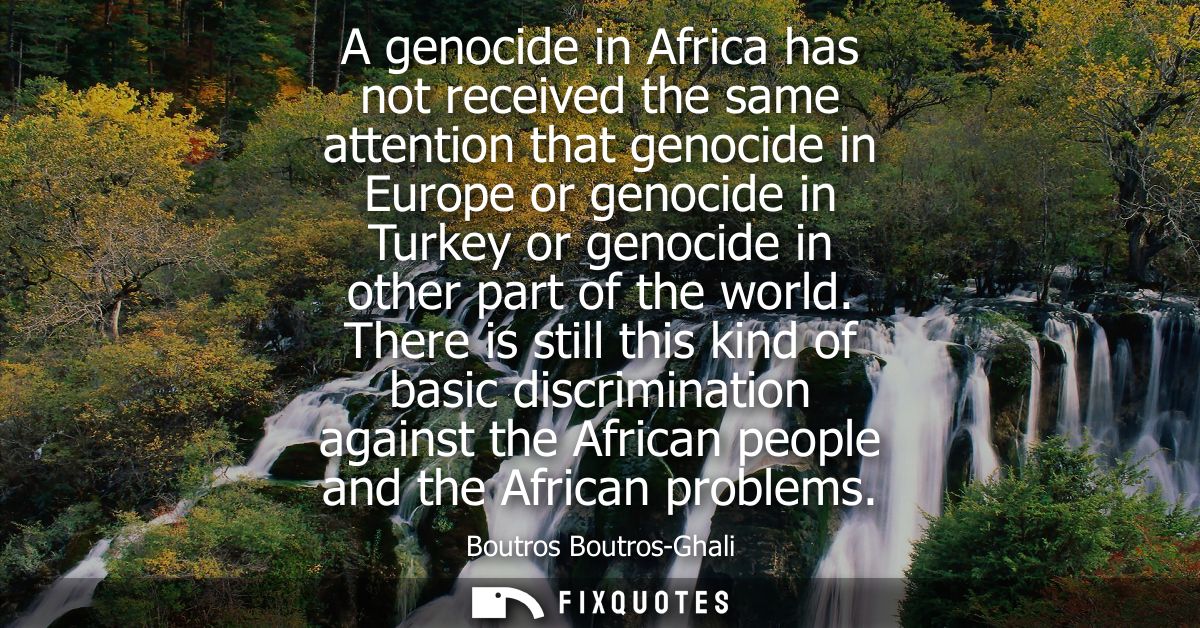
"A genocide in Africa has not received the same attention that genocide in Europe, or genocide in Turkey, or genocide in other part of the world. There is still this kind of basic discrimination against the African people and the African problems"
About this Quote
The subtext is aimed at the institutions he knew intimately: the UN Security Council, Western capitals, and the global press. “Attention” here is a proxy for everything that attention unlocks - emergency aid, sanctions, peacekeepers, sustained diplomatic pressure, even the permission to name a crime as a crime. When he says “basic discrimination,” he’s pointing to a deeper bias than policy disagreement: a default assumption that African catastrophes are perennial, complicated, and therefore tolerable. Not less tragic, just less urgent.
Context matters. Boutros-Ghali’s tenure as UN Secretary-General coincided with Rwanda and the broader post-Cold War moment when “never again” became a slogan with selective enforcement. The quote also carries a careful universality: he doesn’t claim Africa is uniquely victimized by genocide; he argues the world ranks genocides, and Africa is consistently ranked down. Coming from a public servant, not an activist, the line is a strategic moral rebuke - the kind that tries to shame power into consistency without pretending power is naturally consistent.
Quote Details
| Topic | Human Rights |
|---|---|
| Source | Help us find the source |
| Cite |
Citation Formats
APA Style (7th ed.)
Boutros-Ghali, Boutros. (2026, February 18). A genocide in Africa has not received the same attention that genocide in Europe, or genocide in Turkey, or genocide in other part of the world. There is still this kind of basic discrimination against the African people and the African problems. FixQuotes. https://fixquotes.com/quotes/a-genocide-in-africa-has-not-received-the-same-69899/
Chicago Style
Boutros-Ghali, Boutros. "A genocide in Africa has not received the same attention that genocide in Europe, or genocide in Turkey, or genocide in other part of the world. There is still this kind of basic discrimination against the African people and the African problems." FixQuotes. February 18, 2026. https://fixquotes.com/quotes/a-genocide-in-africa-has-not-received-the-same-69899/.
MLA Style (9th ed.)
"A genocide in Africa has not received the same attention that genocide in Europe, or genocide in Turkey, or genocide in other part of the world. There is still this kind of basic discrimination against the African people and the African problems." FixQuotes, 18 Feb. 2026, https://fixquotes.com/quotes/a-genocide-in-africa-has-not-received-the-same-69899/. Accessed 11 Mar. 2026.