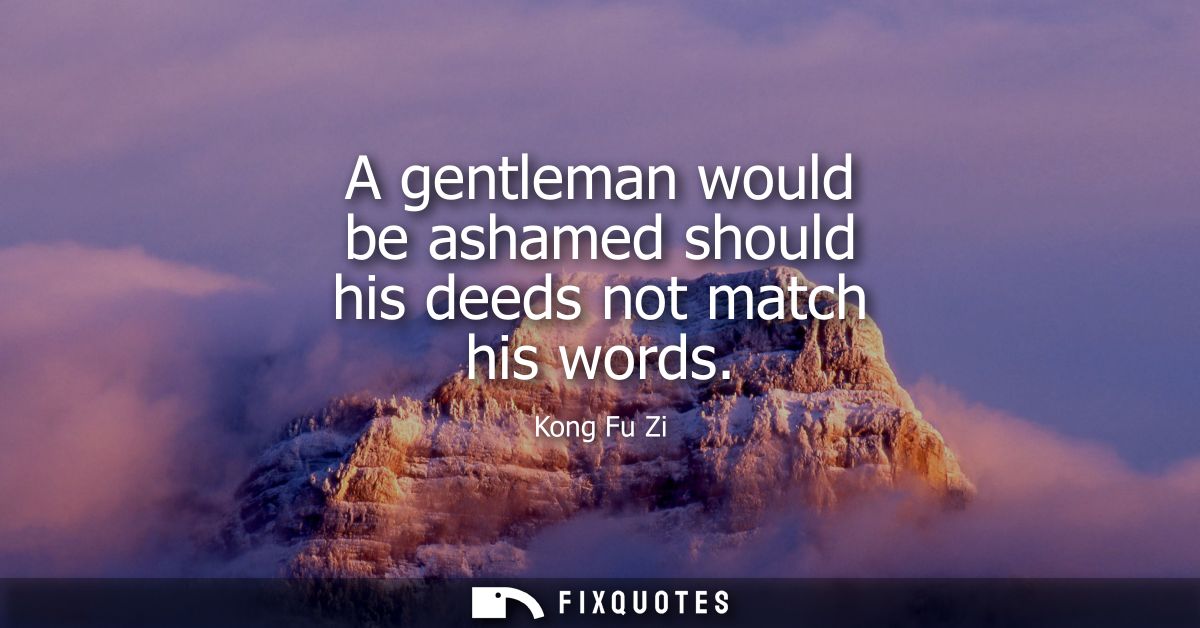
"A gentleman would be ashamed should his deeds not match his words"
About this Quote
Shame is doing the heavy lifting here, and Confucius knows it. He isn’t praising the “gentleman” (junzi) as some polished aristocrat with good manners; he’s using the figure as a moral technology: a person trained to feel an inner alarm when speech outruns conduct. In a culture where public reputation mattered and social roles were sticky, shame wasn’t merely personal embarrassment. It was a civic instrument, a pressure that keeps trust from evaporating in daily life.
The line targets a common human dodge: treating language as a substitute for action. Confucius is skeptical of verbal performance, especially the kind that wins admiration while leaving obligations untouched. A “gentleman” in this framework doesn’t avoid shame by perfecting rhetoric; he avoids it by narrowing the gap between promise and practice. The implicit warning is that words, unmoored from deeds, don’t just make you a hypocrite - they corrode the social fabric built on reliable ritual, duty, and reciprocity.
Context matters: Confucius lived in the Spring and Autumn period, when old political certainties were fracturing and competing states were normalizing betrayal as strategy. Against that churn, he offers a conservative-sounding but radical demand: legitimacy comes from embodied integrity, not claims, titles, or clever talk. The subtext is almost managerial: society can’t be repaired by slogans. It’s repaired when influential people make their language costly - when saying something commits you, and failing to follow through actually hurts.
The line targets a common human dodge: treating language as a substitute for action. Confucius is skeptical of verbal performance, especially the kind that wins admiration while leaving obligations untouched. A “gentleman” in this framework doesn’t avoid shame by perfecting rhetoric; he avoids it by narrowing the gap between promise and practice. The implicit warning is that words, unmoored from deeds, don’t just make you a hypocrite - they corrode the social fabric built on reliable ritual, duty, and reciprocity.
Context matters: Confucius lived in the Spring and Autumn period, when old political certainties were fracturing and competing states were normalizing betrayal as strategy. Against that churn, he offers a conservative-sounding but radical demand: legitimacy comes from embodied integrity, not claims, titles, or clever talk. The subtext is almost managerial: society can’t be repaired by slogans. It’s repaired when influential people make their language costly - when saying something commits you, and failing to follow through actually hurts.
Quote Details
| Topic | Honesty & Integrity |
|---|---|
| Source | Analects (Lunyu) — commonly rendered in English as “The superior man is ashamed to let his words outrun his deeds” (Chinese: 君子恥其言而過其行), attributed to Confucius (Kong Fuzi). |
| Cite |
Citation Formats
APA Style (7th ed.)
Zi, Kong Fu. (2026, January 15). A gentleman would be ashamed should his deeds not match his words. FixQuotes. https://fixquotes.com/quotes/a-gentleman-would-be-ashamed-should-his-deeds-not-162210/
Chicago Style
Zi, Kong Fu. "A gentleman would be ashamed should his deeds not match his words." FixQuotes. January 15, 2026. https://fixquotes.com/quotes/a-gentleman-would-be-ashamed-should-his-deeds-not-162210/.
MLA Style (9th ed.)
"A gentleman would be ashamed should his deeds not match his words." FixQuotes, 15 Jan. 2026, https://fixquotes.com/quotes/a-gentleman-would-be-ashamed-should-his-deeds-not-162210/. Accessed 28 Mar. 2026.
More Quotes by Kong
Add to List