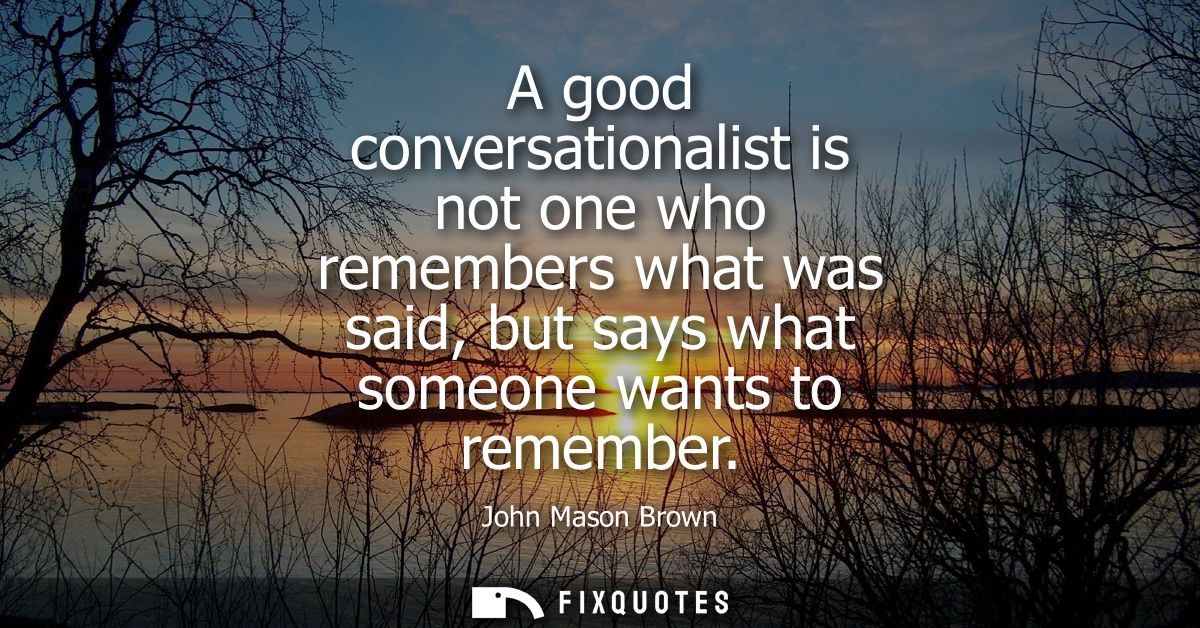
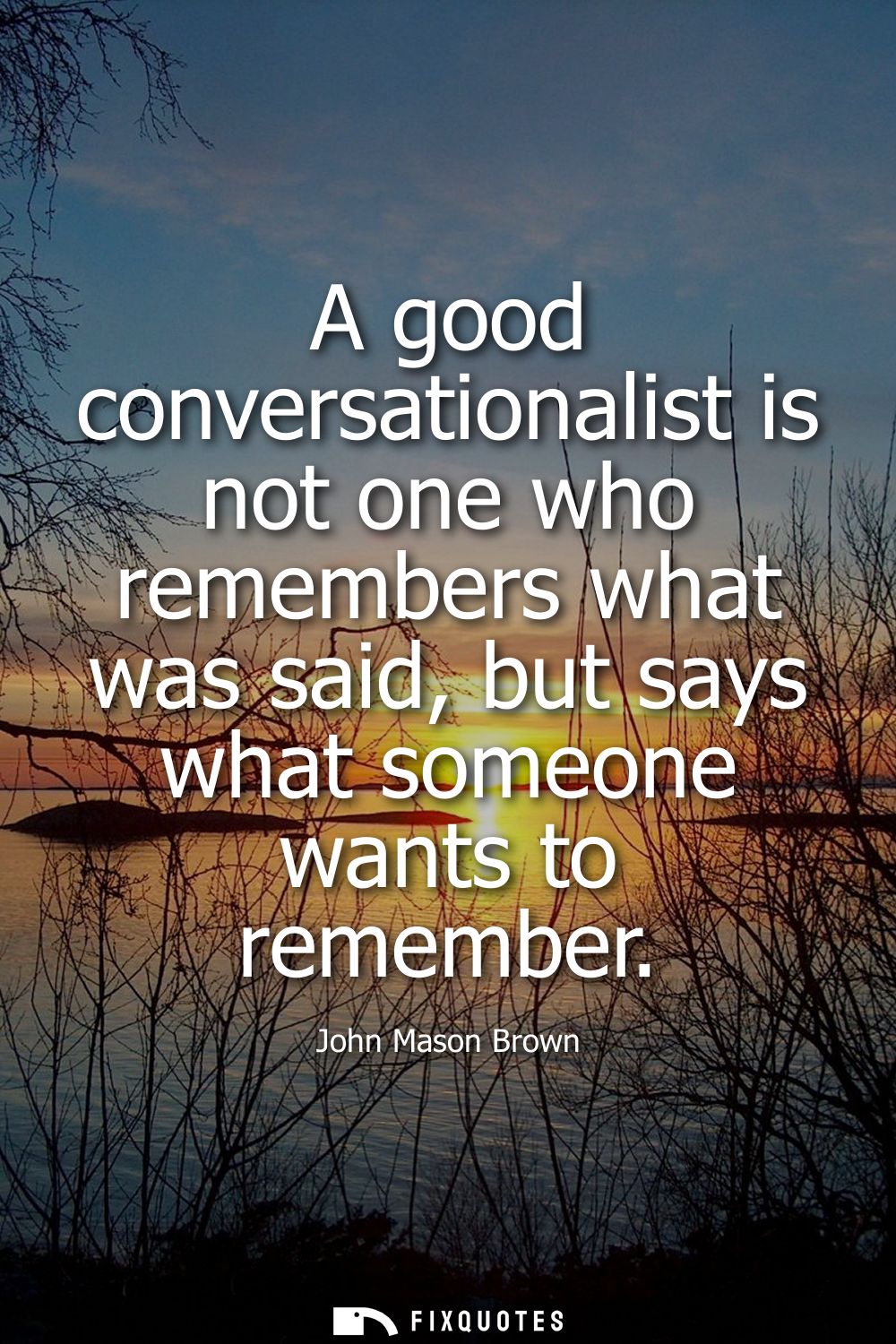
"A good conversationalist is not one who remembers what was said, but says what someone wants to remember"
About this Quote
The subtext is mildly cynical and very theatrical. A “good conversationalist” here is less an equal participant than an intuitive editor: someone who senses what another person is trying to become, then hands them a line that fits. It’s empathy, yes, but also performance and a hint of manipulation. You’re not just listening; you’re curating someone else’s memory, installing a quote in their head that they’ll later repeat as proof that the evening meant something.
Contextually, it’s a critic’s worldview smuggled into etiquette. Brown spent his life judging what endures - books, plays, cultural moments - and he applies the same standard to talk. Conversation becomes a miniature art form governed by afterlife, not accuracy. That’s why the phrasing lands: it swaps the usual moral metric (goodness as careful listening) for a cultural one (goodness as leaving a residue). In an era that prized salon wit and public intellect, Brown is naming the social power of a well-placed sentence: not to document what happened, but to give someone a memory worth keeping.
Quote Details
| Topic | Witty One-Liners |
|---|---|
| Source | Help us find the source |
| Cite |
Citation Formats
APA Style (7th ed.)
Brown, John Mason. (2026, January 16). A good conversationalist is not one who remembers what was said, but says what someone wants to remember. FixQuotes. https://fixquotes.com/quotes/a-good-conversationalist-is-not-one-who-remembers-128202/
Chicago Style
Brown, John Mason. "A good conversationalist is not one who remembers what was said, but says what someone wants to remember." FixQuotes. January 16, 2026. https://fixquotes.com/quotes/a-good-conversationalist-is-not-one-who-remembers-128202/.
MLA Style (9th ed.)
"A good conversationalist is not one who remembers what was said, but says what someone wants to remember." FixQuotes, 16 Jan. 2026, https://fixquotes.com/quotes/a-good-conversationalist-is-not-one-who-remembers-128202/. Accessed 30 Mar. 2026.