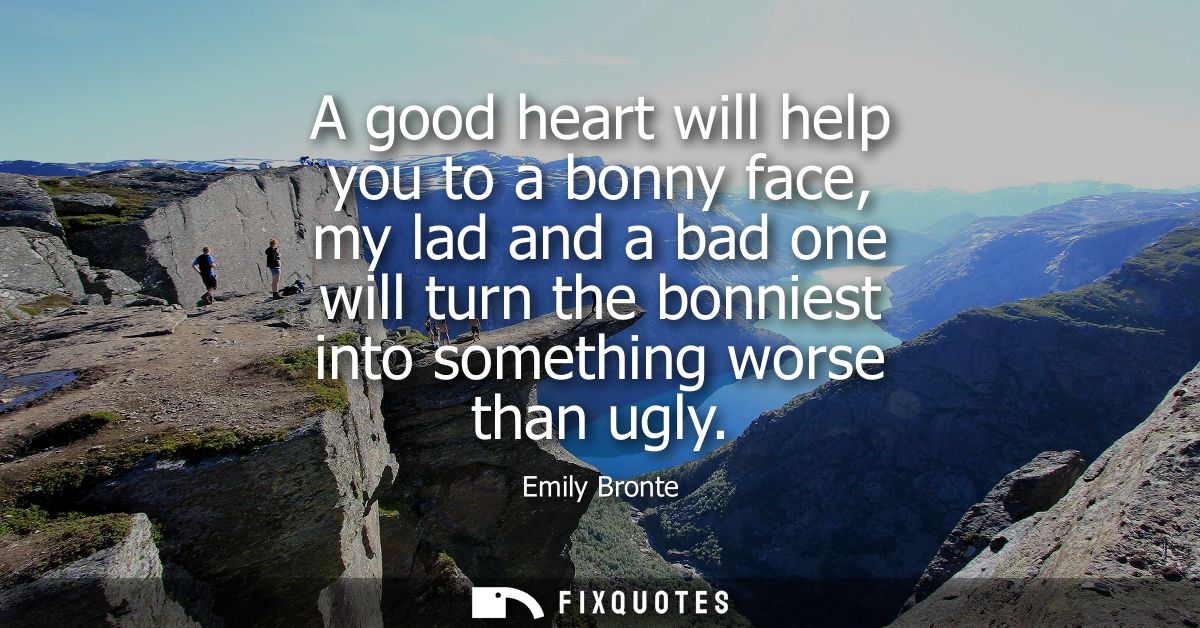
"A good heart will help you to a bonny face, my lad and a bad one will turn the bonniest into something worse than ugly"
About this Quote
Bronte takes the Victorian obsession with appearance and flips it into a moral boomerang: your face is not a fixed asset but a ledger, keeping score of what you carry inside. The line’s power comes from its sly mixture of tenderness and threat. “My lad” sounds like warmth, even mentorship; it lowers your guard. Then the sentence tightens into a verdict. A “good heart” doesn’t just make you nicer in some abstract way - it actively “helps you to a bonny face,” as if character is a kind of long-term skincare routine. The sting is the second clause: a bad heart won’t merely fail to beautify; it will “turn the bonniest” into “something worse than ugly.” Worse than ugly means morally repellent, the kind of ugliness that makes people recoil. Bronte isn’t describing bone structure. She’s describing what happens when cruelty, resentment, and vanity become visible through habit: the hard look, the sneer that arrives too quickly, the eyes that don’t soften.
The intent is corrective, almost parental, but it’s also a critique of social evaluation. In a world that sorts people by beauty and breeding, Bronte insists the real determinant is temperament - and she frames it as inevitable, not aspirational. The subtext is brutal: you can’t reliably fake goodness, because over time it leaks through your expressions and choices, staining even the “bonniest” surface.
In Bronte’s broader context - the Bronte sisters writing against polite fictions about gentility - it’s a compact ethic. Not piety, not manners, but the inner weather that shapes how you are seen and, eventually, what you become.
The intent is corrective, almost parental, but it’s also a critique of social evaluation. In a world that sorts people by beauty and breeding, Bronte insists the real determinant is temperament - and she frames it as inevitable, not aspirational. The subtext is brutal: you can’t reliably fake goodness, because over time it leaks through your expressions and choices, staining even the “bonniest” surface.
In Bronte’s broader context - the Bronte sisters writing against polite fictions about gentility - it’s a compact ethic. Not piety, not manners, but the inner weather that shapes how you are seen and, eventually, what you become.
Quote Details
| Topic | Kindness |
|---|---|
| Source | Help us find the source |
More Quotes by Emily
Add to List