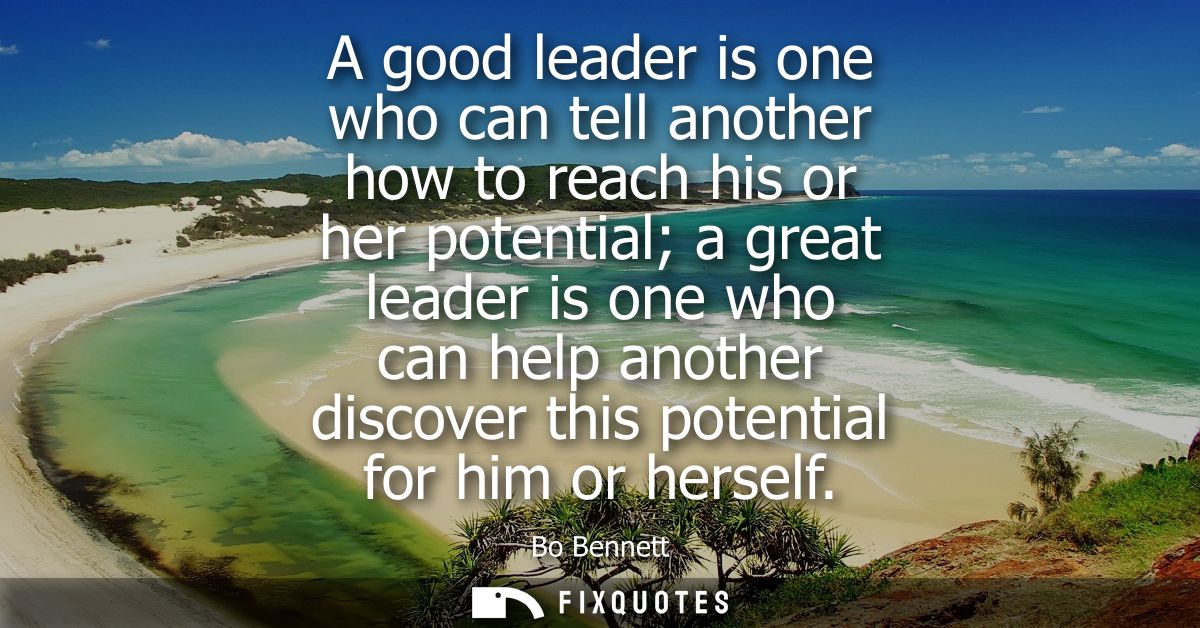
"A good leader is one who can tell another how to reach his or her potential; a great leader is one who can help another discover this potential for him or herself"
About this Quote
Bennett draws a clean line between management-as-instruction and leadership-as-architecture. The “good leader” in his framing is a competent navigator: someone who can map the route, name the milestones, diagnose what’s missing, and hand over a plan. Useful, even necessary. But the “great leader” doesn’t merely deliver answers; they design conditions where the other person generates their own. That shift matters because it relocates ownership. Potential, in this model, isn’t a resource the boss dispenses; it’s something the individual authorizes.
The subtext is a quiet critique of corporate heroics. Modern workplaces still reward the charismatic fixer who swoops in with the solution, yet Bennett implies that kind of leadership can infantilize. If your growth depends on someone else’s directions, you’re not developing judgment; you’re developing compliance. “Help another discover” signals coaching, questions over commands, feedback loops over performance theater. It’s not softer leadership; it’s leadership that scales, because it multiplies decision-makers instead of bottlenecking them under a single “visionary.”
Contextually, this fits late-20th/early-21st century business culture’s pivot toward empowerment language: mentorship, intrinsic motivation, and “unlocking” talent as a competitive advantage. The line also reads like an antidote to the metrics-and-micromanagement era, where potential gets reduced to KPIs and quarterly reviews. Bennett’s intent is aspirational but practical: the highest-value leader isn’t the one with the best answers, but the one who builds people capable of answering for themselves.
The subtext is a quiet critique of corporate heroics. Modern workplaces still reward the charismatic fixer who swoops in with the solution, yet Bennett implies that kind of leadership can infantilize. If your growth depends on someone else’s directions, you’re not developing judgment; you’re developing compliance. “Help another discover” signals coaching, questions over commands, feedback loops over performance theater. It’s not softer leadership; it’s leadership that scales, because it multiplies decision-makers instead of bottlenecking them under a single “visionary.”
Contextually, this fits late-20th/early-21st century business culture’s pivot toward empowerment language: mentorship, intrinsic motivation, and “unlocking” talent as a competitive advantage. The line also reads like an antidote to the metrics-and-micromanagement era, where potential gets reduced to KPIs and quarterly reviews. Bennett’s intent is aspirational but practical: the highest-value leader isn’t the one with the best answers, but the one who builds people capable of answering for themselves.
Quote Details
| Topic | Servant Leadership |
|---|---|
| Source | Help us find the source |
More Quotes by Bo
Add to List