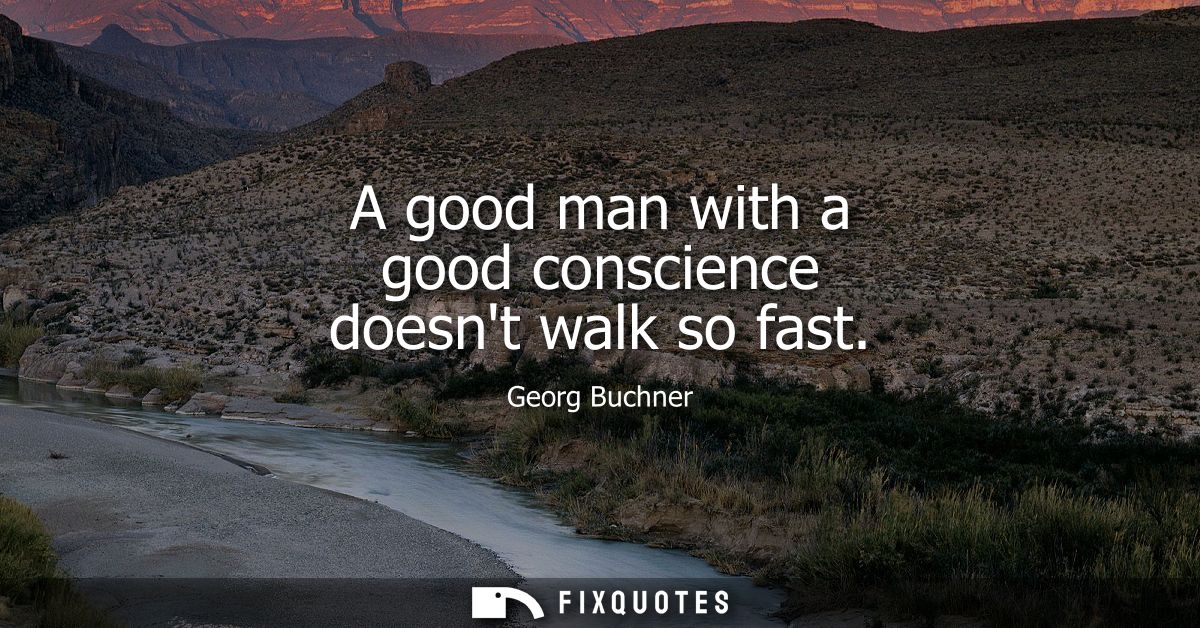
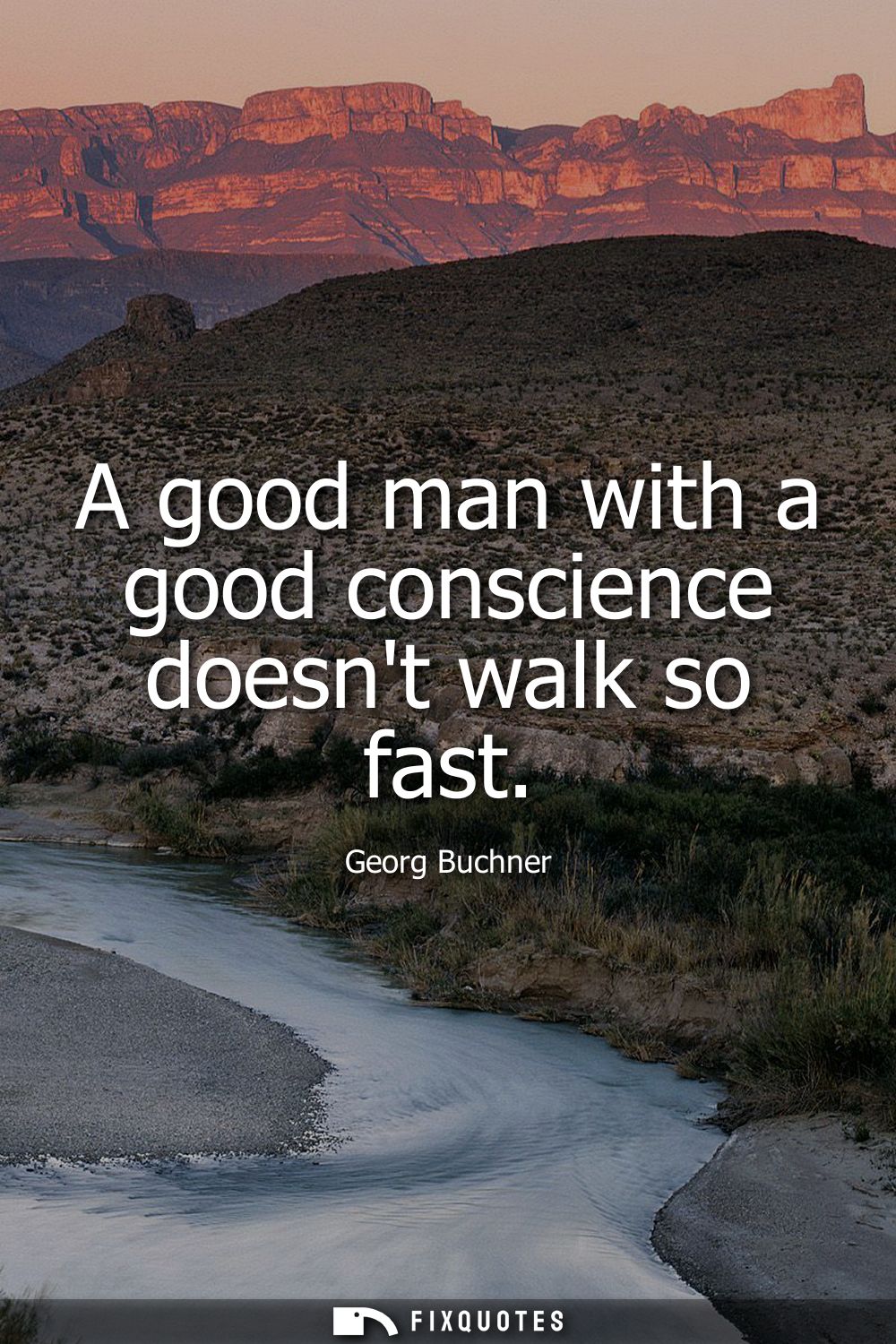
"A good man with a good conscience doesn't walk so fast"
About this Quote
There is a sly accusation tucked into the gait. "A good man with a good conscience doesn't walk so fast" turns morality into a physical tell: hurry as a symptom, speed as self-incrimination. Buchner, a dramatist with a revolutionary’s nerves, isn’t praising leisure; he’s mocking the kinds of innocence that need to outrun their own thoughts. The line works because it’s outwardly mild, almost proverbial, while quietly reframing conscience as a weight. If you have nothing to hide, why the scramble?
Buchner wrote in a Europe where authority moved quickly to punish and the vulnerable moved quickly to survive. That tension shadows the quote: the state’s pursuit, the citizen’s fear, the social reflex to treat calmness as virtue and urgency as guilt. The subtext is cruelly practical. The poor rush because time is rationed. The hunted rush because stillness is dangerous. So when someone claims that a "good" person doesn’t walk fast, Buchner is also exposing how moral judgments get built from optics. Respectability becomes a tempo.
As drama, it’s also a tool of suspicion: a line that can be spoken to needle, to interrogate, to justify distrust. It turns an ordinary gesture into evidence, the way oppressive systems do - translating behavior into confession. Buchner’s genius is compressing an entire social logic into a single observation: conscience is supposed to guide you, but in the wrong hands it becomes a pretext to police the body.
Buchner wrote in a Europe where authority moved quickly to punish and the vulnerable moved quickly to survive. That tension shadows the quote: the state’s pursuit, the citizen’s fear, the social reflex to treat calmness as virtue and urgency as guilt. The subtext is cruelly practical. The poor rush because time is rationed. The hunted rush because stillness is dangerous. So when someone claims that a "good" person doesn’t walk fast, Buchner is also exposing how moral judgments get built from optics. Respectability becomes a tempo.
As drama, it’s also a tool of suspicion: a line that can be spoken to needle, to interrogate, to justify distrust. It turns an ordinary gesture into evidence, the way oppressive systems do - translating behavior into confession. Buchner’s genius is compressing an entire social logic into a single observation: conscience is supposed to guide you, but in the wrong hands it becomes a pretext to police the body.
Quote Details
| Topic | Ethics & Morality |
|---|---|
| Source | Help us find the source |
| Cite | Cite this Quote |
Citation Formats
APA Style (7th ed.)
Buchner, Georg. (n.d.). A good man with a good conscience doesn't walk so fast. FixQuotes. https://fixquotes.com/quotes/a-good-man-with-a-good-conscience-doesnt-walk-so-55276/
Chicago Style
Buchner, Georg. "A good man with a good conscience doesn't walk so fast." FixQuotes. Accessed February 1, 2026. https://fixquotes.com/quotes/a-good-man-with-a-good-conscience-doesnt-walk-so-55276/.
MLA Style (9th ed.)
"A good man with a good conscience doesn't walk so fast." FixQuotes, https://fixquotes.com/quotes/a-good-man-with-a-good-conscience-doesnt-walk-so-55276/. Accessed 1 Feb. 2026.
More Quotes by Georg
Add to List