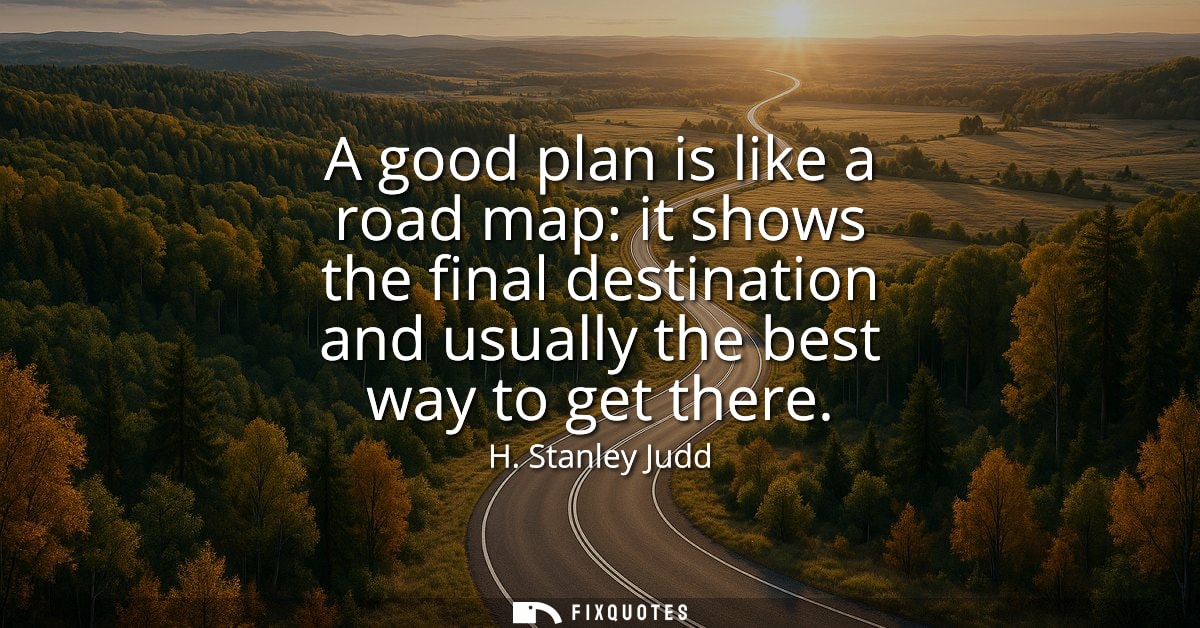
"A good plan is like a road map: it shows the final destination and usually the best way to get there"
About this Quote
The subtext is about limits. A map implies a fixed destination and a world that can be surveyed from above. That’s comforting, and it’s also a tell: Judd is speaking to readers who risk confusing motion with progress, busyness with direction. “Final destination” is the quiet rebuke to endless tinkering; “usually the best way” is the hedge that keeps the metaphor honest. Plans are probabilistic, not prophetic. They work because they’re revisable, because they assume detours and still insist on orientation.
Contextually, the quote sits in a long tradition of pragmatic self-help and managerial thinking: set a goal, plot steps, reduce waste. But its cultural resonance now is sharper. In an era of algorithmic “optimization” and hustle culture, Judd’s map metaphor deflates the fantasy of perfect control while defending the underrated virtue of premeditation. The line sells planning not as rigidity, but as a way to stop wandering on purpose.
Quote Details
| Topic | Goal Setting |
|---|---|
| Source | Later attribution: The Curriculum: Gallimaufry to coherence (Mary Myatt, 2018) modern compilationISBN: 9781398383630 · ID: SJWhEAAAQBAJ
Evidence: ... A good plan is like a road map: it shows the final destination and usually the best way to get there.' H. Stanley Judd Planning is critical and it is fundamental in providing the structure and architecture for pupils' learning. Results ... Other candidates (1) Elvis Presley (H. Stanley Judd) compilation39.0% k he had put out like three records that i had heard the girls were there too and you couldnt really hear because the... |
| Featured | This quote was our Quote of the Day on July 15, 2025 |
| Cite |
Citation Formats
APA Style (7th ed.)
Judd, H. Stanley. (2026, January 11). A good plan is like a road map: it shows the final destination and usually the best way to get there. FixQuotes. https://fixquotes.com/quotes/a-good-plan-is-like-a-road-map-it-shows-the-final-77244/
Chicago Style
Judd, H. Stanley. "A good plan is like a road map: it shows the final destination and usually the best way to get there." FixQuotes. January 11, 2026. https://fixquotes.com/quotes/a-good-plan-is-like-a-road-map-it-shows-the-final-77244/.
MLA Style (9th ed.)
"A good plan is like a road map: it shows the final destination and usually the best way to get there." FixQuotes, 11 Jan. 2026, https://fixquotes.com/quotes/a-good-plan-is-like-a-road-map-it-shows-the-final-77244/. Accessed 27 Mar. 2026.