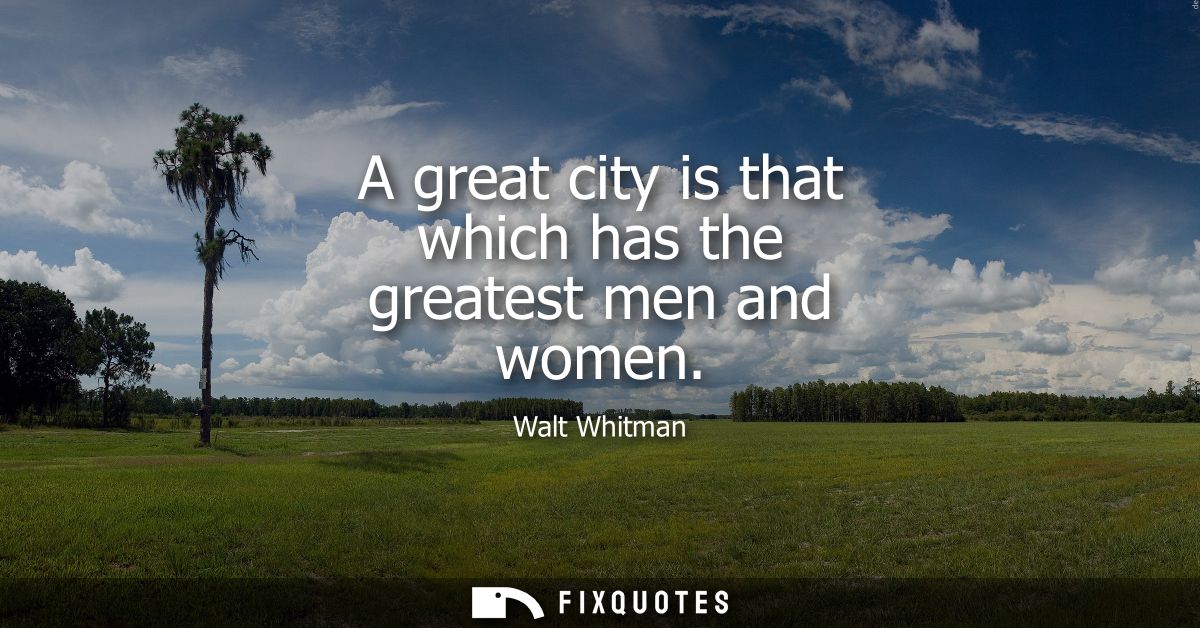
"A great city is that which has the greatest men and women"
About this Quote
Whitman ties civic greatness to human greatness, then quietly detonates the usual brag sheet. Not harbors, stockyards, cathedrals, or conquering armies, but “the greatest men and women” - a metric that turns the city from a skyline into a moral ecosystem. The line works because it sounds like boosterism while refusing boosterism’s favorite proof: monuments. He’s not praising infrastructure; he’s challenging it. If a city is “great,” he implies, it must be a factory for largeness of spirit.
The subtext is classic Whitman: democracy as a lived, bodily, plural thing. “Men and women” is doing real work here. In the 19th century, public greatness was routinely coded male; Whitman’s pairing insists that civic excellence can’t be measured while half the population is treated as background. It also hints at his broader poetic project - the elevation of ordinary people into a shared national epic. “Greatest” in Whitman is less about elite pedigree than about amplitude: generosity, self-reliance, comradeship, the willingness to contain contradictions without turning them into purity tests.
Context matters. Whitman is writing in an America swelling with cities, immigration, industry, and inequality, where urban “progress” could mean exploitation dressed up as modernity. His definition is both aspiration and warning: a city that produces wealth but not dignified lives is, by his standard, a failure. The line flatters no one; it sets a bar that can’t be met by branding. It demands citizens worthy of the place - and places worthy of their citizens.
The subtext is classic Whitman: democracy as a lived, bodily, plural thing. “Men and women” is doing real work here. In the 19th century, public greatness was routinely coded male; Whitman’s pairing insists that civic excellence can’t be measured while half the population is treated as background. It also hints at his broader poetic project - the elevation of ordinary people into a shared national epic. “Greatest” in Whitman is less about elite pedigree than about amplitude: generosity, self-reliance, comradeship, the willingness to contain contradictions without turning them into purity tests.
Context matters. Whitman is writing in an America swelling with cities, immigration, industry, and inequality, where urban “progress” could mean exploitation dressed up as modernity. His definition is both aspiration and warning: a city that produces wealth but not dignified lives is, by his standard, a failure. The line flatters no one; it sets a bar that can’t be met by branding. It demands citizens worthy of the place - and places worthy of their citizens.
Quote Details
| Topic | Wisdom |
|---|---|
| Source | Verified source: Leaves of Grass (Walt Whitman, 1856)
Evidence: The great city is that which has the greatest man or woman; If it be a few ragged huts, it is still the greatest city in the whole world. (Poem: "Song of the Broad-Axe" (first published as "Broad-Axe Poem" in the 1856 edition); later appears in the 1867 edition on p. 174 in the Whitman Archive facsimile). Primary-source match is in Whitman’s poem later titled "Song of the Broad-Axe." The wording commonly circulated online (“A great city is that which has the greatest men and women”) is a later/normalized variant. In Whitman’s text the line reads “The great city … greatest man or woman” (singular, with “or”), followed immediately by the “few ragged huts” line. The Walt Whitman Archive encyclopedia entry states the poem was first published in the 1856 edition of Leaves of Grass (as “Broad-Axe Poem”). For a page reference in a specific edition: in the Whitman Archive’s facsimile/transcription of the 1867 Leaves of Grass, the quoted lines appear with the marker “[ begin page 174 ]” within the poem. See: https://whitmanarchive.org/item/ppp.00473_00543 (lines around the “begin page 174” marker). Other candidates (1) In Re Walt Whitman (Horace Traubel, Richard Maurice Bucke..., 1893) compilation95.0% ... A great city is that which has the greatest men and women , If it be a few ragged huts it is still the greatest c... |
| Cite |
Citation Formats
APA Style (7th ed.)
Whitman, Walt. (2026, February 27). A great city is that which has the greatest men and women. FixQuotes. https://fixquotes.com/quotes/a-great-city-is-that-which-has-the-greatest-men-26769/
Chicago Style
Whitman, Walt. "A great city is that which has the greatest men and women." FixQuotes. February 27, 2026. https://fixquotes.com/quotes/a-great-city-is-that-which-has-the-greatest-men-26769/.
MLA Style (9th ed.)
"A great city is that which has the greatest men and women." FixQuotes, 27 Feb. 2026, https://fixquotes.com/quotes/a-great-city-is-that-which-has-the-greatest-men-26769/. Accessed 8 Mar. 2026.
More Quotes by Walt
Add to List