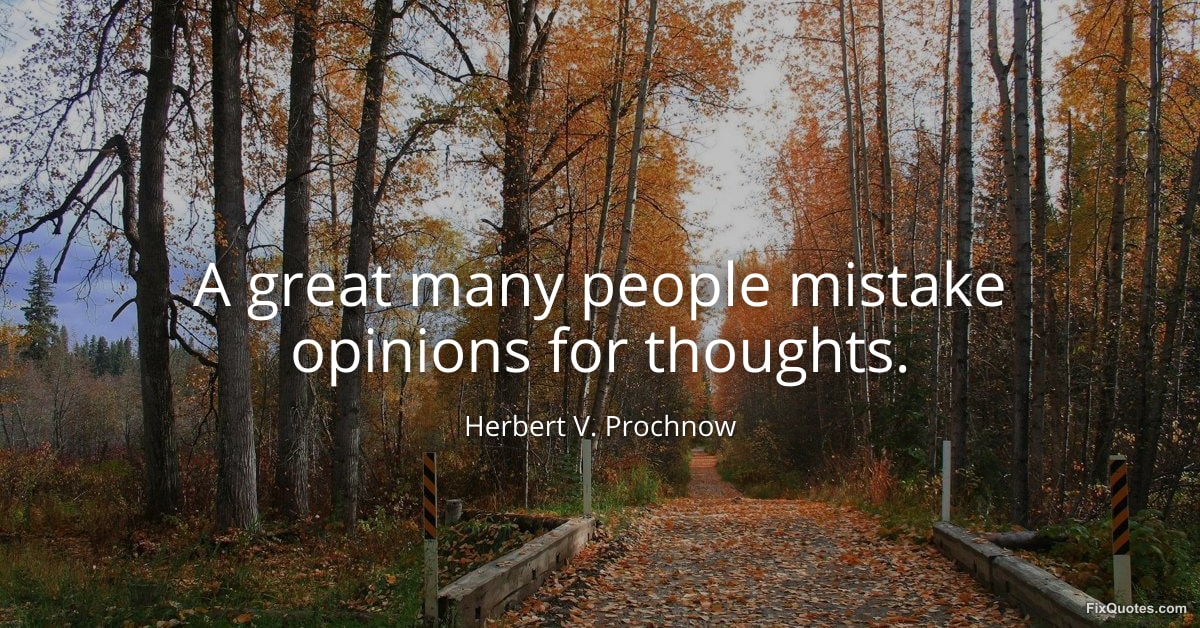
"A great many people mistake opinions for thoughts"
About this Quote
In one clean jab, Prochnow exposes a polite delusion at the heart of civic and corporate life: that having a stance counts as having done the work. The line isn’t anti-opinion; it’s anti-laziness. An opinion is often a flag you plant to signal identity, tribe, or temperament. A thought is closer to an engine: it has moving parts, it shows its workings, it can be tested, revised, and sometimes abandoned. Prochnow’s business-world sensibility matters here. In boardrooms and policy meetings, confident assertions can masquerade as analysis, especially when time is scarce and incentives reward certainty over scrutiny. His sentence quietly calls out how status and volume can substitute for reasoning.
The subtext is about discipline. Thoughts require friction: weighing trade-offs, interrogating assumptions, running numbers, listening to inconvenient data, entertaining the possibility that you’re wrong. Opinions, by contrast, are cheap and often prepackaged; they arrive fully formed from headlines, ideology, or a single vivid anecdote. Prochnow’s phrasing - “mistake” - is key: he frames it as an error anyone can make, not a moral failing. That keeps the critique usable rather than sanctimonious, which is exactly the kind of language that travels in professional settings.
Contextually, Prochnow lived through an era when modern management, mass media, and public relations matured into dominant forces. His warning anticipates today’s attention economy: hot takes proliferate; actual thinking is slower, quieter, and less performative. The quote works because it’s a diagnostic you can apply instantly to yourself mid-sentence: am I reasoning, or just declaring?
The subtext is about discipline. Thoughts require friction: weighing trade-offs, interrogating assumptions, running numbers, listening to inconvenient data, entertaining the possibility that you’re wrong. Opinions, by contrast, are cheap and often prepackaged; they arrive fully formed from headlines, ideology, or a single vivid anecdote. Prochnow’s phrasing - “mistake” - is key: he frames it as an error anyone can make, not a moral failing. That keeps the critique usable rather than sanctimonious, which is exactly the kind of language that travels in professional settings.
Contextually, Prochnow lived through an era when modern management, mass media, and public relations matured into dominant forces. His warning anticipates today’s attention economy: hot takes proliferate; actual thinking is slower, quieter, and less performative. The quote works because it’s a diagnostic you can apply instantly to yourself mid-sentence: am I reasoning, or just declaring?
Quote Details
| Topic | Reason & Logic |
|---|---|
| Source | Later attribution: What I Would Have Said... (Thomas R. Wallin, 2013) modern compilationISBN: 9781483618494 · ID: IY2TAwAAQBAJ
Evidence:
Thomas R. Wallin. 34 " A Great Many People Mistake Opinions For Thoughts , " Herbert V. Prochnow , Reader's Digest , August 1996 . Webster defines “ opinion ” as “ what one thinks ; belief not so strong as knowledge ; judgment ... |
| Cite |
Citation Formats
APA Style (7th ed.)
Prochnow, Herbert V. (2026, February 19). A great many people mistake opinions for thoughts. FixQuotes. https://fixquotes.com/quotes/a-great-many-people-mistake-opinions-for-thoughts-173145/
Chicago Style
Prochnow, Herbert V. "A great many people mistake opinions for thoughts." FixQuotes. February 19, 2026. https://fixquotes.com/quotes/a-great-many-people-mistake-opinions-for-thoughts-173145/.
MLA Style (9th ed.)
"A great many people mistake opinions for thoughts." FixQuotes, 19 Feb. 2026, https://fixquotes.com/quotes/a-great-many-people-mistake-opinions-for-thoughts-173145/. Accessed 5 Apr. 2026.
More Quotes by Herbert
Add to List