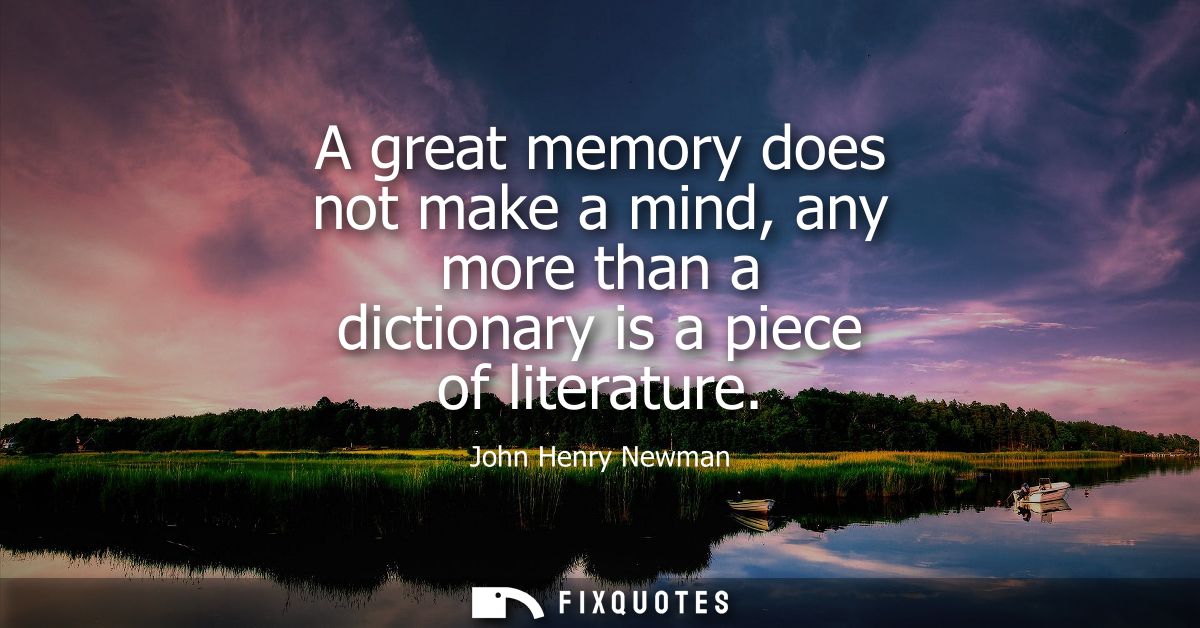
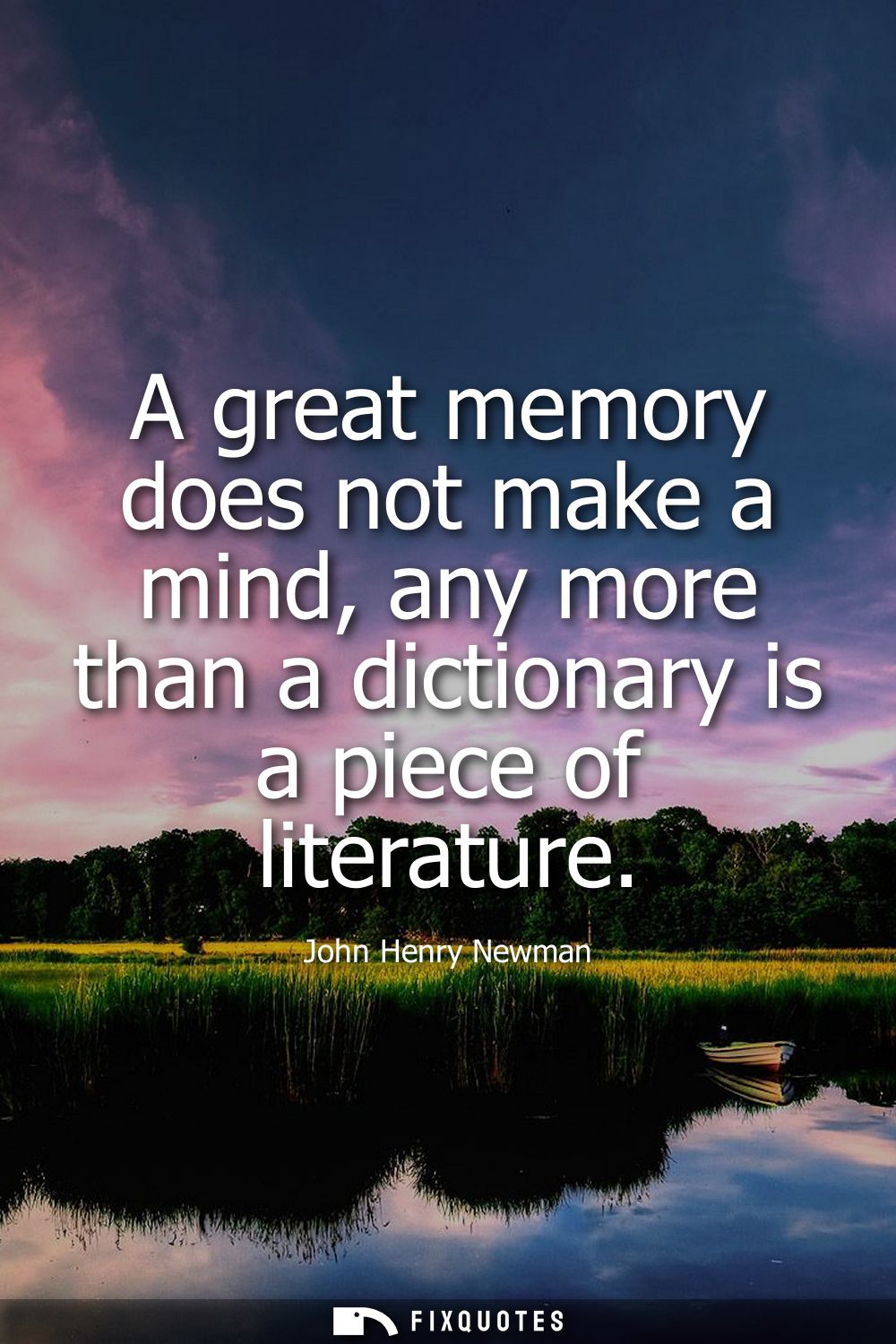
"A great memory does not make a mind, any more than a dictionary is a piece of literature"
About this Quote
The intent is corrective, almost pastoral. As a clergyman and a major voice in 19th-century debates about liberal education, Newman is defending the mind as an active faculty: interpreting, weighing, synthesizing, discerning ends. The subtext is a warning about credentialism before the term existed. A person can be a walking index and still be intellectually thin: quick to recall, slow to understand; fluent in references, empty of insight.
The line also carries a quiet spiritual edge. Newman isn’t only talking about classroom habits; he’s pushing back against a culture that confuses outward signs (knowledge hoarded, doctrines recited) with inward formation. Memory can serve truth, but it can also mimic it, offering the comfort of certainty without the labor of thinking.
It works because the comparison is humiliating in the gentlest way: you don’t have to hate dictionaries to recognize they aren’t art. Newman makes the reader feel the gap between data and meaning, then leaves you nowhere to hide except in the harder work of becoming a mind.
Quote Details
| Topic | Wisdom |
|---|---|
| Source | Help us find the source |
| Cite |
Citation Formats
APA Style (7th ed.)
Newman, John Henry. (2026, January 18). A great memory does not make a mind, any more than a dictionary is a piece of literature. FixQuotes. https://fixquotes.com/quotes/a-great-memory-does-not-make-a-mind-any-more-than-5636/
Chicago Style
Newman, John Henry. "A great memory does not make a mind, any more than a dictionary is a piece of literature." FixQuotes. January 18, 2026. https://fixquotes.com/quotes/a-great-memory-does-not-make-a-mind-any-more-than-5636/.
MLA Style (9th ed.)
"A great memory does not make a mind, any more than a dictionary is a piece of literature." FixQuotes, 18 Jan. 2026, https://fixquotes.com/quotes/a-great-memory-does-not-make-a-mind-any-more-than-5636/. Accessed 6 Mar. 2026.