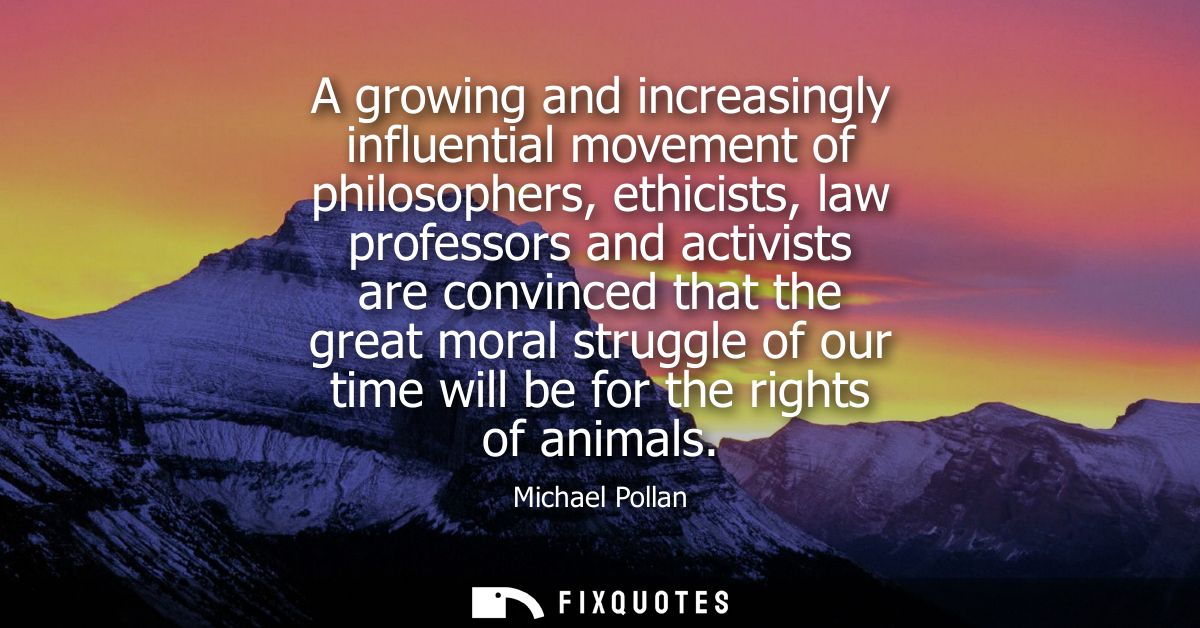
"A growing and increasingly influential movement of philosophers, ethicists, law professors and activists are convinced that the great moral struggle of our time will be for the rights of animals"
About this Quote
The phrase “great moral struggle of our time” is an intentional provocation. Pollan borrows the cadence we associate with civil rights, feminism, anti-apartheid movements-the big chapters of modern moral self-congratulation-and aims it at a target many readers still treat as dinner. The subtext is accusatory without being explicit: if this really becomes the era’s defining ethical fight, then our everyday habits will look, in retrospect, less like personal preference and more like normalized harm.
Context matters. Pollan emerged as a leading voice in critiquing industrial food systems, where animal suffering is not incidental but optimized. So “rights of animals” here isn’t an abstract seminar topic; it’s a forecast about how supply chains, legal definitions of personhood, and consumer identity could collide. He’s also hedging with “are convinced,” a rhetorical move that keeps him from preaching while still validating the movement’s trajectory.
The sentence works because it reframes the debate from taste to history: not whether you eat meat, but which side of the moral record you’ll land on once the culture catches up.
Quote Details
| Topic | Ethics & Morality |
|---|---|
| Source | Help us find the source |
| Cite |
Citation Formats
APA Style (7th ed.)
Pollan, Michael. (2026, January 17). A growing and increasingly influential movement of philosophers, ethicists, law professors and activists are convinced that the great moral struggle of our time will be for the rights of animals. FixQuotes. https://fixquotes.com/quotes/a-growing-and-increasingly-influential-movement-74784/
Chicago Style
Pollan, Michael. "A growing and increasingly influential movement of philosophers, ethicists, law professors and activists are convinced that the great moral struggle of our time will be for the rights of animals." FixQuotes. January 17, 2026. https://fixquotes.com/quotes/a-growing-and-increasingly-influential-movement-74784/.
MLA Style (9th ed.)
"A growing and increasingly influential movement of philosophers, ethicists, law professors and activists are convinced that the great moral struggle of our time will be for the rights of animals." FixQuotes, 17 Jan. 2026, https://fixquotes.com/quotes/a-growing-and-increasingly-influential-movement-74784/. Accessed 12 Feb. 2026.