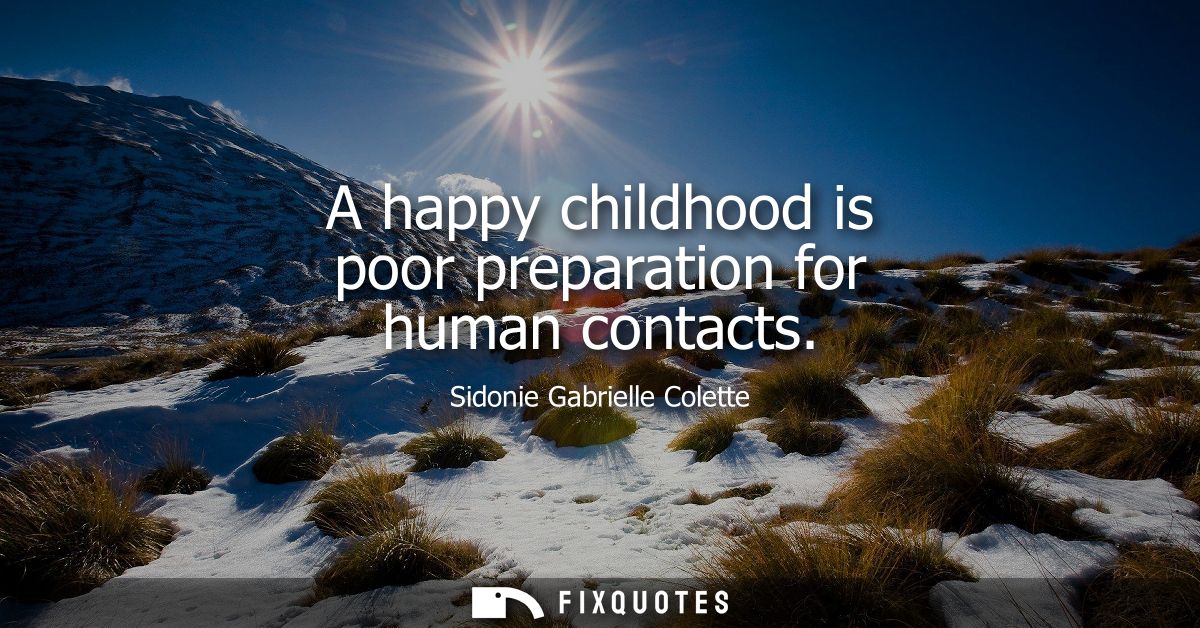
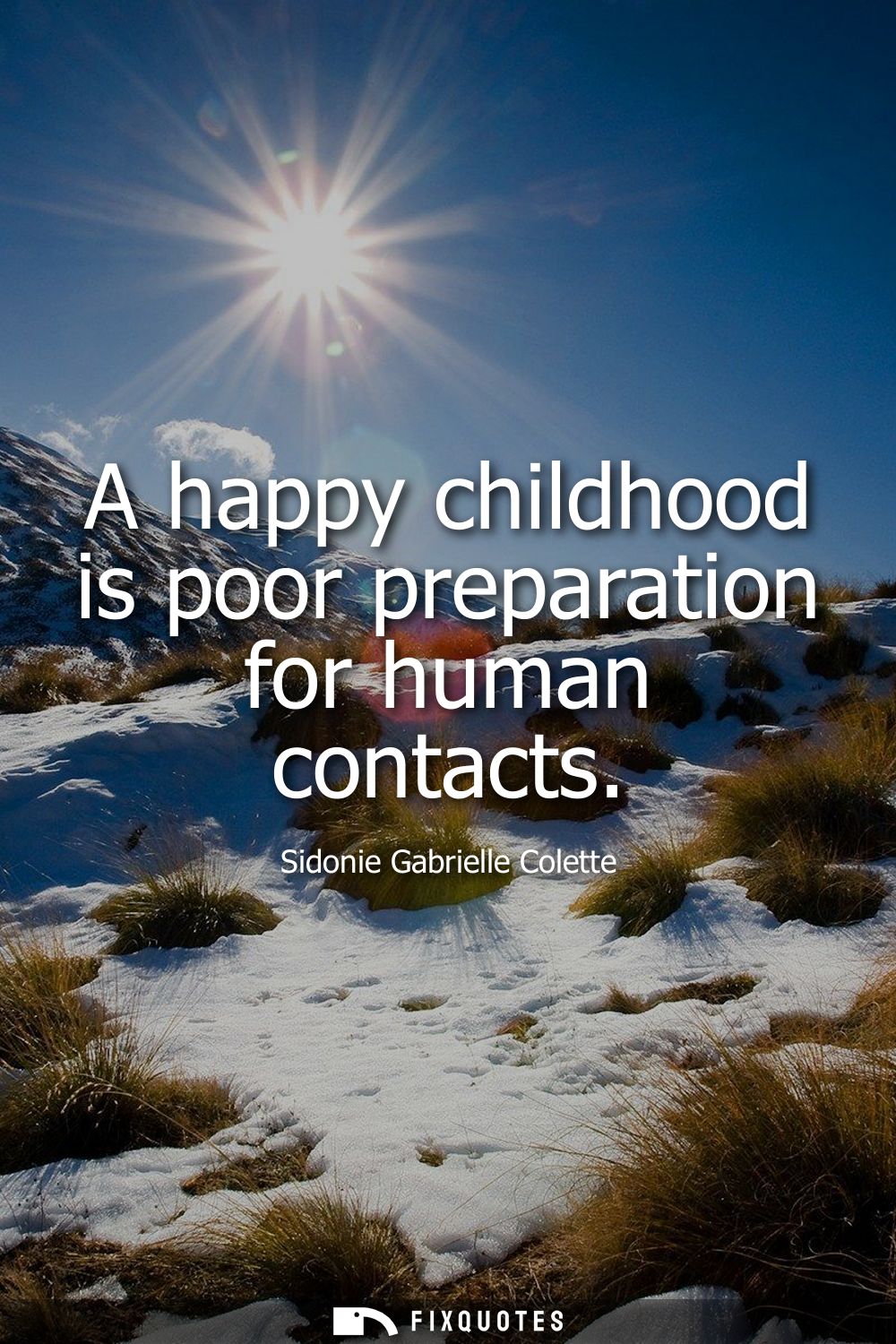
"A happy childhood is poor preparation for human contacts"
About this Quote
Colette’s line lands like a velvet slap: happiness, that most sanctified of childhood goals, is cast as a liability. The provocation isn’t that joy is bad; it’s that ease can be socially anesthetizing. A sheltered childhood teaches you the world is, at baseline, accommodating. Then you step into “human contacts” and discover that people are inconsistent, bargaining, bored, flirtatious, cruel, needy - sometimes all in the same afternoon. The quote works because it treats social life not as a moral lesson but as a rough craft. You don’t learn it in a nursery.
The subtext is Colette’s signature realism about desire and power. “Human contacts” has a faintly physical charge: the collisions of intimacy, reputation, and money that govern adult life, especially for women navigating a culture that prizes innocence until it punishes it. A “happy childhood” can mean fewer negotiations with disappointment, fewer rehearsals for reading moods, protecting boundaries, or spotting manipulation. Suffering isn’t romanticized here; it’s simply acknowledged as training in other people’s weather.
Context matters: Colette wrote out of the Belle Epoque and early 20th-century France, a society obsessed with propriety while thriving on salon intrigue and erotic subcurrents. Her own life - early marriage to Willy, artistic exploitation, public scandal, reinvention on stage and page - makes the sentence feel autobiographical without being confessional. It’s an adult’s hard-earned suspicion of innocence: not purity, but inexperience, and the steep tuition it pays when it finally meets the crowd.
The subtext is Colette’s signature realism about desire and power. “Human contacts” has a faintly physical charge: the collisions of intimacy, reputation, and money that govern adult life, especially for women navigating a culture that prizes innocence until it punishes it. A “happy childhood” can mean fewer negotiations with disappointment, fewer rehearsals for reading moods, protecting boundaries, or spotting manipulation. Suffering isn’t romanticized here; it’s simply acknowledged as training in other people’s weather.
Context matters: Colette wrote out of the Belle Epoque and early 20th-century France, a society obsessed with propriety while thriving on salon intrigue and erotic subcurrents. Her own life - early marriage to Willy, artistic exploitation, public scandal, reinvention on stage and page - makes the sentence feel autobiographical without being confessional. It’s an adult’s hard-earned suspicion of innocence: not purity, but inexperience, and the steep tuition it pays when it finally meets the crowd.
Quote Details
| Topic | Wisdom |
|---|---|
| Source | Help us find the source |
| Cite |
Citation Formats
APA Style (7th ed.)
Colette, Sidonie Gabrielle. (2026, January 16). A happy childhood is poor preparation for human contacts. FixQuotes. https://fixquotes.com/quotes/a-happy-childhood-is-poor-preparation-for-human-106655/
Chicago Style
Colette, Sidonie Gabrielle. "A happy childhood is poor preparation for human contacts." FixQuotes. January 16, 2026. https://fixquotes.com/quotes/a-happy-childhood-is-poor-preparation-for-human-106655/.
MLA Style (9th ed.)
"A happy childhood is poor preparation for human contacts." FixQuotes, 16 Jan. 2026, https://fixquotes.com/quotes/a-happy-childhood-is-poor-preparation-for-human-106655/. Accessed 6 Mar. 2026.
More Quotes by Sidonie
Add to List