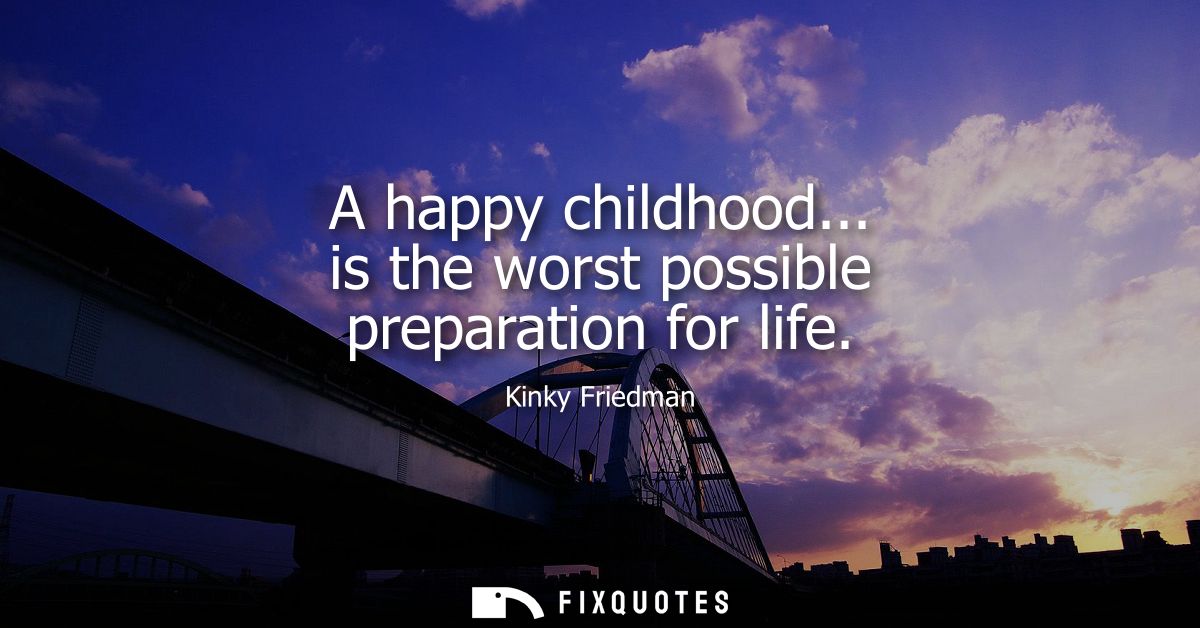
"A happy childhood... is the worst possible preparation for life"
About this Quote
“A happy childhood” lands here like a dare, not a blessing. Friedman, a musician who built a persona on barbed one-liners and outlaw mischief, twists the Hallmark ideal into a cautionary joke: if your early life is too soft, adulthood hits like an unannounced bar fight. The ellipsis is doing work, too. It’s a pause that lets you picture the sentimental montage before he pulls the rug out. Setup, then punchline.
The intent isn’t to dunk on joy; it’s to puncture the American promise that comfort automatically equals character. In Friedman’s world - part country storytelling, part comedian’s sting - innocence isn’t sacred, it’s expensive. The subtext is that struggle teaches the skills you actually spend: suspicion, resilience, a sense of absurdity, the ability to take a hit and keep talking. A “happy childhood” can produce adults who expect life to negotiate, who interpret disappointment as injustice rather than weather.
Context matters because Friedman’s whole shtick lives in the gap between sweetness and rot: songs and stories that flirt with sentimentality, then swerve into cynicism. Coming out of the postwar era, when middle-class stability was marketed as destiny, he’s also taking a side-eye at nostalgia itself. The line plays like a dirty-laugh truth: happiness can be real, but it can also be insulation. And insulation, he’s warning, doesn’t make you stronger; it just delays the first cold night.
The intent isn’t to dunk on joy; it’s to puncture the American promise that comfort automatically equals character. In Friedman’s world - part country storytelling, part comedian’s sting - innocence isn’t sacred, it’s expensive. The subtext is that struggle teaches the skills you actually spend: suspicion, resilience, a sense of absurdity, the ability to take a hit and keep talking. A “happy childhood” can produce adults who expect life to negotiate, who interpret disappointment as injustice rather than weather.
Context matters because Friedman’s whole shtick lives in the gap between sweetness and rot: songs and stories that flirt with sentimentality, then swerve into cynicism. Coming out of the postwar era, when middle-class stability was marketed as destiny, he’s also taking a side-eye at nostalgia itself. The line plays like a dirty-laugh truth: happiness can be real, but it can also be insulation. And insulation, he’s warning, doesn’t make you stronger; it just delays the first cold night.
Quote Details
| Topic | Life |
|---|---|
| Source | Help us find the source |
| Cite |
Citation Formats
APA Style (7th ed.)
Friedman, Kinky. (2026, January 15). A happy childhood... is the worst possible preparation for life. FixQuotes. https://fixquotes.com/quotes/a-happy-childhood-is-the-worst-possible-157429/
Chicago Style
Friedman, Kinky. "A happy childhood... is the worst possible preparation for life." FixQuotes. January 15, 2026. https://fixquotes.com/quotes/a-happy-childhood-is-the-worst-possible-157429/.
MLA Style (9th ed.)
"A happy childhood... is the worst possible preparation for life." FixQuotes, 15 Jan. 2026, https://fixquotes.com/quotes/a-happy-childhood-is-the-worst-possible-157429/. Accessed 28 Mar. 2026.
More Quotes by Kinky
Add to List