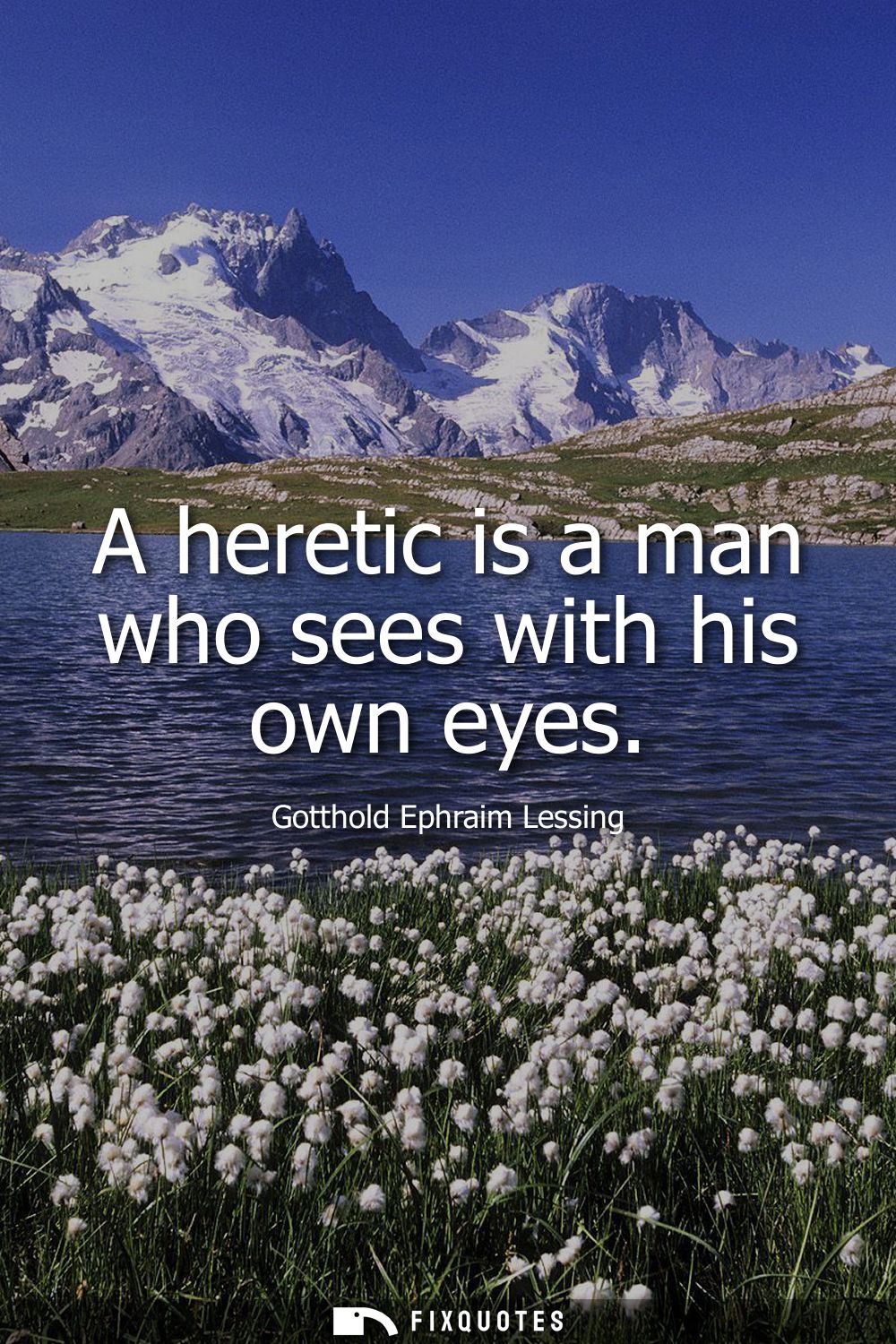
"A heretic is a man who sees with his own eyes"
About this Quote
“Heresy” is supposed to be a crime of doctrine; Lessing flips it into a compliment for perception. The jab lands because it exposes how communities often treat independent seeing as a social threat rather than an intellectual virtue. In one stroke, he recasts orthodoxy as a kind of sanctioned blindness: the faithful don’t just believe differently, they outsource their eyesight to institutions, creeds, and inherited consensus.
Lessing’s context matters. As an Enlightenment-era critic in German letters, he was immersed in the era’s central quarrel: revelation versus reason, authority versus inquiry. His work, especially the controversies around religious tolerance, insisted that truth is not a sealed container handed down intact but something tested in public, revised by argument, and complicated by human limits. Calling the self-reliant observer a “heretic” hints at how fragile official truth can be; if a belief system collapses when someone simply looks, that system was never sturdy.
The line’s subtext is also strategic. It doesn’t celebrate contrarianism for its own sake; it elevates the discipline of firsthand judgment. “Sees with his own eyes” suggests an ethics of attention: verify, scrutinize, refuse convenient narratives. Lessing is poking at the politics of belonging, too. Heresy isn’t just wrongness, it’s disloyalty. By tying heresy to perception, he implies that institutions may punish not error but autonomy.
It reads eerily current in an age of algorithmic consensus. Today’s heretic might be the person refusing the feed’s prefab reality, insisting on looking, checking, and thinking anyway.
Lessing’s context matters. As an Enlightenment-era critic in German letters, he was immersed in the era’s central quarrel: revelation versus reason, authority versus inquiry. His work, especially the controversies around religious tolerance, insisted that truth is not a sealed container handed down intact but something tested in public, revised by argument, and complicated by human limits. Calling the self-reliant observer a “heretic” hints at how fragile official truth can be; if a belief system collapses when someone simply looks, that system was never sturdy.
The line’s subtext is also strategic. It doesn’t celebrate contrarianism for its own sake; it elevates the discipline of firsthand judgment. “Sees with his own eyes” suggests an ethics of attention: verify, scrutinize, refuse convenient narratives. Lessing is poking at the politics of belonging, too. Heresy isn’t just wrongness, it’s disloyalty. By tying heresy to perception, he implies that institutions may punish not error but autonomy.
It reads eerily current in an age of algorithmic consensus. Today’s heretic might be the person refusing the feed’s prefab reality, insisting on looking, checking, and thinking anyway.
Quote Details
| Topic | Truth |
|---|---|
| Source | Help us find the source |
| Cite |
Citation Formats
APA Style (7th ed.)
Lessing, Gotthold Ephraim. (2026, January 15). A heretic is a man who sees with his own eyes. FixQuotes. https://fixquotes.com/quotes/a-heretic-is-a-man-who-sees-with-his-own-eyes-143982/
Chicago Style
Lessing, Gotthold Ephraim. "A heretic is a man who sees with his own eyes." FixQuotes. January 15, 2026. https://fixquotes.com/quotes/a-heretic-is-a-man-who-sees-with-his-own-eyes-143982/.
MLA Style (9th ed.)
"A heretic is a man who sees with his own eyes." FixQuotes, 15 Jan. 2026, https://fixquotes.com/quotes/a-heretic-is-a-man-who-sees-with-his-own-eyes-143982/. Accessed 7 Apr. 2026.
More Quotes by Gotthold
Add to List