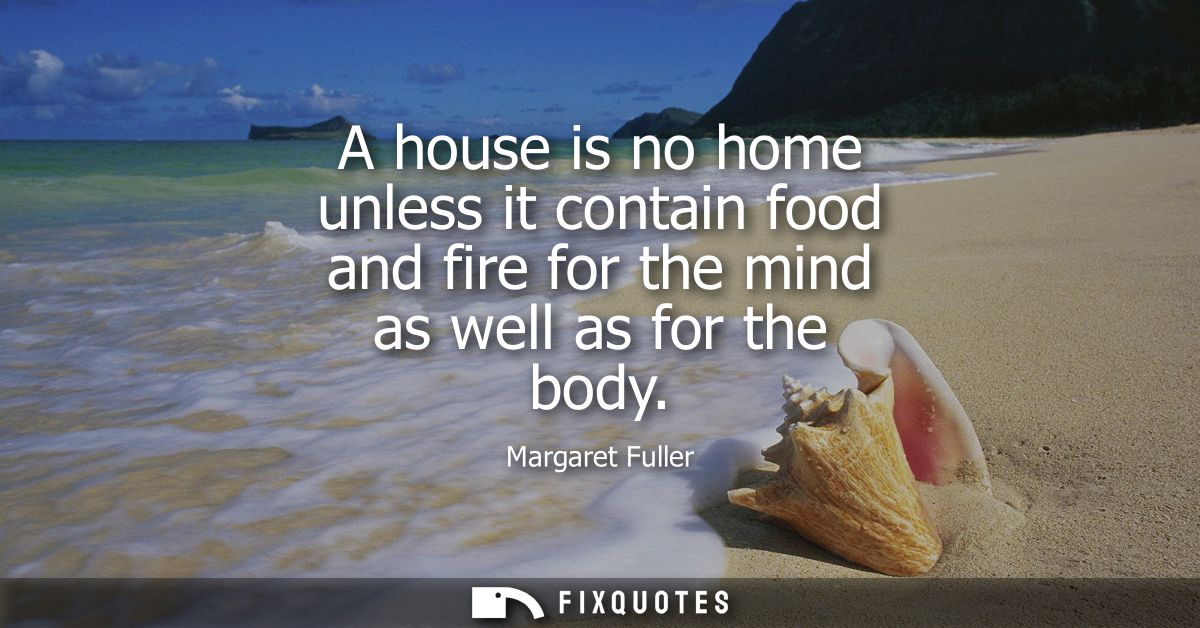
"A house is no home unless it contain food and fire for the mind, as well as for the body"
About this Quote
The subtext is a critique of respectability. A well-kept house can be a performance, a display of order that masks spiritual and mental starvation. By pairing “mind” with “body,” she insists that thinking, reading, and conversation aren’t indulgences reserved for men or for the public sphere; they’re basic human requirements, as necessary as bread. The “fire” metaphor is doing double duty: it evokes comfort and also ignition - the spark of ideas, the heat of argument, the warmth of being understood.
Context sharpens the edge. Fuller, a Transcendentalist and formidable critic, wrote and organized in a culture that treated women’s education as ornamental and their ambitions as disruptive. This sentence is activism in parlor language: not a manifesto shouted from the street, but a standard quietly raised inside the home. It implies that a society content with mere shelter is a society keeping its citizens tame.
Quote Details
| Topic | Knowledge |
|---|---|
| Source | Help us find the source |
| Cite |
Citation Formats
APA Style (7th ed.)
Fuller, Margaret. (2026, February 17). A house is no home unless it contain food and fire for the mind, as well as for the body. FixQuotes. https://fixquotes.com/quotes/a-house-is-no-home-unless-it-contain-food-and-162397/
Chicago Style
Fuller, Margaret. "A house is no home unless it contain food and fire for the mind, as well as for the body." FixQuotes. February 17, 2026. https://fixquotes.com/quotes/a-house-is-no-home-unless-it-contain-food-and-162397/.
MLA Style (9th ed.)
"A house is no home unless it contain food and fire for the mind, as well as for the body." FixQuotes, 17 Feb. 2026, https://fixquotes.com/quotes/a-house-is-no-home-unless-it-contain-food-and-162397/. Accessed 7 Apr. 2026.