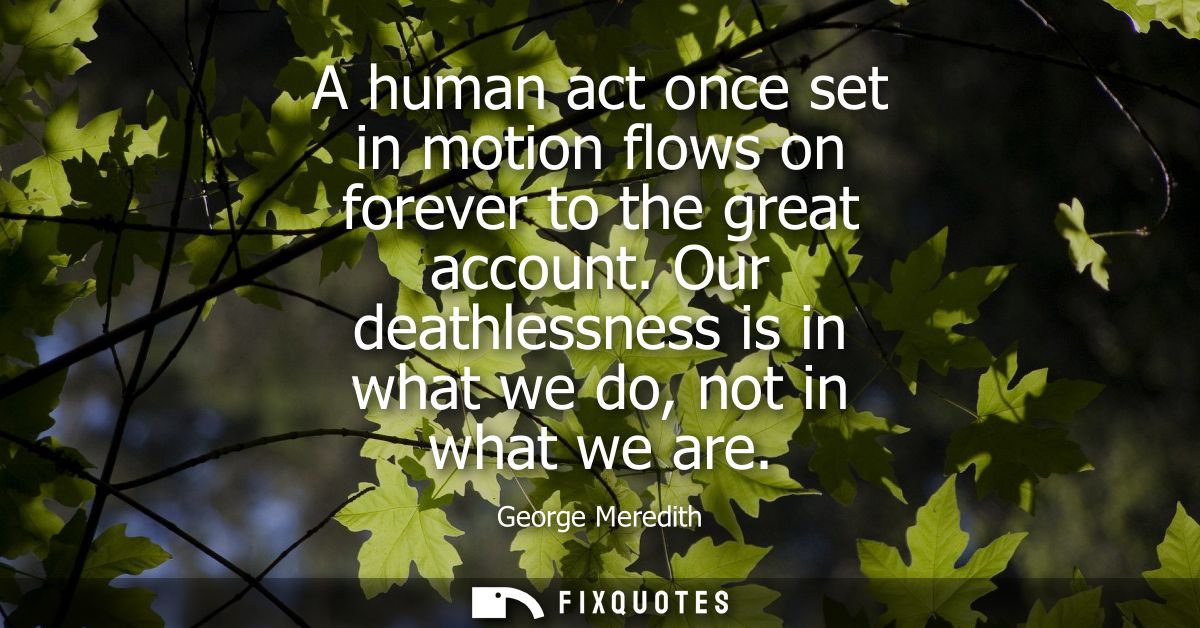
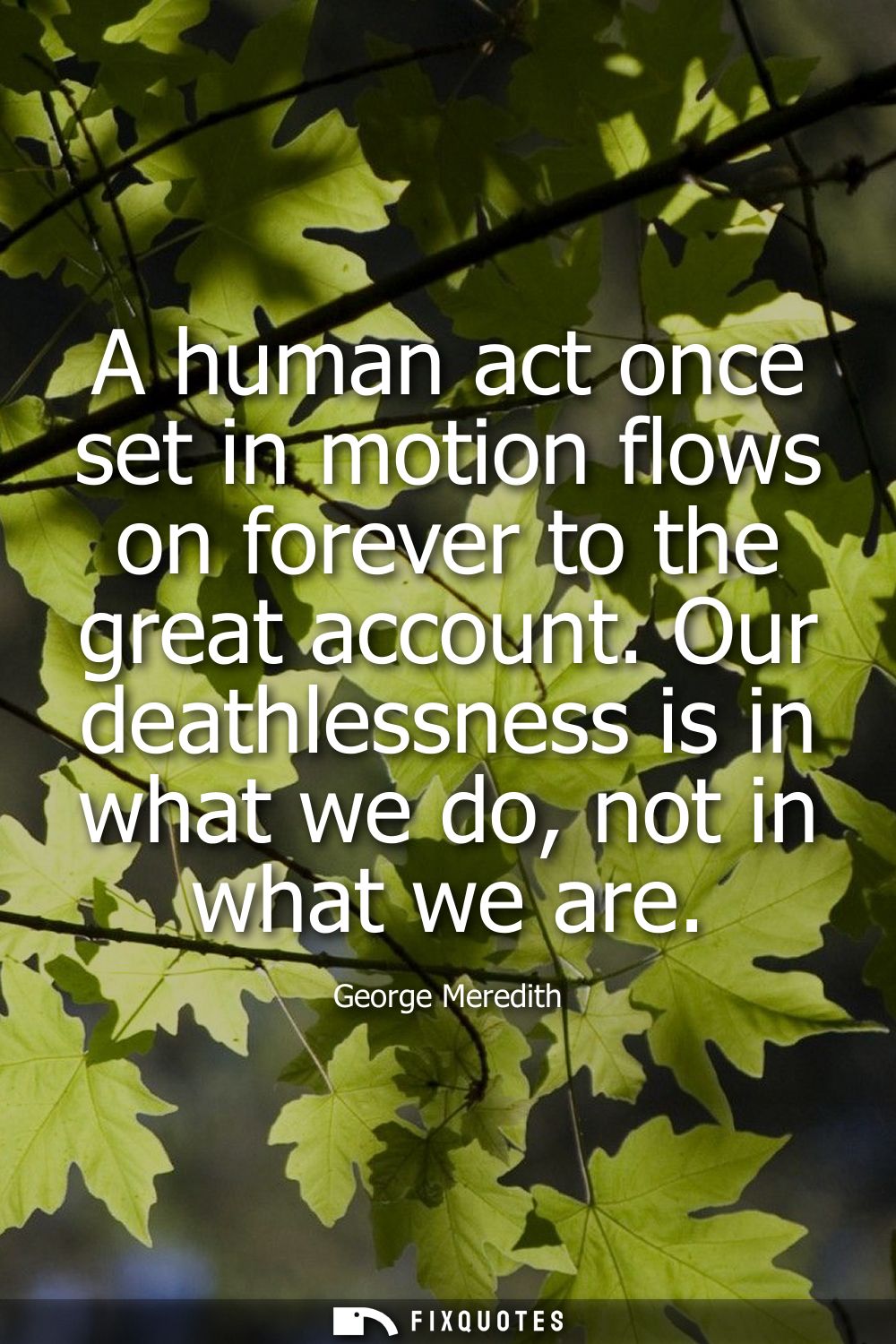
"A human act once set in motion flows on forever to the great account. Our deathlessness is in what we do, not in what we are"
About this Quote
The syntax does the heavy lifting. “Once set in motion” makes action sound like physics, not preference. Intention matters less than momentum; your choices acquire a life that outruns your self-image. The line “flows on forever” is both promise and threat: good deeds propagate, harms metastasize, and neither can be neatly retrieved with regret. Meredith’s “deathlessness” is pointedly unromantic, a rebuke to the Victorian cult of character and essence. “Not in what we are” punctures the era’s obsession with pedigree, temperament, and moral “nature.” He’s saying your identity is cheap; your impact is expensive.
As a novelist working in the late 19th century, Meredith is writing in a world newly sensitized to systems - industry, empire, social class - where individual gestures ripple through institutions and families. His intent feels corrective: don’t narrate yourself as a fixed being (“I am this kind of person”); measure yourself by what you set loose. The subtext is accountability without metaphysics: even if the heavens are silent, the ledger isn’t. Your immortality is the part of your life other people have to live with.
Quote Details
| Topic | Legacy & Remembrance |
|---|---|
| Source | Help us find the source |
| Cite |
Citation Formats
APA Style (7th ed.)
Meredith, George. (2026, January 17). A human act once set in motion flows on forever to the great account. Our deathlessness is in what we do, not in what we are. FixQuotes. https://fixquotes.com/quotes/a-human-act-once-set-in-motion-flows-on-forever-60278/
Chicago Style
Meredith, George. "A human act once set in motion flows on forever to the great account. Our deathlessness is in what we do, not in what we are." FixQuotes. January 17, 2026. https://fixquotes.com/quotes/a-human-act-once-set-in-motion-flows-on-forever-60278/.
MLA Style (9th ed.)
"A human act once set in motion flows on forever to the great account. Our deathlessness is in what we do, not in what we are." FixQuotes, 17 Jan. 2026, https://fixquotes.com/quotes/a-human-act-once-set-in-motion-flows-on-forever-60278/. Accessed 12 Feb. 2026.