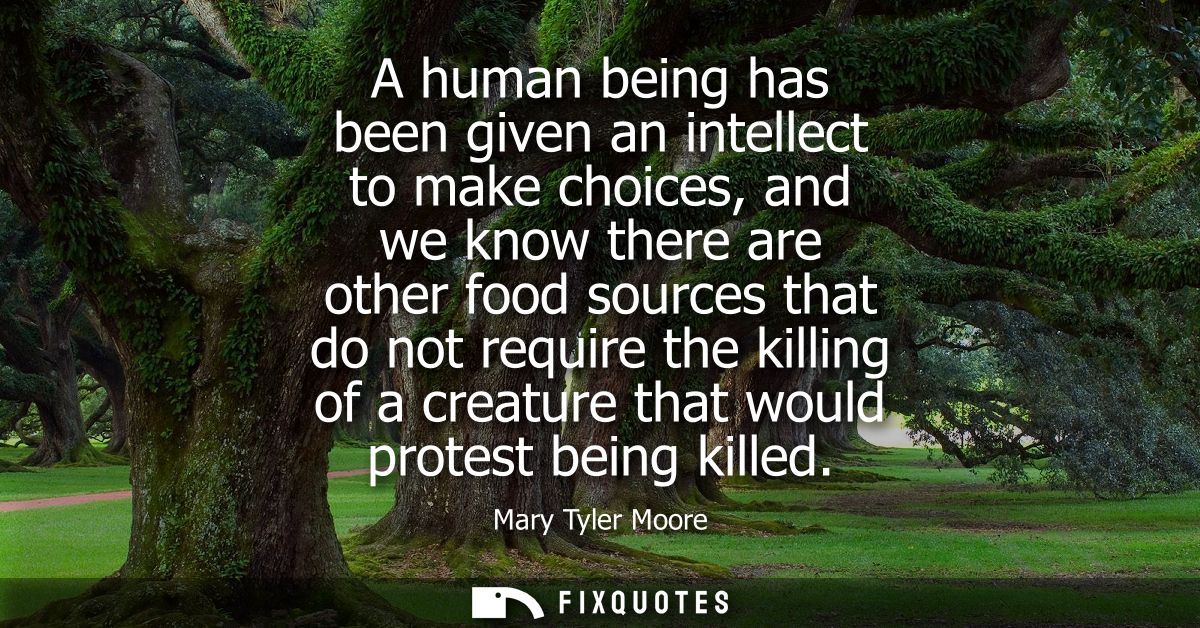
"A human being has been given an intellect to make choices, and we know there are other food sources that do not require the killing of a creature that would protest being killed"
About this Quote
The key move is how she frames “intellect.” It’s not IQ-as-bragging-rights; it’s conscience with a job description. By calling choice the defining human trait, she preempts the usual excuses (nature, tradition, taste) and relocates the argument from biology to responsibility. The phrasing “we know” is doing social pressure, too. She’s recruiting the listener into a shared, modern awareness: supermarkets and global supply chains make ignorance harder to claim than it used to be.
Then comes the sentence’s emotional lever: “a creature that would protest being killed.” Moore doesn’t say “animal” or “livestock,” words that let us file living beings into categories that feel safely economic. “Creature” is intimate and slightly childlike, a term that refuses the emotional distance built into meat culture. “Would protest” is devastatingly simple. It forces the reader to imagine agency, fear, refusal - the exact things slaughterhouses and euphemisms are designed to keep offstage.
Context matters: as an actress and animal-rights advocate, Moore is translating activism into mass-cultural language. It’s not a manifesto; it’s a moral nudge delivered in the cadence of common sense. The intent isn’t to win a debate on nutrition. It’s to make the listener feel that continuing to eat animals, in a world of alternatives, is less a preference than a choice they now have to own.
Quote Details
| Topic | Ethics & Morality |
|---|---|
| Source | Help us find the source |
| Cite |
Citation Formats
APA Style (7th ed.)
Moore, Mary Tyler. (2026, January 15). A human being has been given an intellect to make choices, and we know there are other food sources that do not require the killing of a creature that would protest being killed. FixQuotes. https://fixquotes.com/quotes/a-human-being-has-been-given-an-intellect-to-make-165457/
Chicago Style
Moore, Mary Tyler. "A human being has been given an intellect to make choices, and we know there are other food sources that do not require the killing of a creature that would protest being killed." FixQuotes. January 15, 2026. https://fixquotes.com/quotes/a-human-being-has-been-given-an-intellect-to-make-165457/.
MLA Style (9th ed.)
"A human being has been given an intellect to make choices, and we know there are other food sources that do not require the killing of a creature that would protest being killed." FixQuotes, 15 Jan. 2026, https://fixquotes.com/quotes/a-human-being-has-been-given-an-intellect-to-make-165457/. Accessed 12 Feb. 2026.