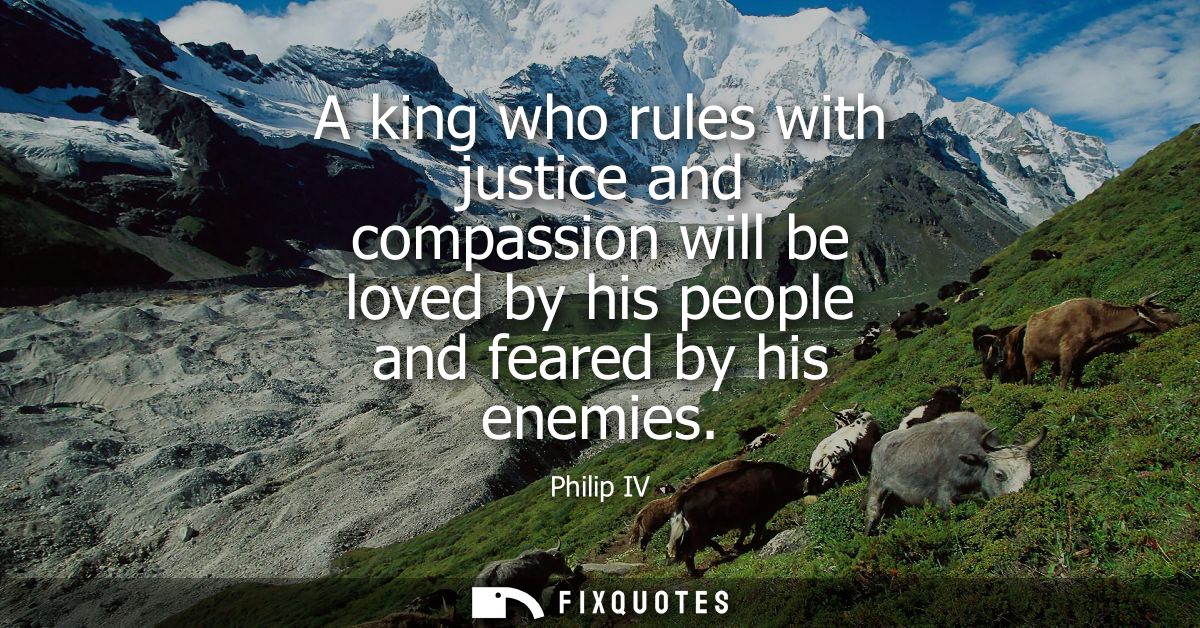
"A king who rules with justice and compassion will be loved by his people and feared by his enemies"
About this Quote
The subtext is more tactical than saintly. A loved king faces fewer rebellions, fewer expensive crackdowns, fewer elite conspiracies. Fear in enemies, meanwhile, is not just battlefield terror but strategic deterrence: stability at home projects strength outward. The sentence pretends these outcomes are natural consequences of goodness, sidestepping the machinery that actually sustains crowns - taxation, patronage, censorship, and armies.
Context sharpens the stakes. Philip IV’s Spain was a superpower in visible decline, strained by the Thirty Years’ War, costly foreign campaigns, and internal unrest (Catalonia, Portugal). In that world, “compassion” reads as damage control: a monarch’s promise to relieve pressure without surrendering authority. “Justice” reassures subjects that burdens are fair, even when the empire’s finances say otherwise. The rhetoric is consequential because it’s aspirational propaganda: a king describing the version of himself the state needs people to believe in, especially when reality is fraying.
Quote Details
| Topic | Servant Leadership |
|---|---|
| Source | Help us find the source |
| Cite |
Citation Formats
APA Style (7th ed.)
IV, Philip. (2026, January 15). A king who rules with justice and compassion will be loved by his people and feared by his enemies. FixQuotes. https://fixquotes.com/quotes/a-king-who-rules-with-justice-and-compassion-will-171698/
Chicago Style
IV, Philip. "A king who rules with justice and compassion will be loved by his people and feared by his enemies." FixQuotes. January 15, 2026. https://fixquotes.com/quotes/a-king-who-rules-with-justice-and-compassion-will-171698/.
MLA Style (9th ed.)
"A king who rules with justice and compassion will be loved by his people and feared by his enemies." FixQuotes, 15 Jan. 2026, https://fixquotes.com/quotes/a-king-who-rules-with-justice-and-compassion-will-171698/. Accessed 7 Mar. 2026.