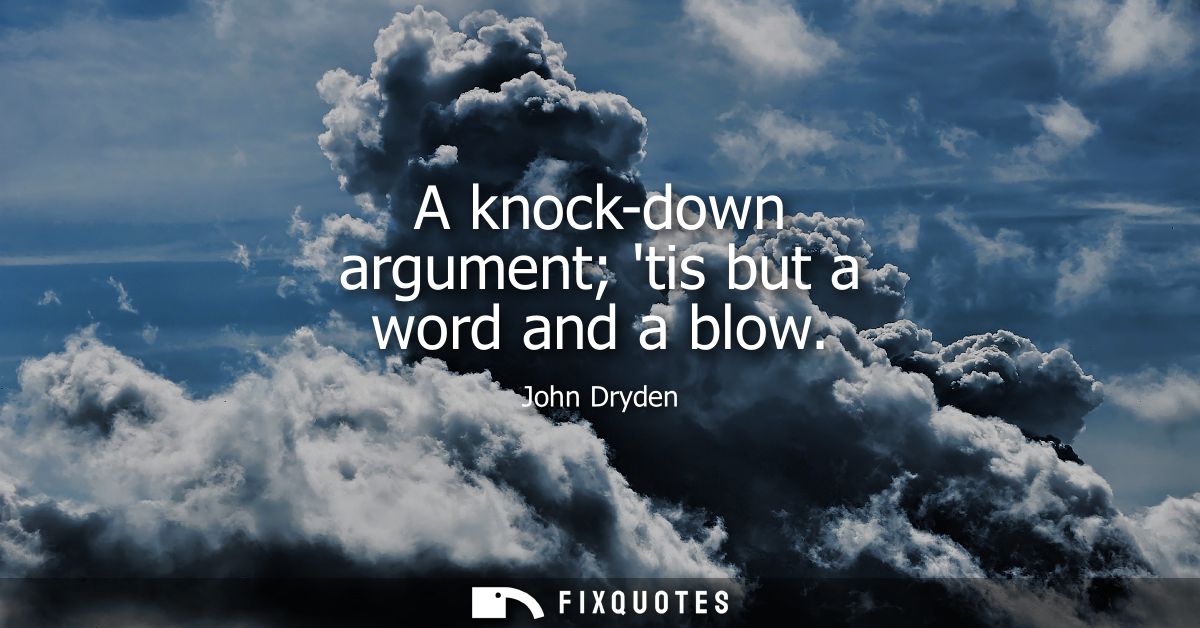
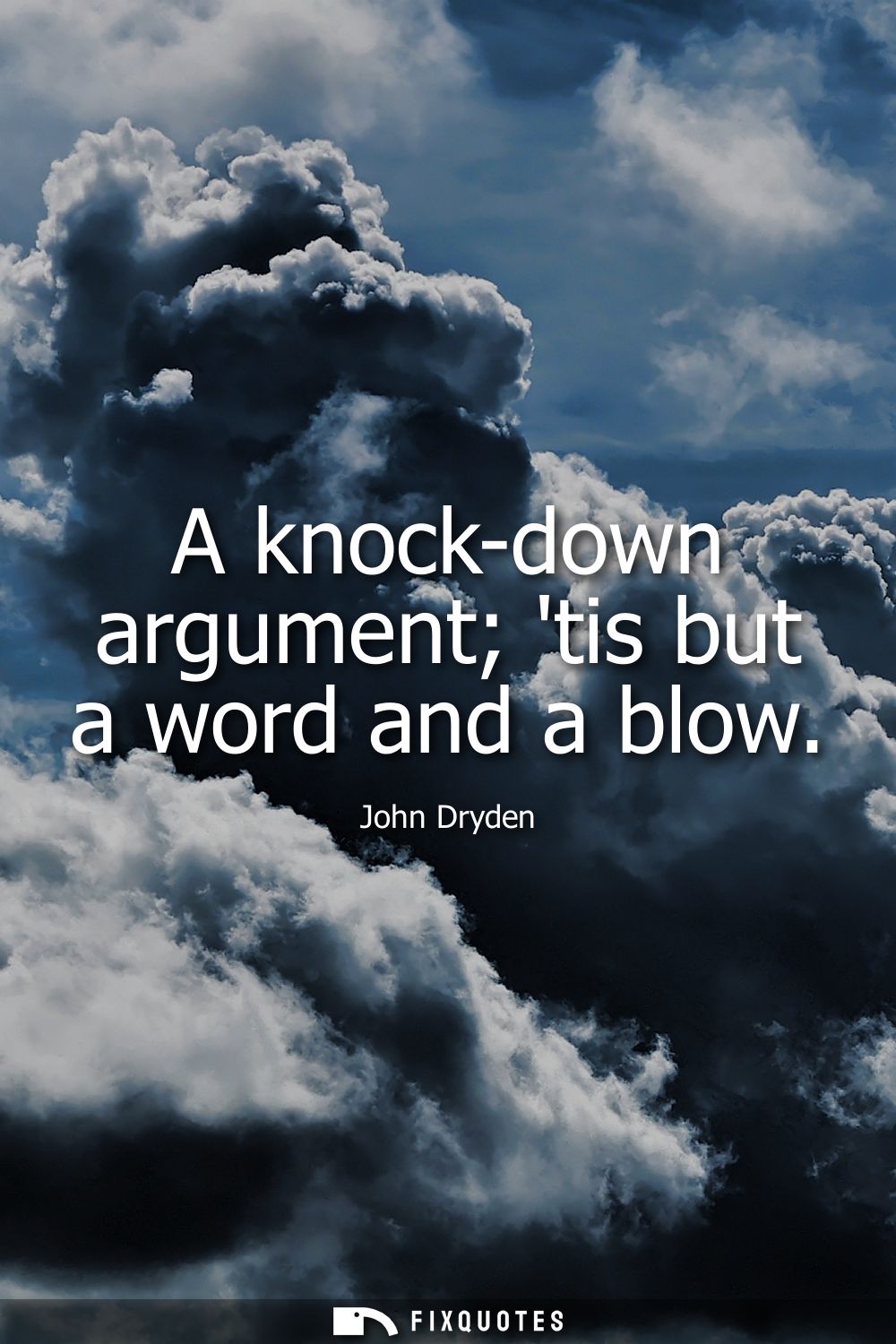
"A knock-down argument; 'tis but a word and a blow"
About this Quote
Dryden’s line lands like a staged fistfight: it takes a phrase we treat as lofty - “a knock-down argument” - and strips it down to its brute ingredients: language plus violence. The pun is the point. “Knock-down” is supposed to describe rhetorical decisiveness, the kind of reasoning that leaves an opponent speechless. Dryden reminds you that, in practice, decisive “arguments” often win by force, intimidation, or social power rather than logic. It’s wit with teeth: one neat turn exposes how easily persuasion slides into coercion.
The syntax does some of the work. “‘Tis but” is dismissive, almost bored, like a man waving away the pretensions of debate. “A word and a blow” balances two monosyllables that feel equally concrete; it makes speech sound physical and violence sound routine. Dryden is diagnosing a culture where public dispute - in courts, coffeehouses, pamphlet wars, and the theater - wasn’t just an exchange of ideas but a contest of status. Restoration England prized verbal brilliance, yet it was also an era of duels, faction, and political whiplash. Arguments could end in literal knock-downs.
Subtext: the “winning” of arguments is rarely pure. Dryden, a poet enmeshed in patronage and partisan shifts, knew that correctness isn’t the only currency; leverage is. The line’s cynical elegance is a warning disguised as a joke: if your “argument” needs a blow, it was never about truth.
The syntax does some of the work. “‘Tis but” is dismissive, almost bored, like a man waving away the pretensions of debate. “A word and a blow” balances two monosyllables that feel equally concrete; it makes speech sound physical and violence sound routine. Dryden is diagnosing a culture where public dispute - in courts, coffeehouses, pamphlet wars, and the theater - wasn’t just an exchange of ideas but a contest of status. Restoration England prized verbal brilliance, yet it was also an era of duels, faction, and political whiplash. Arguments could end in literal knock-downs.
Subtext: the “winning” of arguments is rarely pure. Dryden, a poet enmeshed in patronage and partisan shifts, knew that correctness isn’t the only currency; leverage is. The line’s cynical elegance is a warning disguised as a joke: if your “argument” needs a blow, it was never about truth.
Quote Details
| Topic | Witty One-Liners |
|---|---|
| Source | Help us find the source |
| Cite |
Citation Formats
APA Style (7th ed.)
Dryden, John. (2026, January 16). A knock-down argument; 'tis but a word and a blow. FixQuotes. https://fixquotes.com/quotes/a-knock-down-argument-tis-but-a-word-and-a-blow-83685/
Chicago Style
Dryden, John. "A knock-down argument; 'tis but a word and a blow." FixQuotes. January 16, 2026. https://fixquotes.com/quotes/a-knock-down-argument-tis-but-a-word-and-a-blow-83685/.
MLA Style (9th ed.)
"A knock-down argument; 'tis but a word and a blow." FixQuotes, 16 Jan. 2026, https://fixquotes.com/quotes/a-knock-down-argument-tis-but-a-word-and-a-blow-83685/. Accessed 28 Mar. 2026.
More Quotes by John
Add to List