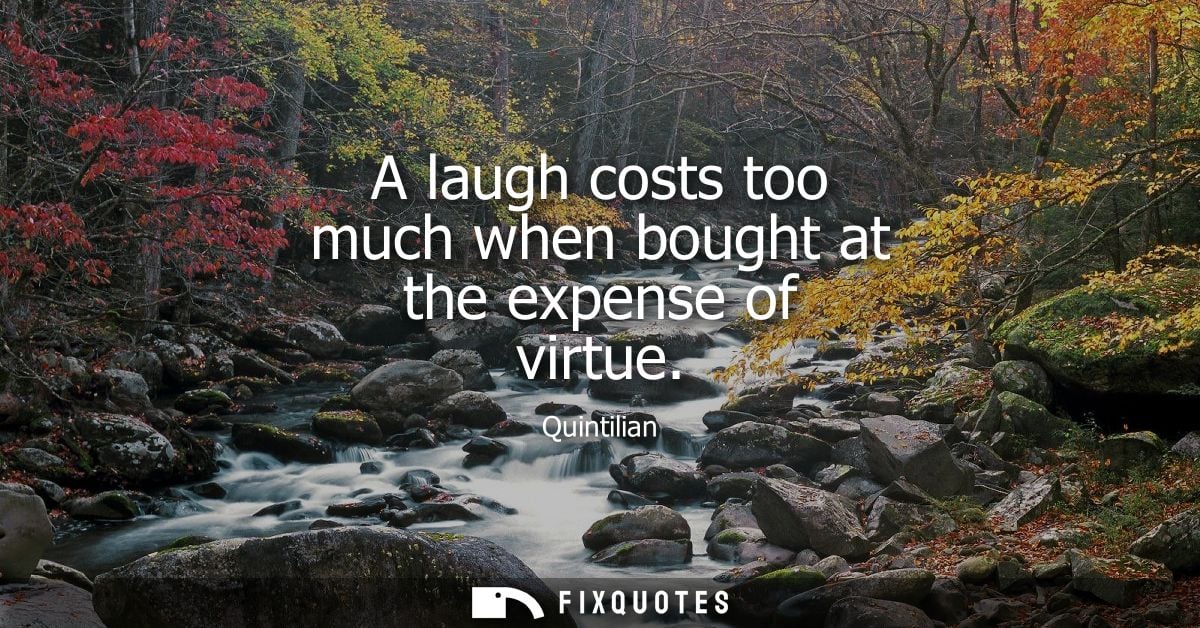
"A laugh costs too much when bought at the expense of virtue"
About this Quote
The line lands like a lesson disguised as a warning: humor is never free, and the bill often comes due in character. Quintilian, Rome's premier teacher of rhetoric, isn’t policing jokes out of prudishness; he’s policing the speaker. In a culture where public life ran on performance and status, a sharp laugh could be social currency, a way to win the room fast. Quintilian’s point is that the quickest laugh is frequently the cheapest trick: cruelty dressed up as wit, corruption turned into entertainment, moral compromise smuggled in as “just kidding.”
The phrasing is calibrated for a classroom and a courtroom. “Bought” makes laughter a transaction, not a spontaneous joy. That verb implies intention and calculation: you chose the laugh, you paid for it, and you did so with something that wasn’t yours to spend. “At the expense of virtue” turns moral integrity into a finite resource, something that can be traded away for applause. Quintilian is training orators to think beyond the immediate win - the roar of approval - toward the long game of credibility. In his rhetorical system, ethos matters: the audience’s trust is the real platform, and it erodes when the speaker’s jokes reveal contempt, dishonesty, or opportunism.
Under the surface, it’s also a critique of a society increasingly amused by spectacle and humiliation. Quintilian suggests that a laugh can function as a moral alibi: if everyone’s laughing, no one has to admit what the joke is doing. He refuses that comfort. The best rhetoric, for him, isn’t merely effective; it’s accountable.
The phrasing is calibrated for a classroom and a courtroom. “Bought” makes laughter a transaction, not a spontaneous joy. That verb implies intention and calculation: you chose the laugh, you paid for it, and you did so with something that wasn’t yours to spend. “At the expense of virtue” turns moral integrity into a finite resource, something that can be traded away for applause. Quintilian is training orators to think beyond the immediate win - the roar of approval - toward the long game of credibility. In his rhetorical system, ethos matters: the audience’s trust is the real platform, and it erodes when the speaker’s jokes reveal contempt, dishonesty, or opportunism.
Under the surface, it’s also a critique of a society increasingly amused by spectacle and humiliation. Quintilian suggests that a laugh can function as a moral alibi: if everyone’s laughing, no one has to admit what the joke is doing. He refuses that comfort. The best rhetoric, for him, isn’t merely effective; it’s accountable.
Quote Details
| Topic | Honesty & Integrity |
|---|---|
| Source | Help us find the source |
More Quotes by Quintilian
Add to List