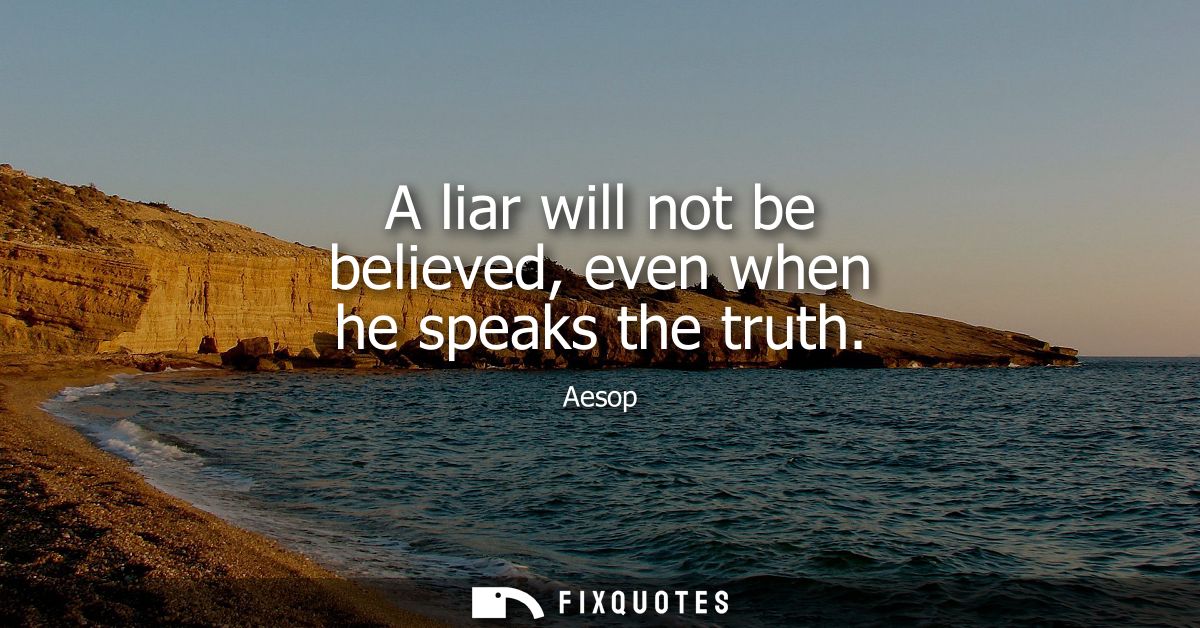
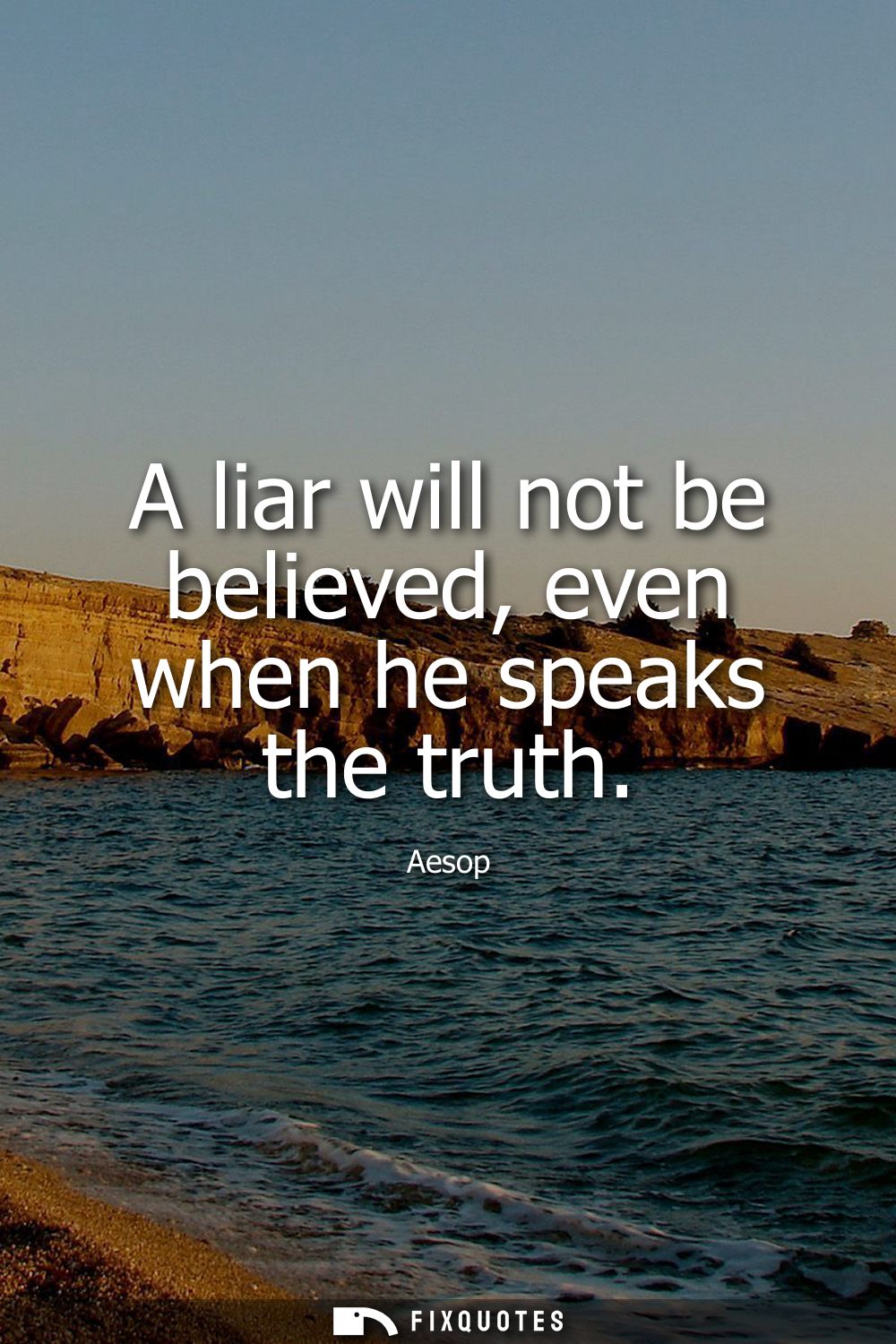
"A liar will not be believed, even when he speaks the truth"
About this Quote
Reputation is the real currency in Aesop's moral universe, and this line spends it with brutal efficiency. "A liar will not be believed, even when he speaks the truth" isn’t a pious warning about honesty; it’s a cold description of how trust works once it’s been vandalized. The sentence turns on a quiet inevitability: not "may not be believed", but "will not". Aesop frames credibility as something you don’t get to renegotiate in the moment. You build it over time, then you live inside it.
The subtext is almost legalistic. Truth isn’t presented as self-evident; it’s socially adjudicated. People don’t evaluate facts in a vacuum, they evaluate messengers. The liar’s tragedy is that the one thing he can’t counterfeit is the audience’s willingness to grant him the benefit of the doubt. Even when he finally tells the truth, he’s trapped by his own track record, like a witness whose prior perjury poisons every future testimony.
Context matters: Aesop’s fables were designed for oral circulation, for communities where information traveled through voices, not documents. In that world, your name functioned as verification. The line also carries a faintly punitive edge, almost a communal self-defense mechanism: if liars could always reset to zero by telling the truth once, deceit would be costless. The moral tightens the screws. It warns would-be manipulators that the long game has consequences, and it warns everyone else that skepticism isn’t cynicism - it’s memory.
The subtext is almost legalistic. Truth isn’t presented as self-evident; it’s socially adjudicated. People don’t evaluate facts in a vacuum, they evaluate messengers. The liar’s tragedy is that the one thing he can’t counterfeit is the audience’s willingness to grant him the benefit of the doubt. Even when he finally tells the truth, he’s trapped by his own track record, like a witness whose prior perjury poisons every future testimony.
Context matters: Aesop’s fables were designed for oral circulation, for communities where information traveled through voices, not documents. In that world, your name functioned as verification. The line also carries a faintly punitive edge, almost a communal self-defense mechanism: if liars could always reset to zero by telling the truth once, deceit would be costless. The moral tightens the screws. It warns would-be manipulators that the long game has consequences, and it warns everyone else that skepticism isn’t cynicism - it’s memory.
Quote Details
| Topic | Honesty & Integrity |
|---|---|
| Source | Evidence: ... Wolf made a good meal off the boy's flock , and when the boy complained , the wise man of the village said : " A liar will not be believed , even when he speaks the truth . " 4 THE YOUNG THIEF AND HIS MOTHER · THE YOUNG - ÆSOP'S FABLES 103. Other candidates (1) The Fables of Aesop (Aesop, 1894)50.0% “A liar will not be believed, even when he speaks the truth.” (In the fable “The Shepherd’s Boy” (page not numbered i... |
| Cite |
Citation Formats
APA Style (7th ed.)
Aesop. (2026, February 28). A liar will not be believed, even when he speaks the truth. FixQuotes. https://fixquotes.com/quotes/a-liar-will-not-be-believed-even-when-he-speaks-61466/
Chicago Style
Aesop. "A liar will not be believed, even when he speaks the truth." FixQuotes. February 28, 2026. https://fixquotes.com/quotes/a-liar-will-not-be-believed-even-when-he-speaks-61466/.
MLA Style (9th ed.)
"A liar will not be believed, even when he speaks the truth." FixQuotes, 28 Feb. 2026, https://fixquotes.com/quotes/a-liar-will-not-be-believed-even-when-he-speaks-61466/. Accessed 27 Mar. 2026.
More Quotes by Aesop
Add to List