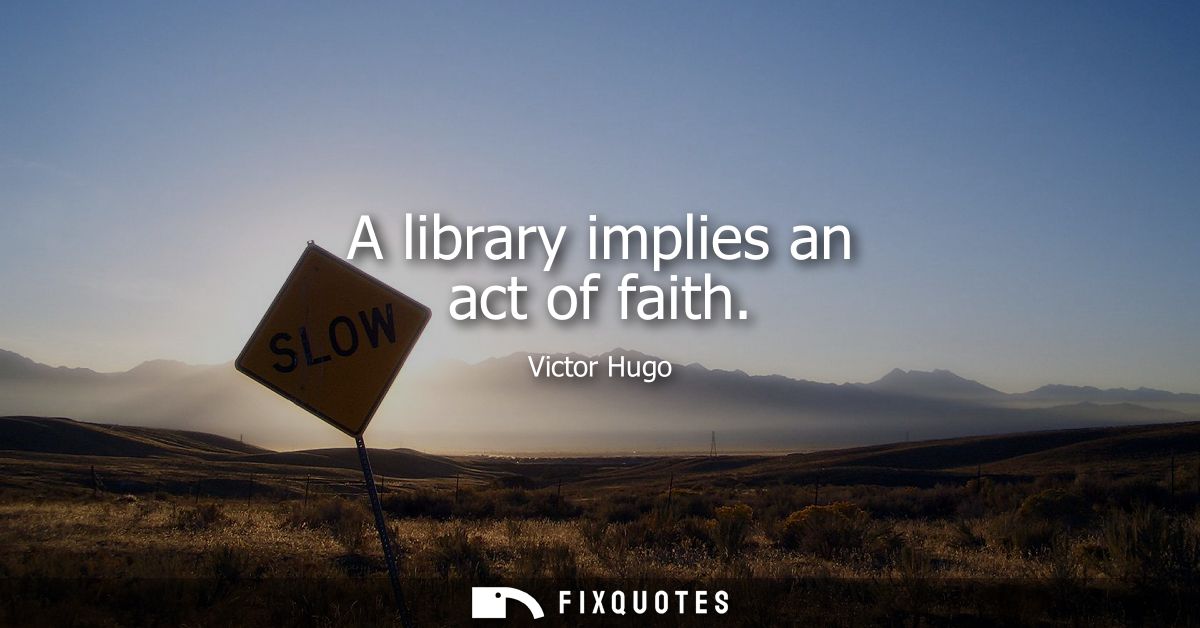
"A library implies an act of faith"
About this Quote
Calling a library “an act of faith” sounds like one of Hugo’s grand, slightly theatrical turns, but it lands because it’s practical, not pious. A library is expensive, slow to build, easy to burn, and rarely “efficient” by the standards of power. You fund it anyway. You shelve words for readers you’ll never meet, in a future you can’t control. That’s faith: a bet that human beings will keep wanting more than bread and orders.
Hugo wrote in a 19th-century France convulsed by revolution, empire, restoration, and censorship. In that world, books were not neutral furniture. They were contraband ideas, reputations made and ruined, proofs that the state didn’t own the mind. So the line carries political subtext: a library is a quiet declaration that knowledge should outlast regimes. It’s an institution designed to resist the amnesia that authority depends on.
The phrasing also smuggles in Hugo’s romantic moralism. He’s not talking about faith in God so much as faith in people: that education can soften brutality, that literature can widen sympathy, that memory can be organized instead of weaponized. A library is society admitting it might be wrong later and preparing the evidence.
There’s an irony baked in, too. Libraries hoard contradictions. They preserve saints and cynics, propaganda and its rebuttal. The “act of faith” is trusting that exposure to that mess won’t collapse us - that the reader can handle the freedom to choose, argue, and change.
Hugo wrote in a 19th-century France convulsed by revolution, empire, restoration, and censorship. In that world, books were not neutral furniture. They were contraband ideas, reputations made and ruined, proofs that the state didn’t own the mind. So the line carries political subtext: a library is a quiet declaration that knowledge should outlast regimes. It’s an institution designed to resist the amnesia that authority depends on.
The phrasing also smuggles in Hugo’s romantic moralism. He’s not talking about faith in God so much as faith in people: that education can soften brutality, that literature can widen sympathy, that memory can be organized instead of weaponized. A library is society admitting it might be wrong later and preparing the evidence.
There’s an irony baked in, too. Libraries hoard contradictions. They preserve saints and cynics, propaganda and its rebuttal. The “act of faith” is trusting that exposure to that mess won’t collapse us - that the reader can handle the freedom to choose, argue, and change.
Quote Details
| Topic | Knowledge |
|---|---|
| Source | Verified source: L’Année terrible (Victor Hugo, 1872)
Evidence:
Une bibliothèque est un acte de foi (Poem VIII, « À qui la faute ? » (page 243 in the 1872 DjVu scan on Wikisource)). The commonly circulated English line “A library implies an act of faith” is a translation/paraphrase of Hugo’s original French verse. In Hugo’s primary text it appears in the poem « À qui la faute ? » within the collection L’Année terrible (published 1872). The surrounding lines in the same stanza continue: « Des générations ténébreuses encore / Qui rendent dans la nuit témoignage à l’aurore. » |
| Cite |
Citation Formats
APA Style (7th ed.)
Hugo, Victor. (2026, February 7). A library implies an act of faith. FixQuotes. https://fixquotes.com/quotes/a-library-implies-an-act-of-faith-22571/
Chicago Style
Hugo, Victor. "A library implies an act of faith." FixQuotes. February 7, 2026. https://fixquotes.com/quotes/a-library-implies-an-act-of-faith-22571/.
MLA Style (9th ed.)
"A library implies an act of faith." FixQuotes, 7 Feb. 2026, https://fixquotes.com/quotes/a-library-implies-an-act-of-faith-22571/. Accessed 2 Apr. 2026.
More Quotes by Victor
Add to List