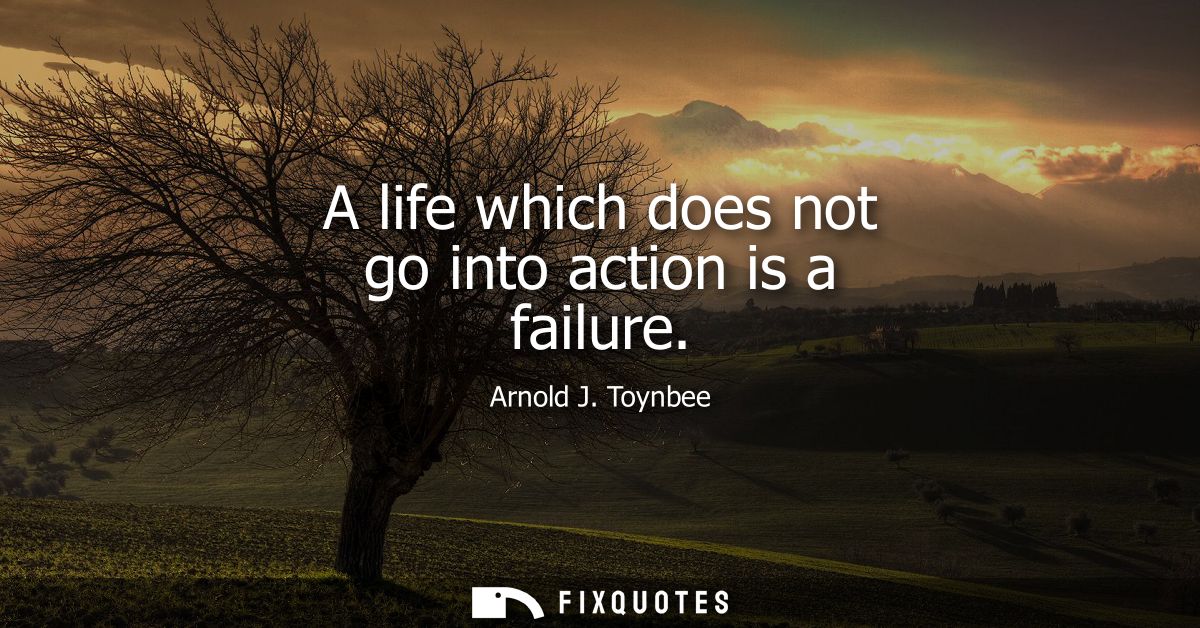
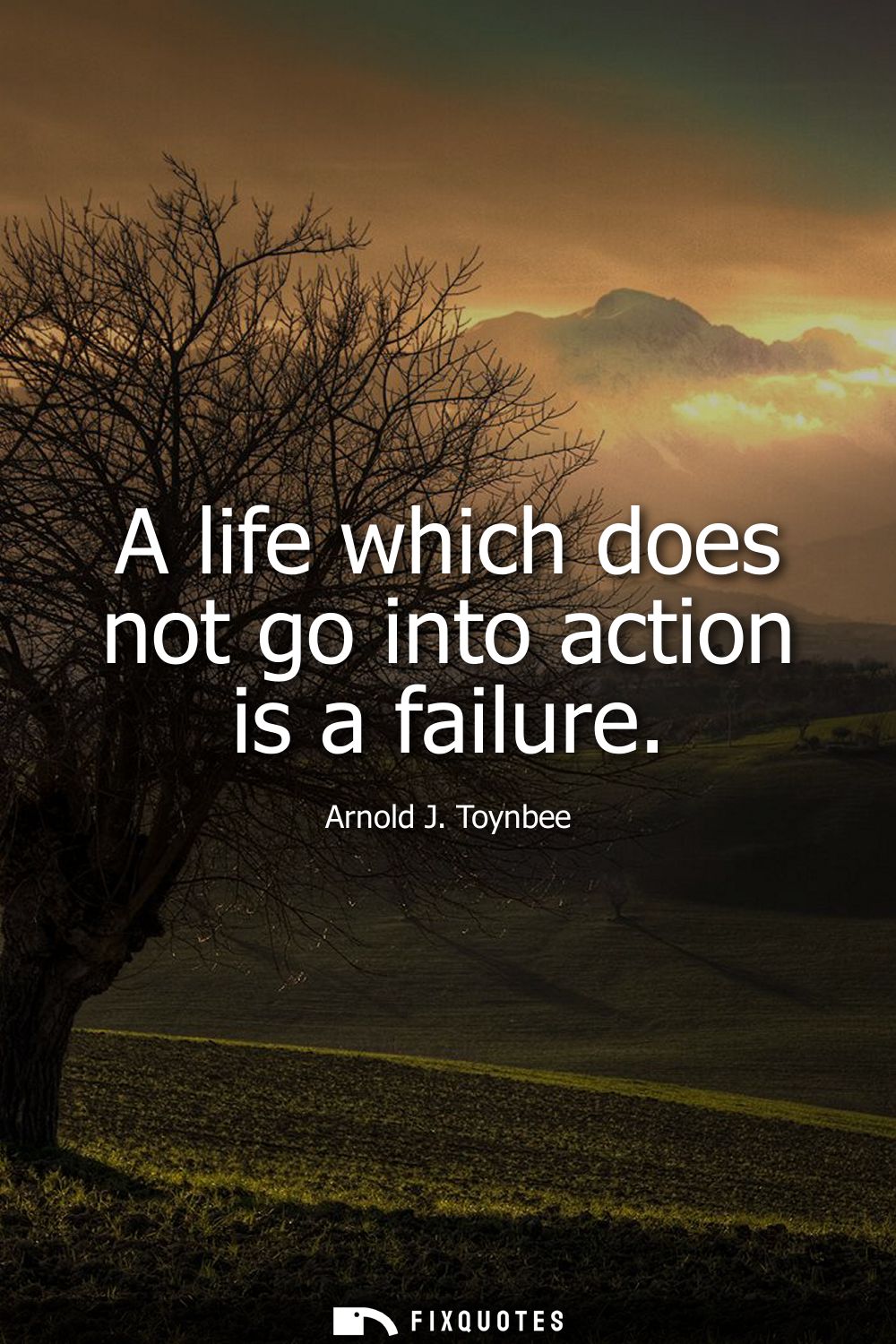
"A life which does not go into action is a failure"
About this Quote
Toynbee’s line lands like a verdict because it turns “action” from a lifestyle choice into a moral accounting. For a historian who spent his career tracing why civilizations rise, ossify, and break, “failure” isn’t a private feeling; it’s an historical category. The sentence reads less like self-help than like a civilizational diagnostic: societies (and people) that don’t translate insight into movement become footnotes.
The intent is to shame passivity, but the subtext is sharper. Toynbee isn’t merely praising busyness. He’s targeting the seductive refuge of contemplation without consequence: the smart person who reads, critiques, and understands, yet never risks exposure in the world where outcomes can contradict theory. “Go into action” implies crossing a threshold, leaving the safe interior of analysis for the messy exterior of commitment. That’s a historian’s impatience with armchair certainty: history judges by deeds because deeds are what alter the record.
Context matters. Toynbee wrote through the wreckage of two world wars and the ideological trench warfare of the mid-20th century, an era when ideas were not parlor games but engines for mass mobilization, liberation, and atrocity. His sweeping theory of “challenge and response” hangs in the background here: vitality comes from answering pressure with creative adaptation. “Action,” then, isn’t a synonym for aggression; it’s the willingness to respond rather than drift.
The line works because it compresses a whole worldview into a binary that feels uncomfortably personal. It dares you to ask whether your intelligence is a form of participation or merely a well-decorated hiding place.
The intent is to shame passivity, but the subtext is sharper. Toynbee isn’t merely praising busyness. He’s targeting the seductive refuge of contemplation without consequence: the smart person who reads, critiques, and understands, yet never risks exposure in the world where outcomes can contradict theory. “Go into action” implies crossing a threshold, leaving the safe interior of analysis for the messy exterior of commitment. That’s a historian’s impatience with armchair certainty: history judges by deeds because deeds are what alter the record.
Context matters. Toynbee wrote through the wreckage of two world wars and the ideological trench warfare of the mid-20th century, an era when ideas were not parlor games but engines for mass mobilization, liberation, and atrocity. His sweeping theory of “challenge and response” hangs in the background here: vitality comes from answering pressure with creative adaptation. “Action,” then, isn’t a synonym for aggression; it’s the willingness to respond rather than drift.
The line works because it compresses a whole worldview into a binary that feels uncomfortably personal. It dares you to ask whether your intelligence is a form of participation or merely a well-decorated hiding place.
Quote Details
| Topic | Motivational |
|---|---|
| Source | Help us find the source |
| Cite |
Citation Formats
APA Style (7th ed.)
Toynbee, Arnold J. (2026, January 18). A life which does not go into action is a failure. FixQuotes. https://fixquotes.com/quotes/a-life-which-does-not-go-into-action-is-a-failure-4350/
Chicago Style
Toynbee, Arnold J. "A life which does not go into action is a failure." FixQuotes. January 18, 2026. https://fixquotes.com/quotes/a-life-which-does-not-go-into-action-is-a-failure-4350/.
MLA Style (9th ed.)
"A life which does not go into action is a failure." FixQuotes, 18 Jan. 2026, https://fixquotes.com/quotes/a-life-which-does-not-go-into-action-is-a-failure-4350/. Accessed 12 Feb. 2026.
More Quotes by Arnold
Add to List