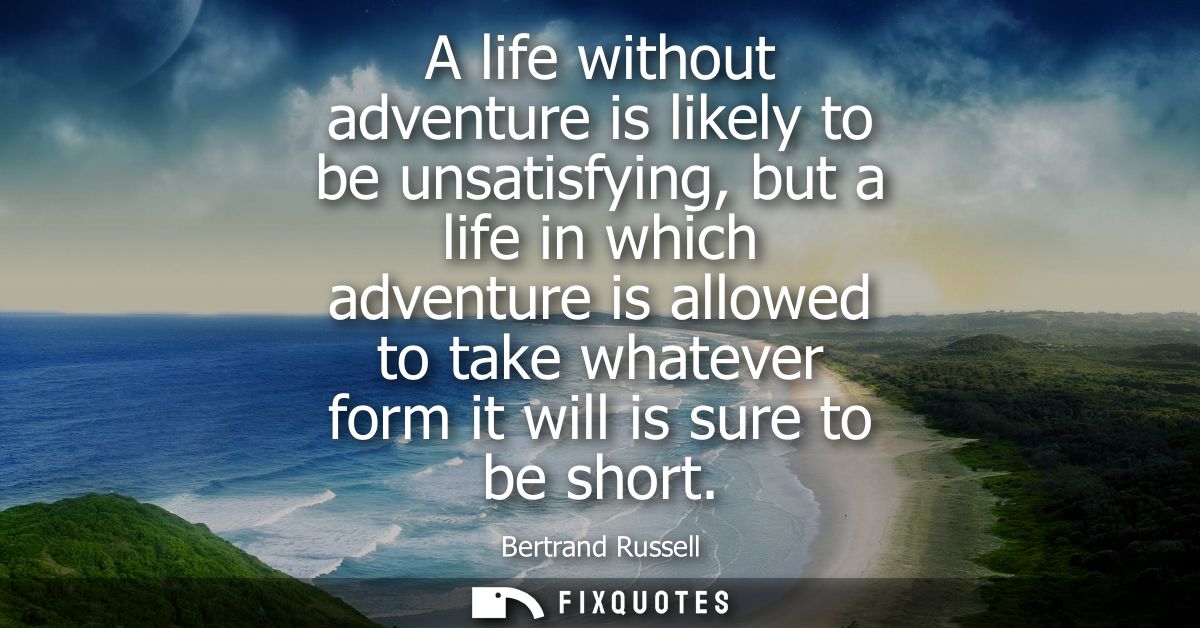
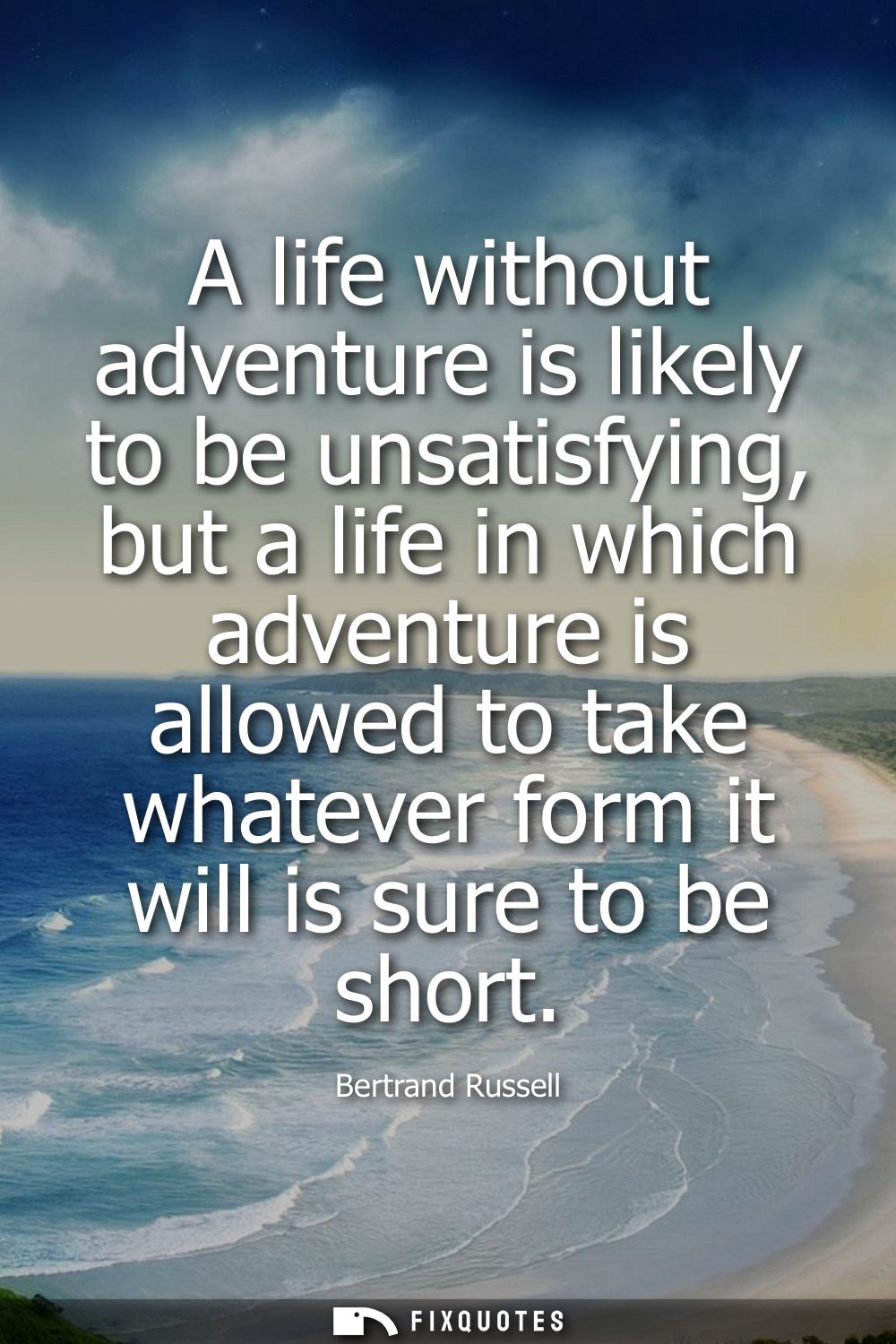
"A life without adventure is likely to be unsatisfying, but a life in which adventure is allowed to take whatever form it will is sure to be short"
About this Quote
Russell’s line is a tidy piece of philosophical contraband: it smuggles a whole ethics of risk into a sentence that reads like commonsense. The first clause nods to the modern fear of sleepwalking through life. “Adventure” here isn’t just mountaintops and shipwrecks; it’s novelty, intellectual danger, the willingness to revise your self-image. Russell, who watched Europe pitch itself into mechanized catastrophe, understood that comfort can be its own kind of slow death: the spirit atrophies when nothing tests it.
Then he turns the blade. Let adventure “take whatever form it will,” and you’ve ceded agency to impulse, appetite, ideology, or sheer thrill-seeking. The phrase is almost parental in its reprimand, but the subtext is distinctly Russell: freedom isn’t the absence of limits; it’s the practice of choosing limits you can defend. He’s not romanticizing recklessness. He’s diagnosing a temptation in the cult of spontaneity: the belief that authenticity requires surrendering to whatever urge arrives first.
Context matters. Russell lived through two world wars, flirted with radical politics, wrote against dogma, and still argued for rational self-governance. The quote reads like an anti-romantic manifesto for an age drunk on heroic narratives. Adventure is necessary because stagnation corrodes meaning; it’s dangerous because unchecked “adventure” becomes a theology of risk. The satisfaction Russell wants is earned, not chanced upon: a life that stays porous to the unknown without mistaking chaos for depth.
Then he turns the blade. Let adventure “take whatever form it will,” and you’ve ceded agency to impulse, appetite, ideology, or sheer thrill-seeking. The phrase is almost parental in its reprimand, but the subtext is distinctly Russell: freedom isn’t the absence of limits; it’s the practice of choosing limits you can defend. He’s not romanticizing recklessness. He’s diagnosing a temptation in the cult of spontaneity: the belief that authenticity requires surrendering to whatever urge arrives first.
Context matters. Russell lived through two world wars, flirted with radical politics, wrote against dogma, and still argued for rational self-governance. The quote reads like an anti-romantic manifesto for an age drunk on heroic narratives. Adventure is necessary because stagnation corrodes meaning; it’s dangerous because unchecked “adventure” becomes a theology of risk. The satisfaction Russell wants is earned, not chanced upon: a life that stays porous to the unknown without mistaking chaos for depth.
Quote Details
| Topic | Adventure |
|---|
More Quotes by Bertrand
Add to List