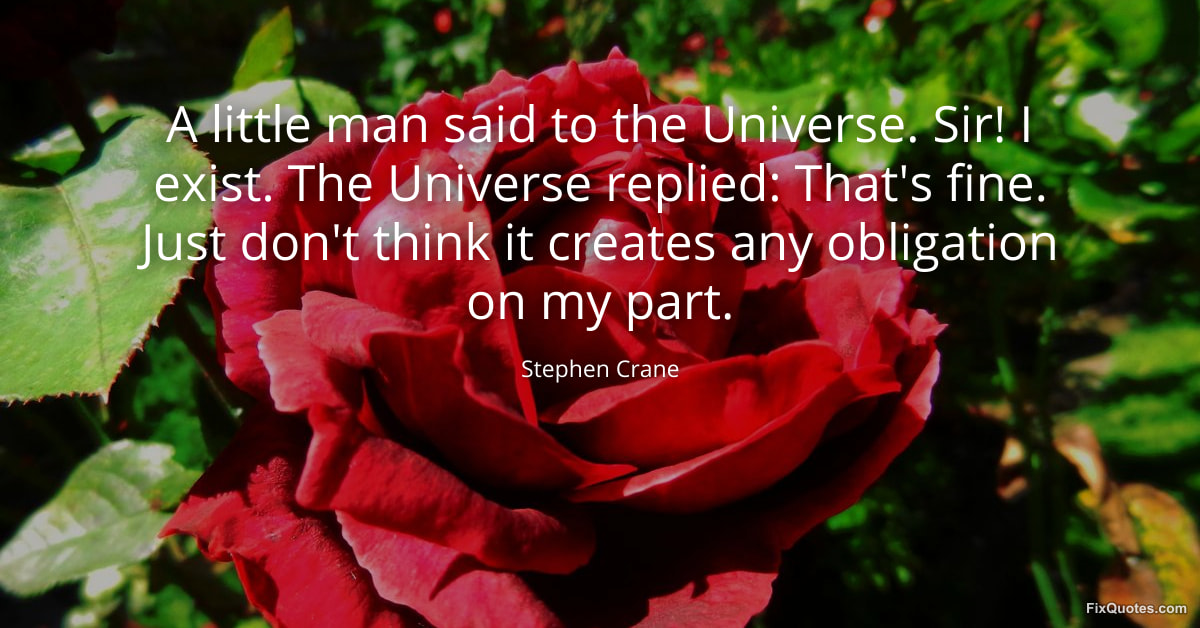
"A little man said to the Universe, 'Sir! I exist.' The Universe replied: 'That's fine. Just don't think it creates any obligation on my part'"
About this Quote
Then the Universe answers with devastating customer-service indifference. “That’s fine” is the chillest possible acknowledgement: not denial, not argument, just a shrug. The sting lands in the second sentence, where the Universe clarifies the real terms of existence: being here doesn’t entitle you to care, meaning, justice, or even notice. It’s not actively cruel; it’s worse. It’s uninvested.
The subtext is a demolition of the Victorian reflex to treat the world as morally responsive. In Crane’s lifetime, Darwinian thinking, industrial violence, and mechanized war were eroding the comforting idea that the cosmos rewards virtue or even tracks it. Crane’s naturalism thrives on that friction: humans narrate themselves as central characters; reality behaves like weather.
The poem works because it stages the collision in miniature, almost like a joke with a brutal punchline. A “little man” speaks in the language of rights and civility; the Universe responds in the language of physics. The comedy is bleak, but clean: the only obligation guaranteed by existence is the one we invent for each other.
Quote Details
| Topic | Wisdom |
|---|---|
| Source | "A Man Said to the Universe," poem by Stephen Crane; published in The Black Riders and Other Lines (1895). |
| Cite |
Citation Formats
APA Style (7th ed.)
Crane, Stephen. (2026, February 16). A little man said to the Universe, 'Sir! I exist.' The Universe replied: 'That's fine. Just don't think it creates any obligation on my part'. FixQuotes. https://fixquotes.com/quotes/a-little-man-said-to-the-universe-sir-i-exist-the-173377/
Chicago Style
Crane, Stephen. "A little man said to the Universe, 'Sir! I exist.' The Universe replied: 'That's fine. Just don't think it creates any obligation on my part'." FixQuotes. February 16, 2026. https://fixquotes.com/quotes/a-little-man-said-to-the-universe-sir-i-exist-the-173377/.
MLA Style (9th ed.)
"A little man said to the Universe, 'Sir! I exist.' The Universe replied: 'That's fine. Just don't think it creates any obligation on my part'." FixQuotes, 16 Feb. 2026, https://fixquotes.com/quotes/a-little-man-said-to-the-universe-sir-i-exist-the-173377/. Accessed 5 Apr. 2026.