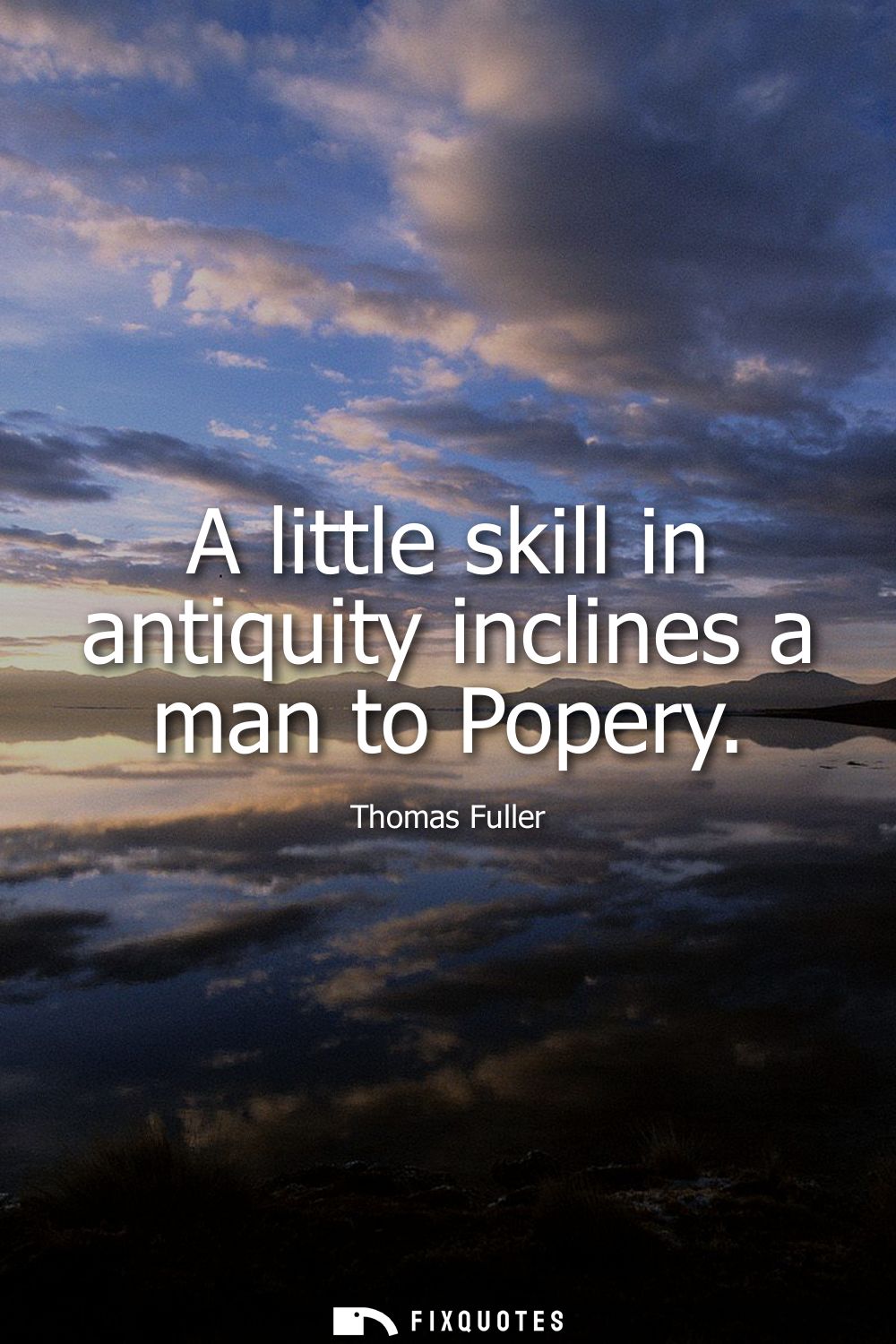
"A little skill in antiquity inclines a man to Popery"
About this Quote
A jab disguised as pastoral advice, Fullers line frames classical learning as a slippery slope to Rome. "A little skill" is the knife twist: he is not condemning scholarship outright so much as warning against the half-educated enthusiast who dabbles in antiquity and comes back enamored with ritual, hierarchy, and the aura of an older church. The sentence works because it turns intellectual curiosity into a moral hazard, making education feel like exposure to a contagious glamour.
In Fullers England, that anxiety had teeth. He lived through a century of Reformation aftershocks, when "Popery" was less a theology than a political bogeyman: foreign influence, absolutism, priestly power, and the specter of civil conflict. Antiquity mattered because both Protestants and Catholics fought over it. Rome claimed continuity with the early church; Protestants countered that true antiquity meant Scripture and the primitive church shorn of later accretions. Fuller is signaling a Protestant suspicion that the aesthetics and institutional memory of Catholicism can seduce faster than doctrinal arguments can be answered.
The subtext is also a class and authority squabble. Humanist learning had raised the prestige of texts, liturgies, and patristic citations; clergy who could quote the Fathers could also challenge local Protestant norms. Fuller, a moderate Anglican voice, is policing the boundary: learn deeply and critically, or dont flirt with the parts of the past that make Catholic claims feel inevitable.
Its a warning about how history can be weaponized - and how the past, selectively sampled, can become an argument for surrender.
In Fullers England, that anxiety had teeth. He lived through a century of Reformation aftershocks, when "Popery" was less a theology than a political bogeyman: foreign influence, absolutism, priestly power, and the specter of civil conflict. Antiquity mattered because both Protestants and Catholics fought over it. Rome claimed continuity with the early church; Protestants countered that true antiquity meant Scripture and the primitive church shorn of later accretions. Fuller is signaling a Protestant suspicion that the aesthetics and institutional memory of Catholicism can seduce faster than doctrinal arguments can be answered.
The subtext is also a class and authority squabble. Humanist learning had raised the prestige of texts, liturgies, and patristic citations; clergy who could quote the Fathers could also challenge local Protestant norms. Fuller, a moderate Anglican voice, is policing the boundary: learn deeply and critically, or dont flirt with the parts of the past that make Catholic claims feel inevitable.
Its a warning about how history can be weaponized - and how the past, selectively sampled, can become an argument for surrender.
Quote Details
| Topic | Faith |
|---|---|
| Source | Help us find the source |
| Cite |
Citation Formats
APA Style (7th ed.)
Fuller, Thomas. (2026, January 18). A little skill in antiquity inclines a man to Popery. FixQuotes. https://fixquotes.com/quotes/a-little-skill-in-antiquity-inclines-a-man-to-2042/
Chicago Style
Fuller, Thomas. "A little skill in antiquity inclines a man to Popery." FixQuotes. January 18, 2026. https://fixquotes.com/quotes/a-little-skill-in-antiquity-inclines-a-man-to-2042/.
MLA Style (9th ed.)
"A little skill in antiquity inclines a man to Popery." FixQuotes, 18 Jan. 2026, https://fixquotes.com/quotes/a-little-skill-in-antiquity-inclines-a-man-to-2042/. Accessed 30 Mar. 2026.
More Quotes by Thomas
Add to List