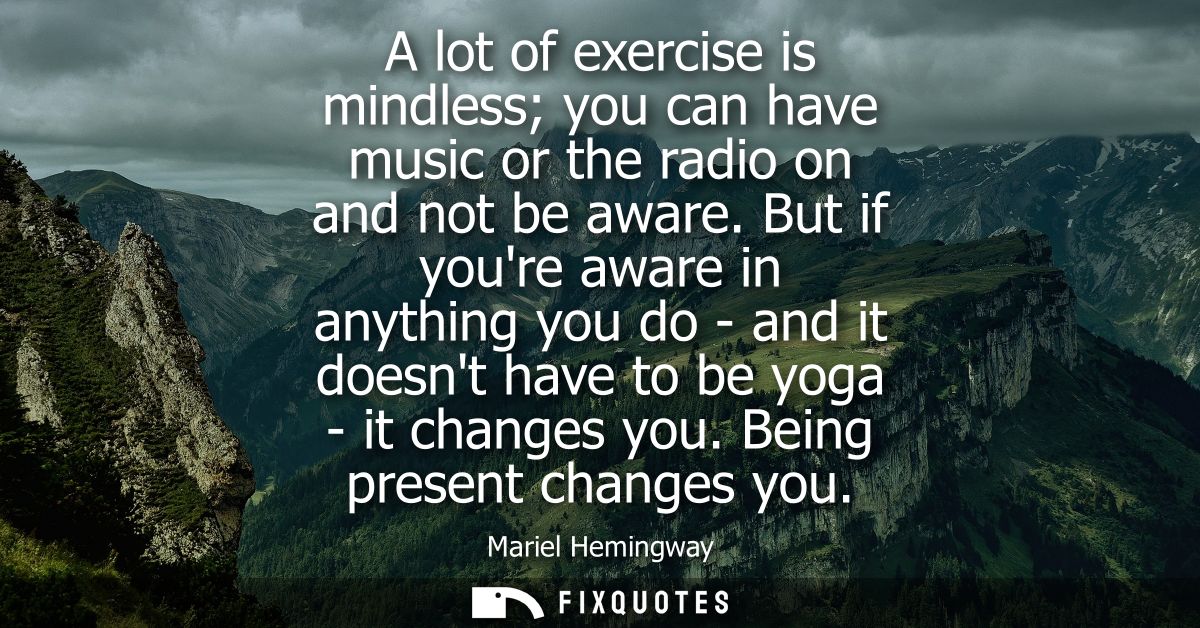
"A lot of exercise is mindless; you can have music or the radio on and not be aware. But if you're aware in anything you do - and it doesn't have to be yoga - it changes you. Being present changes you"
About this Quote
Her pivot is the real payload: awareness is the active ingredient, and it’s portable. By saying “and it doesn’t have to be yoga,” Hemingway pushes back against the lifestyle branding that has come to monopolize mindfulness. Presence isn’t a boutique practice or a studio subscription; it’s a way of paying attention that can happen on a walk, in a gym, in a hard conversation, while washing dishes. That democratizing move also reads as a soft critique of performative wellness, where the aesthetics of being “balanced” replace the uncomfortable interior work of noticing.
The repetition of “changes you” is deliberate. It frames presence less as a moral virtue than as a mechanism: attention alters experience, which alters identity. Coming from an actress - someone trained to be “in the moment” on command, and a public figure who’s navigated the pressures and noise of celebrity culture - the subtext feels practical, almost urgent. Don’t just improve your body. Re-enter it.
Quote Details
| Topic | Live in the Moment |
|---|---|
| Source | Help us find the source |
| Cite |
Citation Formats
APA Style (7th ed.)
Hemingway, Mariel. (2026, January 16). A lot of exercise is mindless; you can have music or the radio on and not be aware. But if you're aware in anything you do - and it doesn't have to be yoga - it changes you. Being present changes you. FixQuotes. https://fixquotes.com/quotes/a-lot-of-exercise-is-mindless-you-can-have-music-100171/
Chicago Style
Hemingway, Mariel. "A lot of exercise is mindless; you can have music or the radio on and not be aware. But if you're aware in anything you do - and it doesn't have to be yoga - it changes you. Being present changes you." FixQuotes. January 16, 2026. https://fixquotes.com/quotes/a-lot-of-exercise-is-mindless-you-can-have-music-100171/.
MLA Style (9th ed.)
"A lot of exercise is mindless; you can have music or the radio on and not be aware. But if you're aware in anything you do - and it doesn't have to be yoga - it changes you. Being present changes you." FixQuotes, 16 Jan. 2026, https://fixquotes.com/quotes/a-lot-of-exercise-is-mindless-you-can-have-music-100171/. Accessed 1 Apr. 2026.