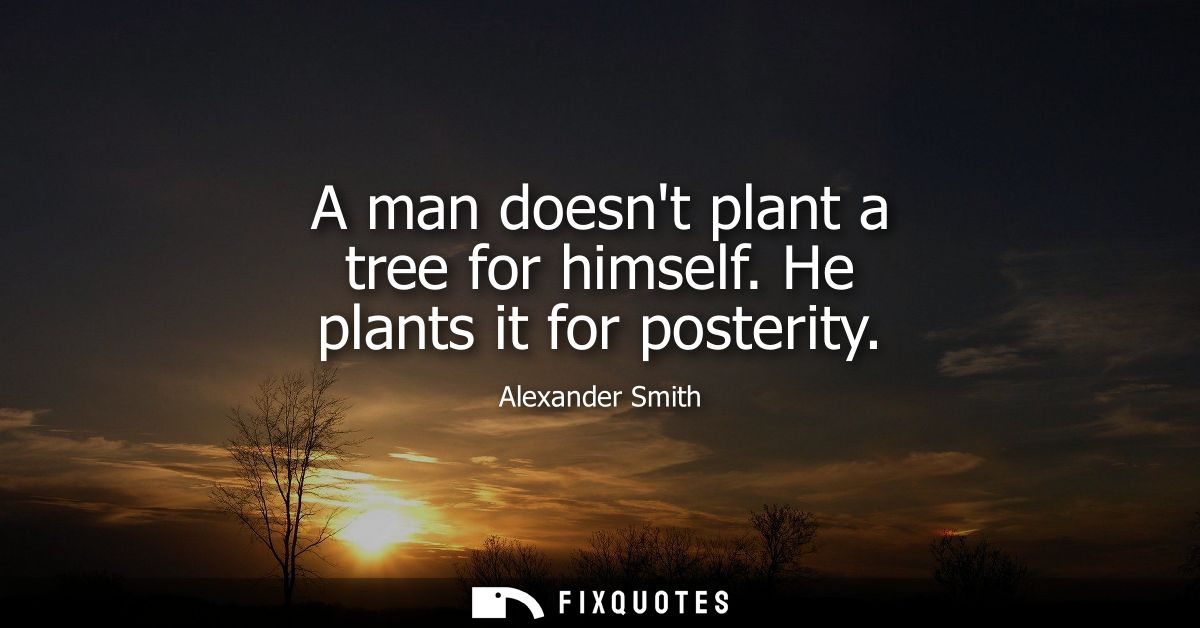
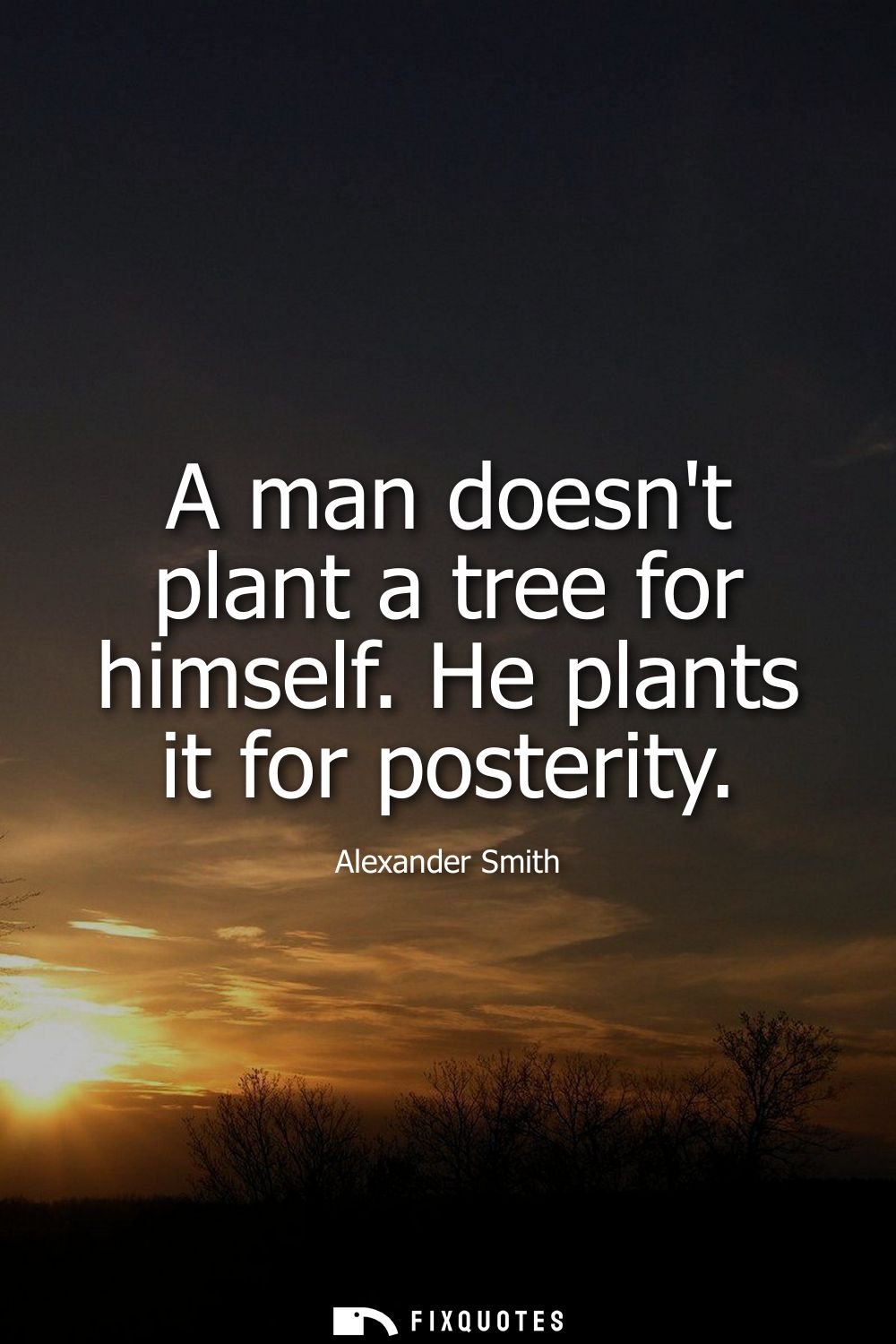
"A man doesn't plant a tree for himself. He plants it for posterity"
About this Quote
The line lands like a quiet rebuke to the cult of the immediate. Smith takes an act as ordinary as planting a tree and turns it into a moral diagnostic: what you choose to build when you know you will not be there to enjoy it. The sentence is simple, almost proverb-like, but its pressure point is time. A tree is slow capital. It asks for labor now, patience later, and rewards someone else first. That asymmetry is the whole argument.
As a poet writing in the mid-Victorian era, Smith is working inside a culture newly obsessed with progress, industry, and legacy at scale: railways, factories, urban growth. Against that backdrop, the tree reads as a counter-image to extraction and speed. It is stewardship instead of consumption, shade instead of smoke. The quote’s subtext is that civilization depends less on grand speeches than on unglamorous commitments that outlast the ego.
The phrasing is also strategically gendered and universalizing in a 19th-century way: “a man” stands in for the citizen, the moral actor, the one expected to convert private virtue into public good. There’s a faint Calvinist edge, too: worth is measured by duty, not pleasure.
What makes it work now is its quiet indictment of short-term thinking. It doesn’t beg for altruism; it assumes it as the baseline of maturity. Posterity isn’t an abstract audience here - it’s the people who will live with what we leave behind, whether it’s shade or scar tissue.
As a poet writing in the mid-Victorian era, Smith is working inside a culture newly obsessed with progress, industry, and legacy at scale: railways, factories, urban growth. Against that backdrop, the tree reads as a counter-image to extraction and speed. It is stewardship instead of consumption, shade instead of smoke. The quote’s subtext is that civilization depends less on grand speeches than on unglamorous commitments that outlast the ego.
The phrasing is also strategically gendered and universalizing in a 19th-century way: “a man” stands in for the citizen, the moral actor, the one expected to convert private virtue into public good. There’s a faint Calvinist edge, too: worth is measured by duty, not pleasure.
What makes it work now is its quiet indictment of short-term thinking. It doesn’t beg for altruism; it assumes it as the baseline of maturity. Posterity isn’t an abstract audience here - it’s the people who will live with what we leave behind, whether it’s shade or scar tissue.
Quote Details
| Topic | Legacy & Remembrance |
|---|---|
| Source | Help us find the source |
| Cite |
Citation Formats
APA Style (7th ed.)
Smith, Alexander. (2026, January 15). A man doesn't plant a tree for himself. He plants it for posterity. FixQuotes. https://fixquotes.com/quotes/a-man-doesnt-plant-a-tree-for-himself-he-plants-20964/
Chicago Style
Smith, Alexander. "A man doesn't plant a tree for himself. He plants it for posterity." FixQuotes. January 15, 2026. https://fixquotes.com/quotes/a-man-doesnt-plant-a-tree-for-himself-he-plants-20964/.
MLA Style (9th ed.)
"A man doesn't plant a tree for himself. He plants it for posterity." FixQuotes, 15 Jan. 2026, https://fixquotes.com/quotes/a-man-doesnt-plant-a-tree-for-himself-he-plants-20964/. Accessed 13 Feb. 2026.
More Quotes by Alexander
Add to List